Utrecht, Netherlands — Northwestern Europe
Het Runensteen van Jelling Afgietsel
⎯⎯⎯
The Jelling Runestone Replica
Photographed by Andrew Ruppenstein, November 23, 2016
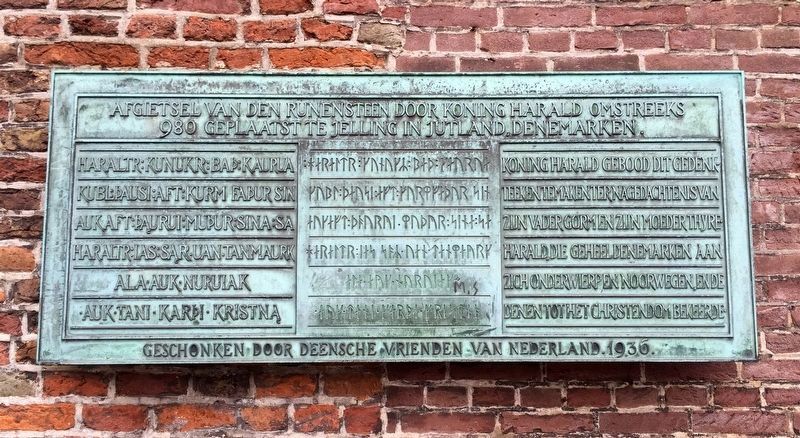
1. Jelling Runestone Marker

haraltr : kunukʀ : baþ : kaurua
kubl : þausi : aft : kurm faþur sin
auk aft : þąurui : muþur : sina : sa
haraltr (:) ias : sąʀ * uan * tanmaurk
ala * auk * nuruiak
* auk * t(a)ni (* karþi *) kristną
ᚼᛅᚱᛅᛚᛏᚱ ᛬ ᚴᚢᚾᚢᚴᛦ ᛬ ᛒᛅᚦ ᛬ ᚴᛅᚢᚱᚢᛅ
ᚴᚢᛒᛚ ᛬ ᚦᛅᚢᛋᛁ ᛬ ᛅᚠᛏ ᛬ ᚴᚢᚱᛘ ᚠᛅᚦᚢᚱ ᛋᛁᚾ
ᛅᚢᚴ ᛅᚠᛏ ᛬ ᚦᚭᚢᚱᚢᛁ ᛬ ᛘᚢᚦᚢᚱ ᛬ ᛋᛁᚾᛅ ᛬ ᛋᛅ
ᚼᛅᚱᛅᛚᛏᚱ (᛬) ᛁᛅᛋ ᛬ ᛋᚭᛦ ᛫ ᚢᛅᚾ ᛫ ᛏᛅᚾᛘᛅᚢᚱᚴ
ᛅᛚᛅ
this page online
᛫ ᛅᚢᚴ ᛫ ᛏ(ᛅ)ᚾᛁ (᛫ ᚴᛅᚱᚦᛁ ᛫) ᚴᚱᛁᛋᛏᚾᚭ
Koning Harald gebood dit gedenkteken te maken ter nagedachtenis van zijn vader Gorm en zijn moeder Thrye. Harald, de geheel Denemarken aan zich onderwierp en Noorwegen, en de Denen tot het Christendom bekeerde.
Geschonken door Deensche Vrienden van Nederland. 1936.
[English translation of the above:]
The left-middle vertical panel is a transliteration of the runes.
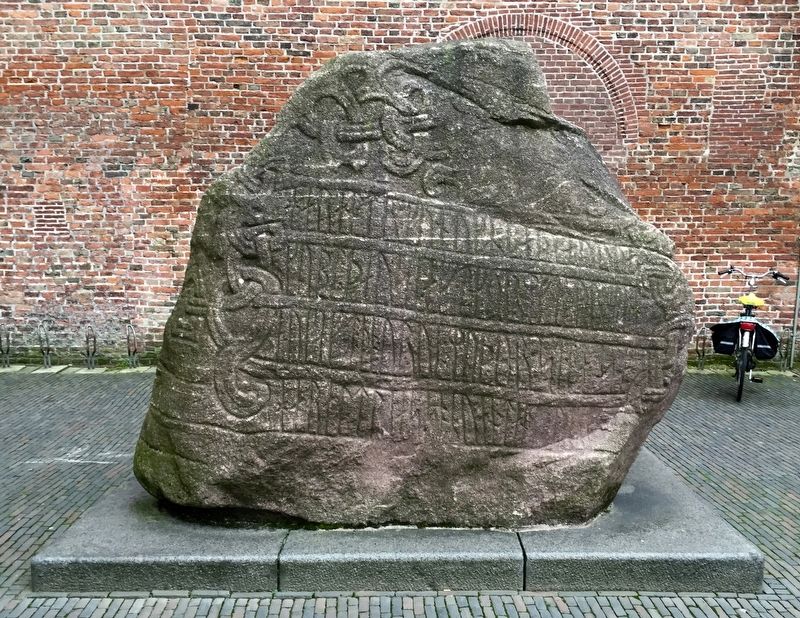
The mid-middle vertical panel is the actual rune text that is found on three sides of the stone.
The right-middle vertical panel is a translation of the runes into Dutch.
The runes may be translated thusly: King Haraldr ordered this monument made in memory of Gormr, his father, and in memory of Thyrvé, his mother; that Haraldr who won for himself all of Denmark and Norway and made the Danes Christian.
Lower
Photographed by Andrew Ruppenstein, November 23, 2016
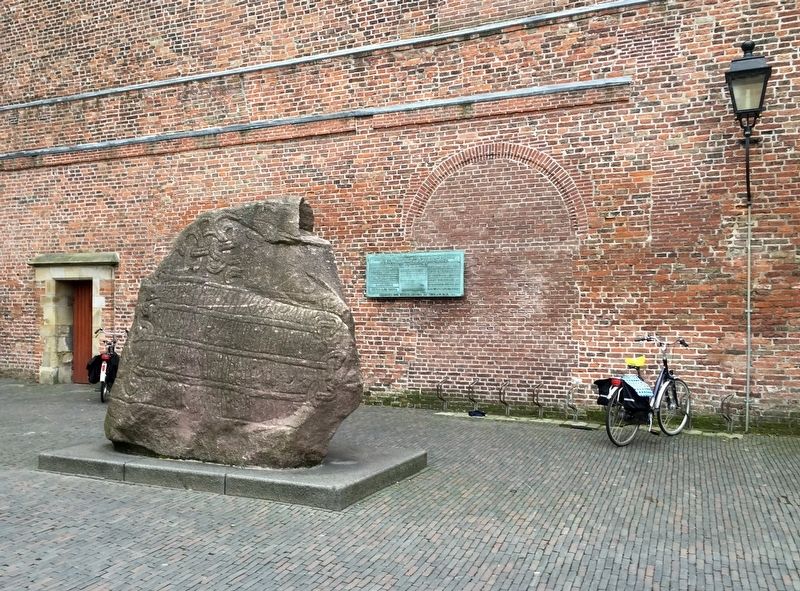
2. Het Runensteen van Jelling en Afgietsel / The Jelling Runestone Replica and Marker - Wide View
Erected 1936 by Deensche Vrienden van Nederland.
Topics. This historical marker is listed in this topic list: Religion & Religious Structures. A significant historical year for this entry is 1936.
Location. 52° 5.43′ N, 5° 7.337′ E. Marker is in Utrecht. It can be reached from Domplein just north of Korte Nieuewstraat. Touch for map. Marker is in this post office area: Utrecht 3512 JG, Netherlands. Touch for directions.

Regionally, it is in Europe, the European Union, Atlantic Europe, the Benelux Low Countries, the Schengen Area, Western Europe, and the Western World. Historically, it finds itself in what was once the Roman Empire and specifically also the Holy Roman Empire.
Other nearby markers. At least 8 other markers are within walking distance of this marker: Universiteit Utrecht / Utrecht University (a few steps from this marker); In Het Voetspuur Van Sint Maarten / In the Footsteps of Saint Martin (within shouting distance of this marker); Verzetsmonument Utrecht / Utrecht Resistance Monument (within shouting distance of this marker);
Photographed by Andrew Ruppenstein, November 23, 2016
3. The Jelling Runestone Replica
More about this marker. The marker is attached to the cloister wall that attaches cathedral to the university. The marker and stone were dedicated on June 22, 1936, and were a gift to the University of Utrecht on its 300th anniversary. Translation of the runes themselves is courtesy of the Samnordisk Runtextdatabas.
Also see . . .
1. Jelling Stones (Wikipedia). (Submitted on December 22, 2016.)
2. Utrecht 1936 (Jellingprojektet, National Museum of Denmark). (Submitted on December 22, 2016.)
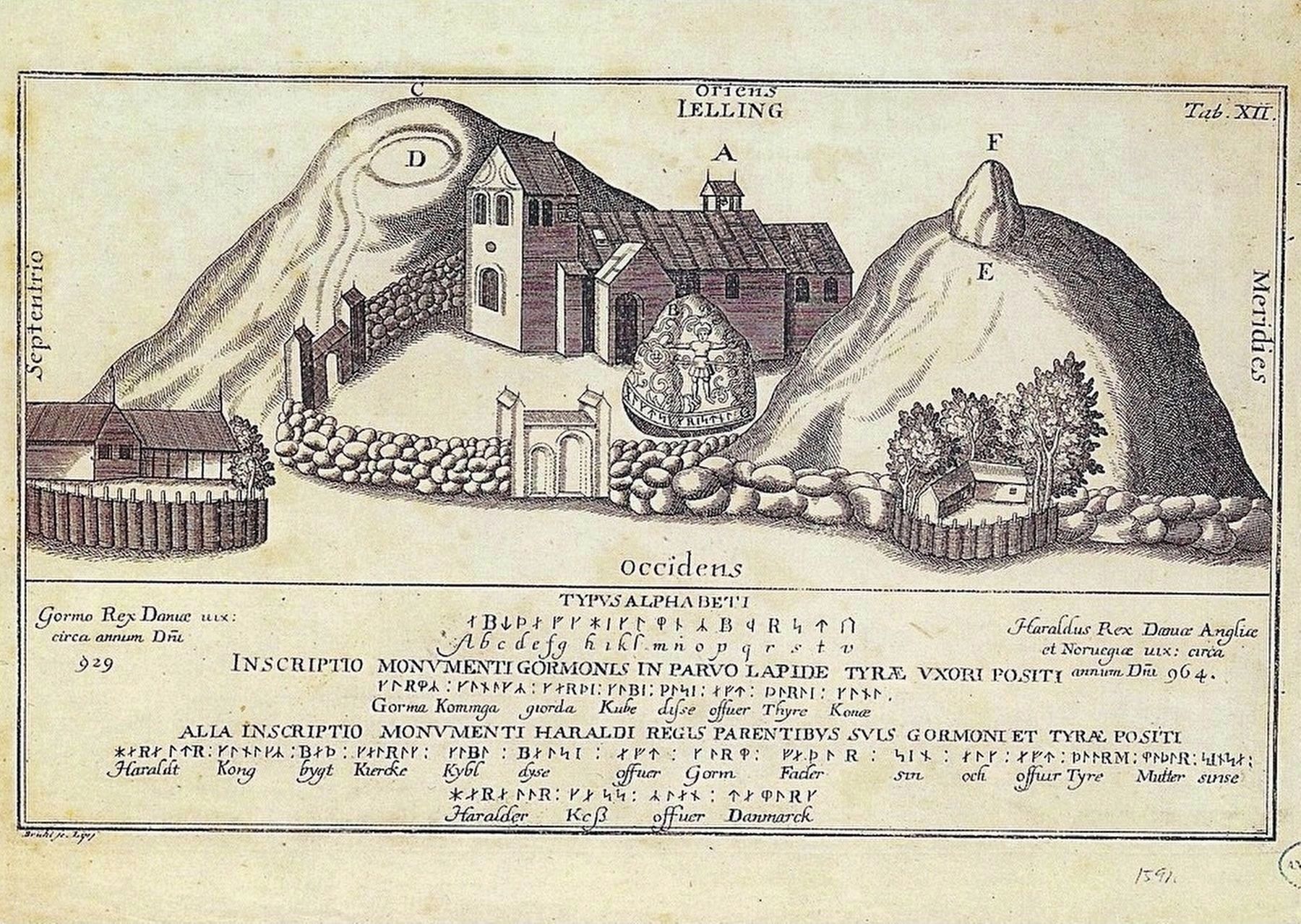
Henrik Rantzau (image courtesy of the National Museum of Denmark), circa 1591
4. A View of Jelling, showing the original Jelling Stones, on site in Jelling, Denmark
The Jelling stones (Danish: Jellingstenene) are massive carved runestones from the 10th century, found at the town of Jelling in Denmark. The older of the two Jelling stones was raised by King Gorm the Old in memory of his wife Thyra. The larger of the two stones was raised by King Gorm's son, Harald Bluetooth in memory of his parents, celebrating his conquest of Denmark and Norway, and his conversion of the Danes to Christianity. The runic inscriptions on these stones are considered the best known in Denmark....The Jelling stones stand in the churchyard of Jelling church between two large mounds. The stones represent the transitional period between the indigenous Norse paganism and the process of Christianization in Denmark; the larger stone is often cited as Denmark's baptismal certificate (dåbsattest), containing a depiction of Christ. They are strongly identified with the creation of Denmark as a nation state and both stones feature one of the earliest records of the name "Danmark" (in the form of accusative "tanmaurk" ([danmɒrk]) on the large stone, and genitive "tanmarkar" (pronounced [danmarkaɽ]) on the small stone). - Wikipedia
Credits. This page was last revised on January 1, 2024. It was originally submitted on December 22, 2016, by Andrew Ruppenstein of Lamorinda, California. This page has been viewed 1,420 times since then and 198 times this year. Photos: 1, 2, 3, 4. submitted on December 22, 2016, by Andrew Ruppenstein of Lamorinda, California.
