Orange City in Volusia County, Florida — The American South (South Atlantic)
Orange City Colored School
Photographed by Tim Fillmon, March 1, 2017
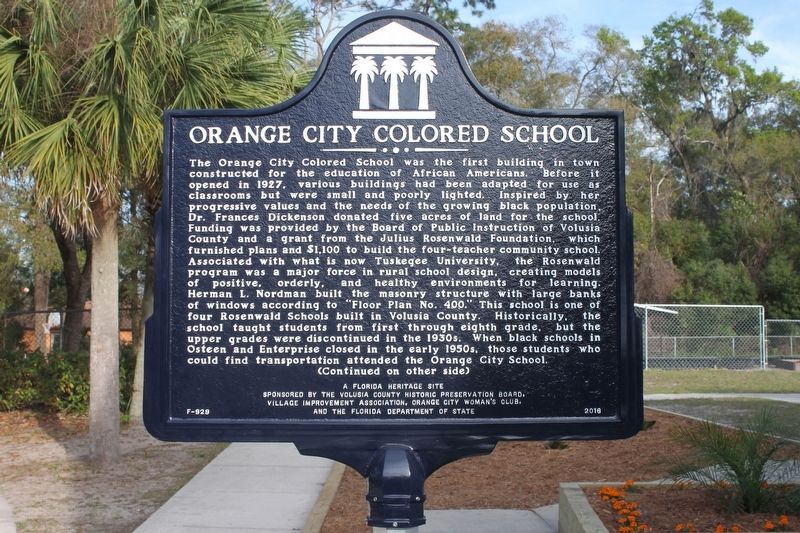
1. Orange City Colored School Marker Side 1
this page online
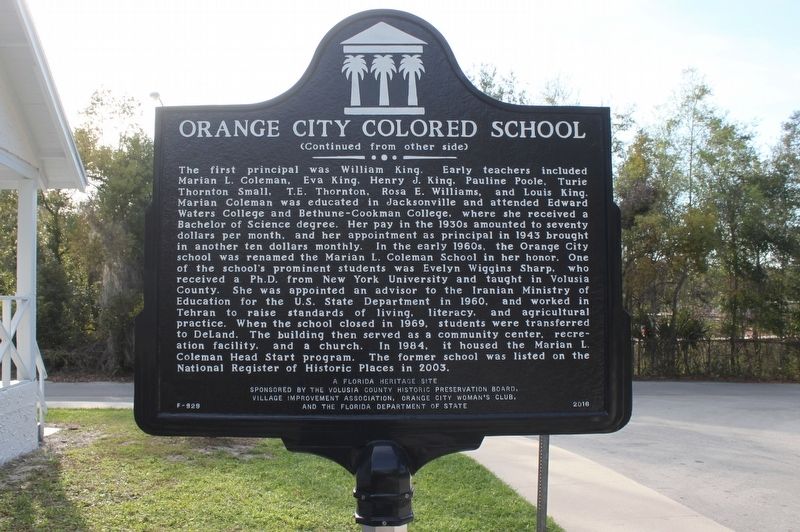
The first principal was William King. Early teachers Marian L. Coleman, Eva King, Henry J. King, Pauline Poole, Turie Thornton Small, T.E. Thornton, Rosa E, Williams, and Louis King. Marian Coleman was educated in Jacksonville and attended Edward Waters College and Bethune-Cookman College, where she received a Bachelor of Science degree. Her pay in the 1930’s amounted to seventy dollars per month, and her appointment as principal in 1943 brought in another ten dollars monthly. In the early 1960’s, the Orange City school was renamed the Marian L. Coleman School in her honor. One of the school’s prominent students was Evelyn Wiggins Sharp, who received a Ph.D. from New York University and taught in Volusia County. She was appointed an advisor to the Iranian Ministry of Education for the US. State Department in 1960, and worked in Tehran to raise standards of living, literacy, and agricultural practice. When the school closed in 1969, students were transferred to Deland. The building then served as a community center, reception facility, and a church. In 1984, it housed the Marian L. Coleman Head Start program. The
Photographed by Tim Fillmon, March 1, 2017
2. Orange City Colored School Marker Side 2
Erected 2016 by The Volusia County Historic Preservation Board, Village Improvement Association, Orange City Women’s Club and the Florida Department of State. (Marker Number F-929.)
Topics and series. This historical marker is listed in these topic lists: African Americans • Education. In addition, it is included in the Historically Black Colleges and Universities, and the Rosenwald Schools series lists. A significant historical year for this entry is 1927.
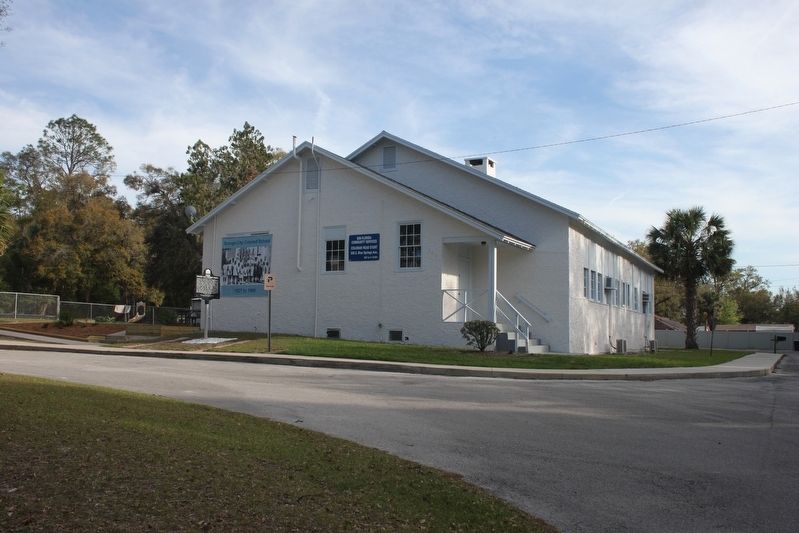
Location. 28° 56.508′ N, 81° 17.791′ W. Marker is in Orange City, Florida, in Volusia County. It can be reached from East Blue Springs Avenue west of South Thorpe Avenue, on the right when traveling east. School is now the Coleman Head Start Center. Touch for map. Marker is at or near this postal address: 200 East Blue Springs Avenue, Orange City FL 32763, United States of America. Touch for directions.

Regionally, this marker is in Florida’s First Coast. It is also in the American South and on the Eastern Seaboard. Globally, it is in the North Atlantic Region, North America, a Gulf
Photographed by Tim Fillmon, March 1, 2017
3. Orange City Colored School and Marker
Other nearby markers. At least 8 other markers are within 3 miles of this marker, measured as the crow flies: Orange City Veterans Memorial (approx. 0.2 miles away); Rollins College (approx. 0.4 miles away); Dickinson Memorial Library (approx. 0.4 miles away); Betsy Ross Airfield for Women (approx. 0.8 miles away); The History of Blue Spring (approx. 2.6 miles away); Thursby House (approx. 2.7 miles away); Bartram at Blue Spring (approx. 2.7 miles away); A Fossil from the Steamboat Age (approx. 2.8 miles away). Touch for a list and map of all markers in Orange City.
Photographed by Tim Fillmon, March 1, 2017
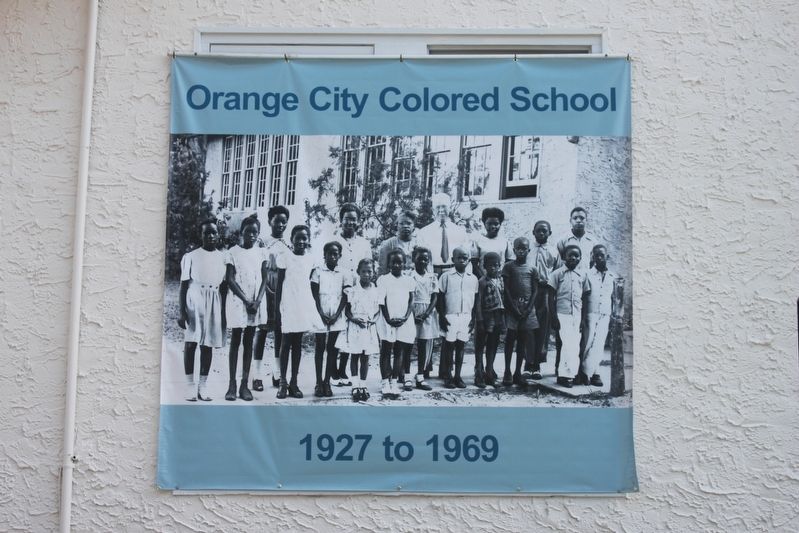
4. Orange City Colored School Banner
Credits. This page was last revised on November 14, 2019. It was originally submitted on March 3, 2017, by Tim Fillmon of Webster, Florida. This page has been viewed 1,148 times since then and 66 times this year. Photos: 1, 2, 3, 4. submitted on March 3, 2017, by Tim Fillmon of Webster, Florida. • Bernard Fisher was the editor who published this page.
