Near Guy Hollow in Scott County, Virginia — The American South (Mid-Atlantic)
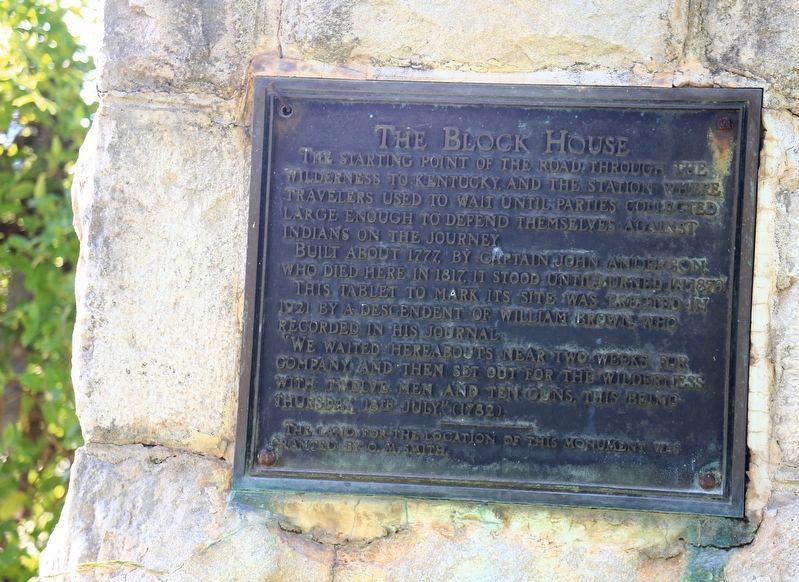
The Block House
| — | The Anderson Block House Monument | — |
Photographed by J. J. Prats, June 9, 2017
1. The Anderson Block House Monument
Built about 1777 by Captain John Anderson, who died here in 1817, it stood until burned in 1876.
This tablet to mark its site was erected in 1921 by a descendant of William Brown who recorded in his journal: “We waited hereabouts near two weeks for company and then set out for the Wilderness with twelve men and ten guns, this being Thursday, 18th July (1782).”
Erected 1921 by a descendant of William Brown. The land for the location of this monument was granted by O. M. Smith.
Topics. This historical marker is listed in these topic lists: Forts and Castles • Settlements & Settlers. A significant historical year for this entry is 1777.
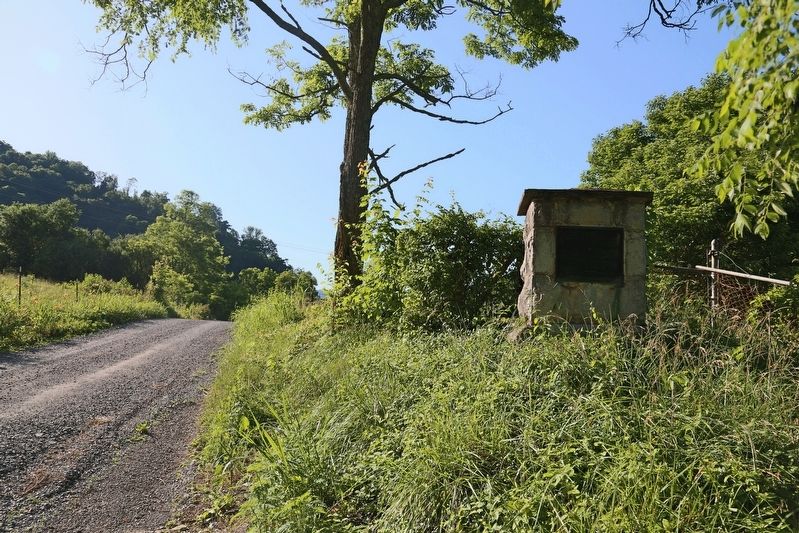
Location. 36° 36.485′ N, 82° 30.848′ W. Marker is near Guy Hollow, Virginia, in Scott County. It is on Smith Hollow Road (County Route 606) just north of East Carter Valley Road (County Route 704), on the right when traveling north. Smith Hollow Road is off East Carters
this page online

Regionally, this marker is in the Tri-Cities Area and in Southwest Virginia. It is also in the American South, specifically in the Upper South, in Appalachia, and specifically in Southern Appalachia. Globally, it is in North America, the Western Hemisphere, the Western World, and the Anglosphere. Historically, it finds itself in what was once the original Cherokee Nation, the territory of the Mississippian Culture, one of the original Thirteen Colonies, one of the Confederate States of America, and the Antebellum South.
Other nearby markers. At least 8 other markers are within 4 miles of this marker, measured as the crow flies: Rock Ledge (approx. 2.2 miles away in Tennessee); First Court of Scott County (approx. 2.7 miles away); Scott County / Tennessee (approx. 3.3 miles away); Carter Musical Family
Photographed by J. J. Prats, June 9, 2017
2. The Anderson Block House Monument
Other markers no longer nearby. McConnell's Birthplace (was approx. 2.9 miles away but has been replaced with another marker now near it); a different marker also named First Court of Scott County (was approx. 2.9 miles away but has been replaced with another marker now near it); Big Moccasin Gap (was approx. 2.9 miles away but has been replaced with another marker now near it); Donelson's Indian Line (was approx. 2.9 miles away but has been replaced with another marker now near it).
Also see . . . Daniel Boone Wilderness Trail. “A blockhouse is a log structure with an upper story that overhung the first. The Anderson Blockhouse was an assembly point for thousands who used the Wilderness Trail to venture into the wilds of Kentucky. Although the original blockhouse is no longer evident, the driving tour passes by its original location. John Anderson built his blockhouse on a knoll just northeast of where the marker stands today. The Anderson Blockhouse functioned as a collecting place for individual pioneers until a party of sufficient size was assembled to make the passage down the Wilderness Trail. It was the last contact with the Holston Settlements, and even though, a few forts existed beyond this point, it really defined the frontier.” (Submitted on June 13, 2017.)
Credits. This page was last revised on July 17, 2017. It was originally submitted on June 13, 2017, by J. J. Prats of Powell, Ohio. This page has been viewed 2,294 times since then and 196 times this year. Photos: 1, 2. submitted on June 13, 2017, by J. J. Prats of Powell, Ohio.
Editor’s want-list for this marker. Photos of the replica of the Anderson Block House located in Natural Tunnel State Park • Can you help?
