Hilo in Hawaii County, Hawaii — Hawaiian Island Archipelago (Pacific Ocean)
Waiakea Town (Yashijima)
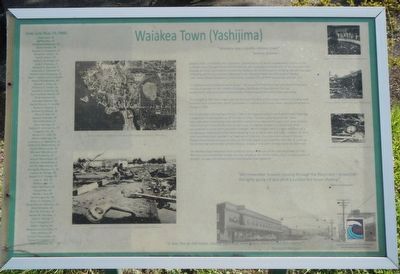
Photographed by Barry Swackhamer, September 1, 2017
1. Waiakea Town (Yashijima) Marker
Waiakea Town, or Yashijima, was a close-knit, vibrant community which occupied what is known today as Banyan Drive. The golf course and park that you see today was once filled with homes, businesses and Waiakea Kai School, all of which provided the backbone for a local economy of fishing, stevedoring, sugar, railroading and service industries. Many businesses exist today have their roots in Waiakea Town; some of these businesses include Suisan Company, LTD., and KTA Superstores and Cafe 100.
The Waiakea Social Settlement which stood in the area just behind where the clock stands today was the hub of activities for the children of Waiakea. The Waiakea Pirates Athletic Club was established in 1924 and contained the Waiakea Pirates baseball team which still exists today.
The tsunami of 1946 had a huge impact on Hilo and Shinmuchi and to a lesser extent on Waiakea Town. However these communities rebuilt and moved on, looking to to the future, never expecting what was to happen in 1960.
On the afternoon and evening of May 22, 1960 a warning was issued to the State of Hawaii following a magnitude 9.5 earthquake
this page online
The Waiakea Social Settlement clock is frozen in time, at 1:04 a.m. on the morning of May 23, 1960. The clock is a lone reminder of what was once a bustling and vibrant community. It is now a symbol of strength, courage and resiliency of the once Waiakea Town residents.
"All I remember is water coming through the floors and I remember the lights going off and all of a sudden the house shaking" -- Gloria Kobayashi
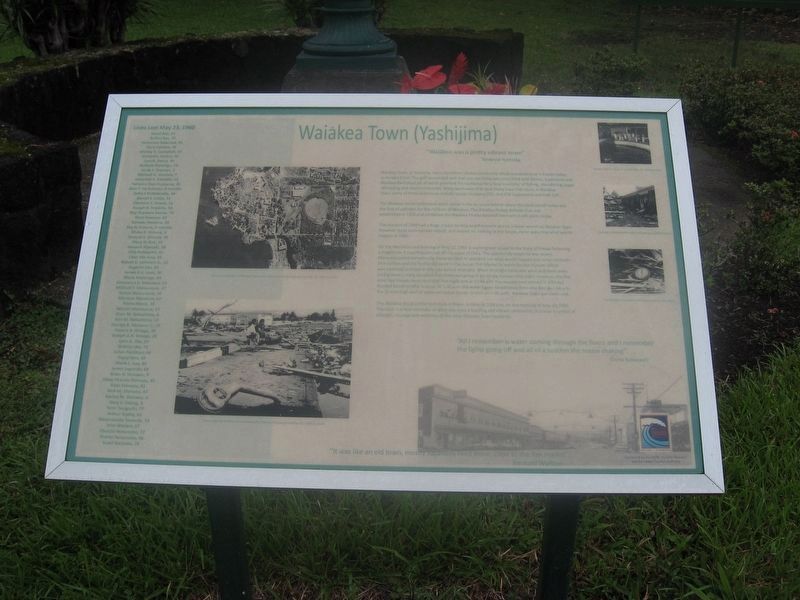
Photographed by Adam Margolis, November 24, 2010
2. Waiakea Town (Yashijima) Marker
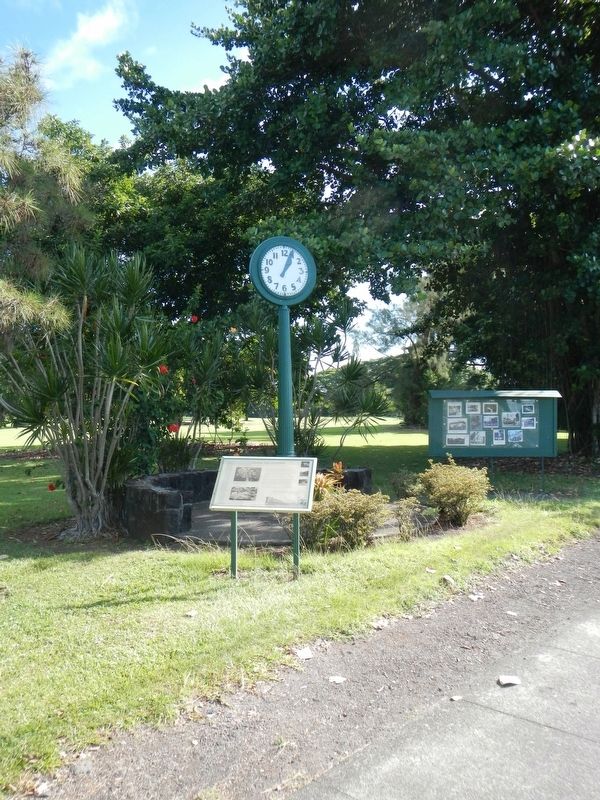
Photographed by Barry Swackhamer, September 1, 2017
3. Waiakea Town (Yashijima) Marker
Topics. This historical marker is listed in these topic lists: Asian Americans • Disasters • Settlements & Settlers. A significant historical date for this entry is May 23, 1960.
Location. 19° 43.368′ N, 155° 4.05′ W. Marker is in Hilo, Hawaii, in Hawaii County. It is on Kamehameha Avenue near Lihiwai Street, on the right when traveling west. Touch for map. Marker is at or near this postal address: 1568 Kamehameha Avenune, Hilo HI 96720, United States of America. Touch for directions.

Regionally, this marker is on Hilo and East Hawaii and in the Volcanic Hawaii. Globally, it is in North America, in Polynesia, in the Pacific Ocean, in North Pacific, on the Pacific Rim, in the Western Hemisphere, in the Western World, and in the Anglosphere.
Other nearby markers. At least 8 other markers are within 7 miles of this marker, measured as the crow flies: Waiakea Social Settlement Clock (a few steps from
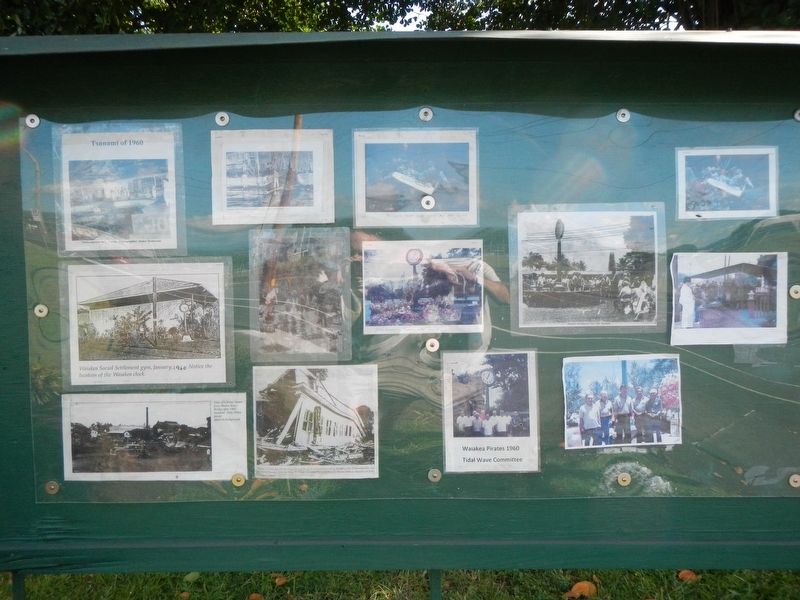
Photographed by Barry Swackhamer, September 1, 2017
4. Photographs of the Tsunami Devastation
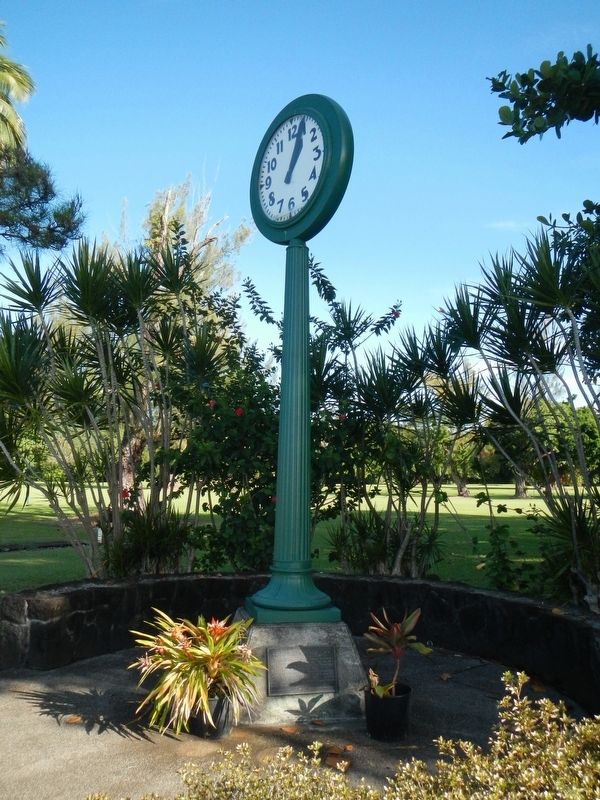
Photographed by Barry Swackhamer, September 2, 2017
5. Waiakea Social Settlement Clock
Credits. This page was last revised on May 14, 2024. It was originally submitted on December 2, 2017, by Barry Swackhamer of Brentwood, California. This page has been viewed 2,353 times since then and 138 times this year. Photos: 1. submitted on December 2, 2017, by Barry Swackhamer of Brentwood, California. 2. submitted on January 11, 2022, by Adam Margolis of Mission Viejo, California. 3, 4, 5. submitted on December 2, 2017, by Barry Swackhamer of Brentwood, California.
