Near Iroquois in Kingsbury County, South Dakota — The American Midwest (Upper Plains)
The Manchester Tornado
Photographed by Ruth VanSteenwyk, May 29, 2018
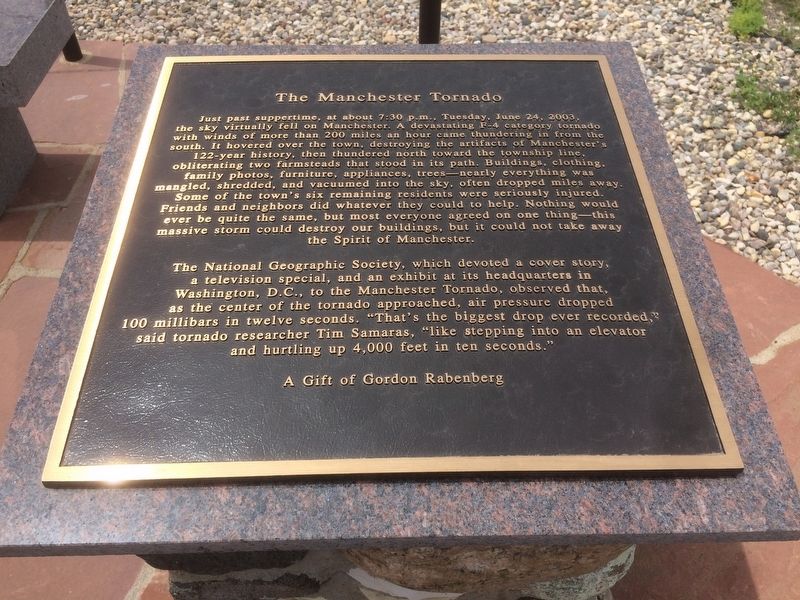
1. The Manchester Tornado Marker
Just past suppertime, at about 7:30 p.m., Tuesday, June 24, 2003, the sky virtually fell on Manchester. A devastating F-4 category tornado with winds of more than 200 miles an hour came thundering in from the south. It hovered over the town, destroying the artifacts of Manchester's 122-year history, then thundered north toward the township line, obliterating two farmsteads that stood in its path. Buildings, clothing, family photos, furniture, appliances, trees-nearly everything was mangled, shredded, and vacuumed into the sky, often dropped miles way. Some of the town's six remaining residents were seriously injured. Friends and neighbors did whatever they could to help. Nothing would ever be quite the same, but most every one agreed on one thing- this massive storm could destroy our buildings, but it could not take away the Spirit of Manchester.
The National Geographic Society, which devoted a cover story, a television special, and an exhibit at its headquarters in Washington, D.C.., to the Manchester Tornado, observe that, as the center of the tornado approached, air pressure dropped 100 millibars in twelve seconds.
this page online
Erected 2007 by Gordon Rabenberg.
Topics. This historical marker is listed in this topic list: Disasters. A significant historical date for this entry is June 24, 2003.
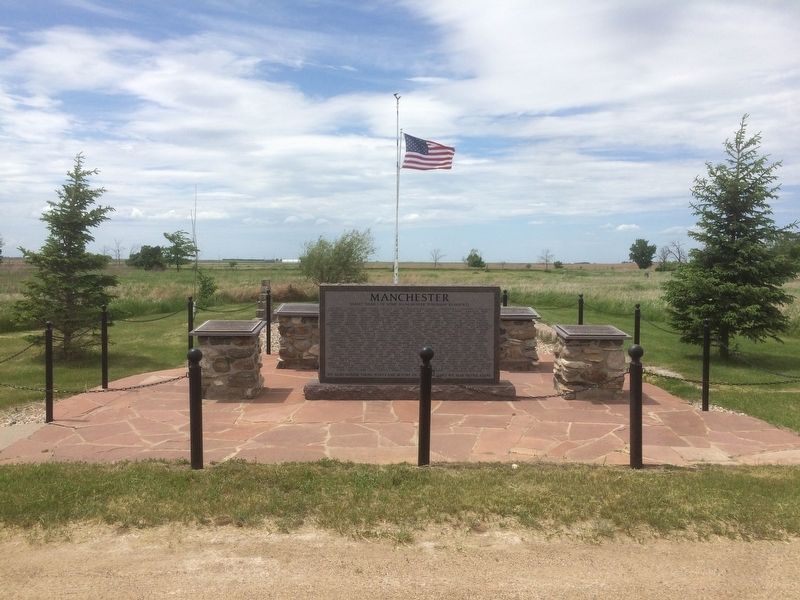
Location. 44° 22.182′ N, 97° 43.225′ W. Marker is near Iroquois, South Dakota, in Kingsbury County. It is on Kingsbury Ave. 0.1 miles north of U.S. 14, on the left when traveling north. This marker is part of the monument to the town of Manchester, SD erected after the devastating tornado destroyed the town. Touch for map. Marker is at or near this postal address: 141 Kingsbury Ave, Iroquois SD 57353, United States of America. Touch for directions.

Regionally, this marker is in East River. It is also in the American Midwest, in the Lewis & Clark Corridor, in the Corn Belt, on the prairies, and on the Northern Plains. Globally, it is in North America, the Western Hemisphere, the Western World, and the Anglosphere. Historically, it finds itself in what was once Rupert’s Land and also the Louisiana Purchase.
Photographed by Ruth VanSteenwyk, May 29, 2018
2. The Manchester Town Monument
Other nearby markers. At least 8 other markers are within 9 miles of this marker, measured as the crow flies: Manchester, South Dakota (here, next to this marker); Harvy Dunn and Grace Ingalls Dow (here, next to this marker); Town Hall and Town Pump (here, next to this marker); a different marker also named Manchester (here, next to this marker); KELO-LAND Centennial Gold Rush (approx. ¼ mile away); Harvey Dunn, N.A. (approx. ¼ mile away); Esmond United Methodist Church (approx. 7.8 miles away); Father Pierre Jean De Smet (approx. 8.1 miles away). Touch for a list and map of all markers in Iroquois.
Related markers. Click here for a list of markers that are related to this marker.
Also see . . . 2003 South Dakota tornado outbreak. Wikipedia entry (Submitted on September 10, 2024, by Larry Gertner of New York, New York.)
Credits. This page was last revised on September 10, 2024. It was originally submitted on June 12, 2018, by Ruth VanSteenwyk of Aberdeen, South Dakota. This page has been viewed 2,152 times since then and 134 times this year. Photos: 1, 2. submitted on June 12, 2018, by Ruth VanSteenwyk of Aberdeen, South Dakota. • Andrew Ruppenstein was the editor who published this page.
