Round Rock in Williamson County, Texas — The American South (West South Central)
Round Rock
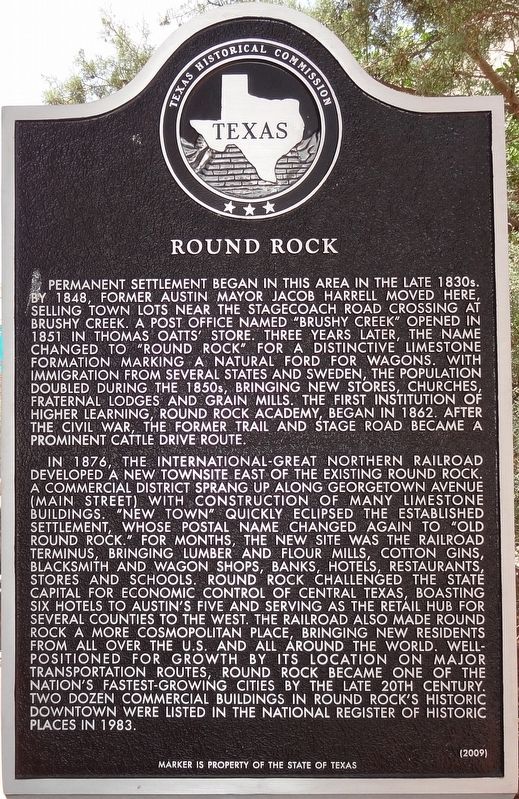
Photographed by Keith Peterson, June 24, 2018
1. Round Rock Marker
In 1876, the International-Great Northern Railroad developed a new townsite east of the existing Round Rock. A commercial district sprang up along Georgetown Avenue (Main Street) with construction of many limestone buildings. “New Town” quickly eclipsed the established settlement, whose postal name changed again to “Old Round Rock.” For months, the new site was the railroad terminus, bringing lumber and flour mills, cotton gins, blacksmith and wagon shops, banks, hotels, restaurants, stores and schools. Round Rock challenged the state capital for economic control of central Texas, boasting six hotels to Austin’s five and serving as the retail hub for several counties to the west. The railroad also made Round Rock a more cosmopolitan place, bringing new residents from all over the U.S. And all around the world. Well-positioned for growth by its location on major transportation routes, Round Rock became one of the nation’s fastest-growing cities by the late 20th century. Two dozen commercial buildings in Round Rock’s historic downtown were listed in the National Register
this page online
Erected 2009 by Texas Historical Commission. (Marker Number 15945.)
Topics. This historical marker is listed in this topic list: Settlements & Settlers.
Location. 30° 30.534′ N, 97° 40.643′ W. Marker is in Round Rock, Texas, in Williamson County. It is on E. Main Ave., on the right when traveling east. Touch for map. Marker is in this post office area: Round Rock TX 78664, United States of America. Touch for directions.

Regionally, this marker is in Central Texas and in the Austin Metropolitan Area. It is also in the American South. Globally, it is in North America, a Gulf of Mexico state, the Western Hemisphere, the Western World, and the Anglosphere. Historically, it finds itself in what was once New Spain, the Republic of Texas, one of the Confederate States of America, and the Antebellum South.
Other nearby markers. At least 8 other markers are within walking distance of this marker: Andrew J. Palm House (a few steps from this marker); Early Commercial Building (a few steps from this marker); Old Broom Factory Building (about 400
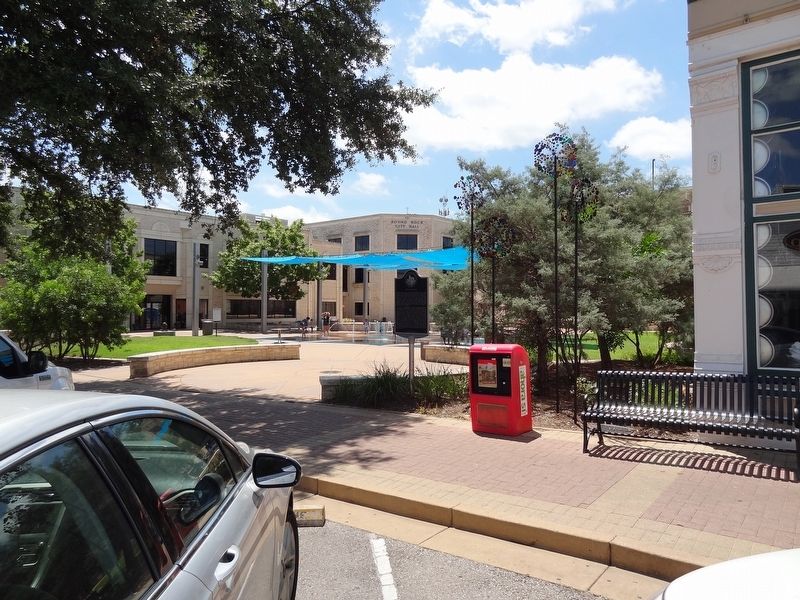
Photographed by Keith Peterson, June 24, 2018
2. Round Rock Marker
Another marker is no longer nearby. Sam Bass' Death Site (was about 600 feet away but has been confirmed missing).
Credits. This page was last revised on January 20, 2020. It was originally submitted on June 24, 2018, by Keith Peterson of Cedar Park, Texas. This page has been viewed 753 times since then and 46 times this year. Photos: 1, 2. submitted on June 24, 2018, by Keith Peterson of Cedar Park, Texas. • Andrew Ruppenstein was the editor who published this page.
