Brownsville in Cameron County, Texas — The American South (West South Central)
San Roman Building
-1850-
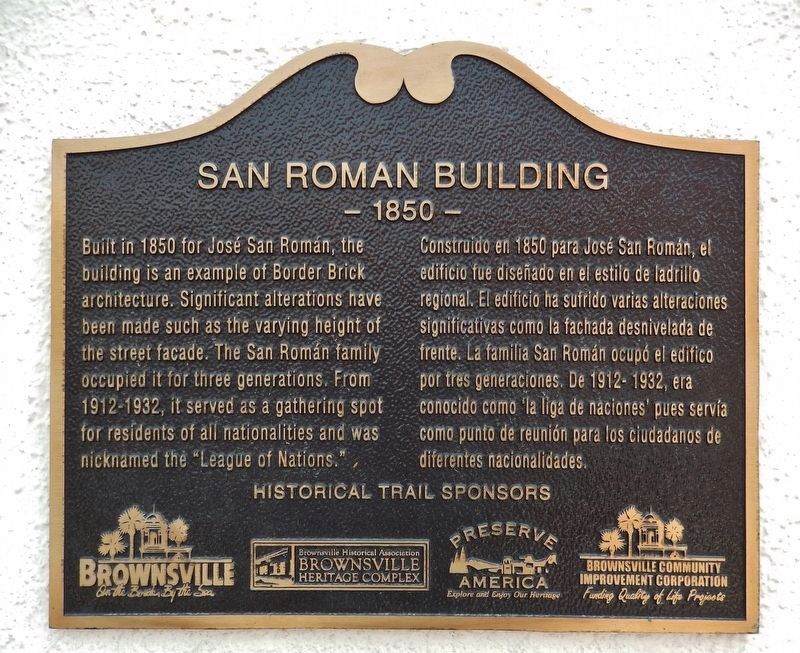
Photographed by Cosmos Mariner, May 18, 2018
1. San Román Building Marker

Spanish
Erected by Brownsville Historical Association.
Topics. This historical marker is listed in these topic lists: Architecture • Notable Buildings. A significant historical year for this entry is 1850.
Location. 25° 54.043′ N, 97° 29.859′ W. Marker is in Brownsville, Texas, in Cameron County. It is on East Elizabeth Street (Business U.S. 77)
this page online

Regionally, this marker is in South Texas. It is also in the American Borderlands, in the South, and on the Gulf Coast. Globally, it is in North America, a Gulf of Mexico state, the Western Hemisphere, the Western World, and the Anglosphere. Historically, it finds itself in what was once New Spain, the Republic of Texas, and one of the Confederate States of America.
Other nearby markers. At least 8 other markers are within walking distance of this marker: San Román Building (here, next to this marker); Bollack Department Store (within shouting distance of this marker); Federal Court Site (within shouting distance of this marker); Celaya Building (within shouting distance of this marker); The Gem/La Joya (about 300 feet away, measured in a direct line); Webb Drug Store (about 300 feet
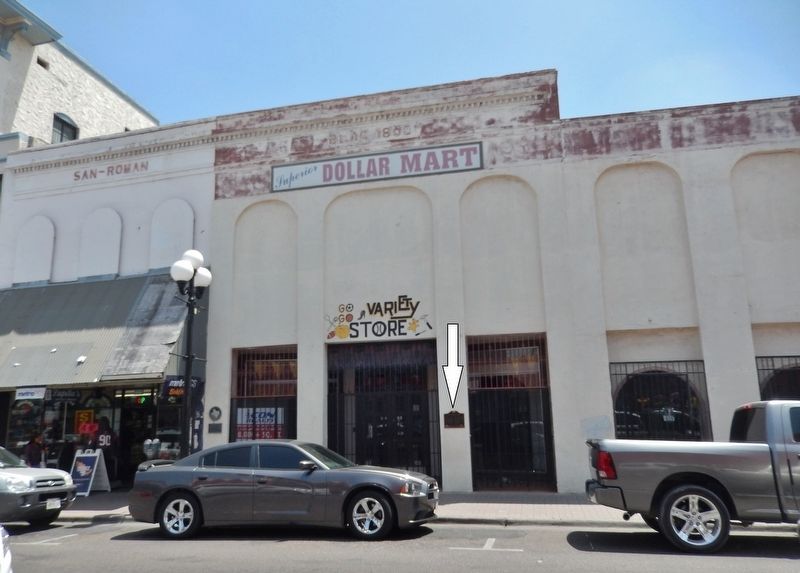
Photographed by Cosmos Mariner, May 18, 2018
2. San Román Buliding (front view from Elizabeth Street; marker visible near center of building)
More about this marker. Marker is in the Brownsville Historical Trail series.
Regarding San Roman Building. Recorded Texas Historic Landmark (1966)
Also see . . . José San Román. During the Union blockade in the Civil War, San Román became a key figure in the contraband trade carried on in Bagdad, Brownsville, and Matamoros. His firm served as a brokerage house for hundreds of cotton farmers west of the Mississippi River. By 1870 he was considered one of the wealthiest men in South Texas. (Submitted on June 28, 2018, by Cosmos Mariner of Cape Canaveral, Florida.)
Credits. This page was last revised on January 27, 2021. It was originally submitted on June 27, 2018, by Cosmos Mariner of Cape Canaveral, Florida. This page has been viewed 663 times since then and 62 times this year. Photos: 1, 2. submitted on June 28, 2018, by Cosmos Mariner of Cape Canaveral, Florida. • Andrew Ruppenstein was the editor who published this page.
