Centennial near Fort Myers in Lee County, Florida — The American South (South Atlantic)
Buckingham Army Air Field Gunnery Ranges
Photographed by Tim Fillmon, October 1, 2018
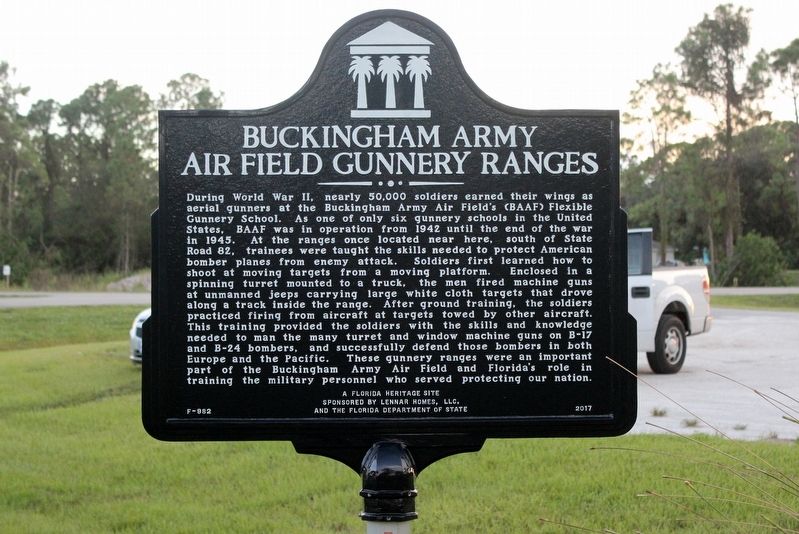
1. Buckingham Army Air Field-Gunnery Ranges Marker
Inscription.
Buckingham Army Air Field Gunnery Ranges. . During World War II, nearly 50,000 soldiers earned their wings as aerial gunners at the Buckingham Army Air Fields (BAAF) Flexible Gunnery School. As one of only six gunnery schools in the United States, BAAF was in operation from 1942 until the end of the war in 1945. At the ranges once located near here, south of State Road 82, trainees were taught the skills needed to protect American bomber planes from enemy attack. Soldiers first learned how to shoot at moving targets from a moving platform. Enclosed in a spinning turret mounted to a truck, the men fired machine guns at unmanned jeeps carrying large white cloth targets that drove along a track inside the range. After ground training, the soldiers practiced firing from aircraft at targets towed by other aircraft. This training provided the soldiers with the skills and knowledge needed to man the many turret and window machine guns on B-17 and B-24 bombers, and successfully defend those bombers in both Europe and the Pacific. These gunnery ranges were an important part of the Buckingham Army Air Field and Floridas role in training the military personnel who served protecting our nation.
During World War II, nearly 50,000 soldiers earned their wings as aerial gunners at the Buckingham Army Air Fields (BAAF) Flexible Gunnery School. As one of only six gunnery schools in the United States, BAAF was in operation from 1942 until the end of the war in 1945. At the ranges once located near here, south of State Road 82, trainees were taught the skills needed to protect American bomber planes from enemy attack. Soldiers first learned how to shoot at moving targets from a moving platform. Enclosed in a spinning turret mounted to a truck, the men fired machine guns at unmanned jeeps carrying large white cloth targets that drove along a track inside the range. After ground training, the soldiers practiced firing from aircraft at targets towed by other aircraft. This training provided the soldiers with the skills and knowledge needed to man the many turret and window machine guns on B-17 and B-24 bombers, and successfully defend those bombers in both Europe and the Pacific. These gunnery ranges were an important part of the Buckingham Army Air Field and Floridas role in training the military personnel who served
Click or scan to see this page online
protecting our nation.
Erected 2017 by Lennar Homes, LLC and the Florida Department of State. (Marker Number F-982.)
Topics. This historical marker is listed in this topic list: War, World II. A significant historical year for this entry is 1942.
Location. 26° 38.21′ N, 81° 44.312′ W. Marker is near Fort Myers, Florida, in Lee County. It is in Centennial. It is at the intersection of Buckingham Road and Ada Avenue, on the left when traveling east on Buckingham Road. Located in the parking area of Buckingham Trails Preserve. Touch for map. Marker is at or near this postal address: 8790 Buckingham Road, Fort Myers FL 33905, United States of America. Touch for directions.

Regionally, this marker is on Florida’s Gulf Coast. It is also in the American South and on the Gulf Coast. Globally, it is in the North Atlantic Region, North America, a Gulf of Mexico state, the Western Hemisphere, the Western World, and the Anglosphere. Historically, it finds itself in what was once New Spain, the territory of the Mississippian Culture, one of the Confederate States of America, and the Antebellum South.
Other nearby markers. At
Photographed by Tim Fillmon, October 1, 2018
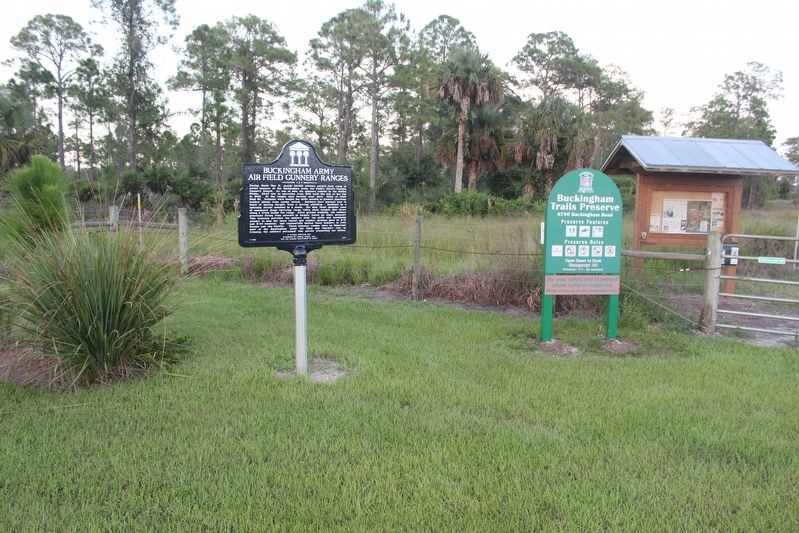
2. Buckingham Army Air Field-Gunnery Ranges Marker at trail parking
Credits. This page was last revised on June 23, 2024. It was originally submitted on December 16, 2018, by Tim Fillmon of Webster, Florida. This page has been viewed 1,719 times since then and 151 times this year. Photos:1, 2. submitted on December 16, 2018, by Tim Fillmon of Webster, Florida. • Bernard Fisher was the editor who published this page.
