Richmond Hill in Bryan County, Georgia — The American South (South Atlantic)
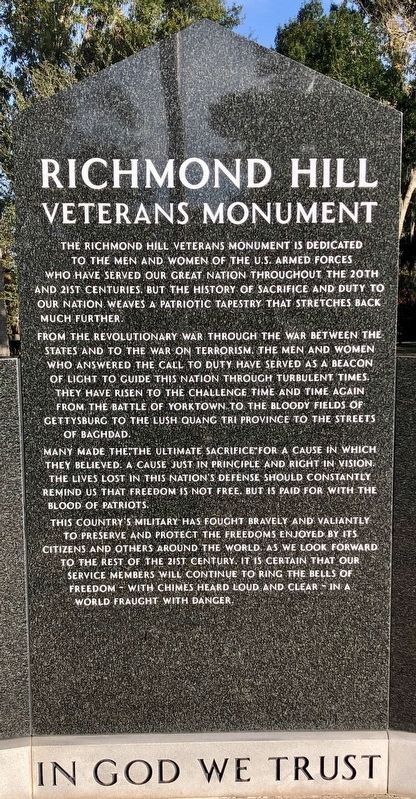
Richmond Hill Veterans Monument
In God We Trust
Photographed by Mark Hilton, December 6, 2018
1. Richmond Hill Veterans Monument
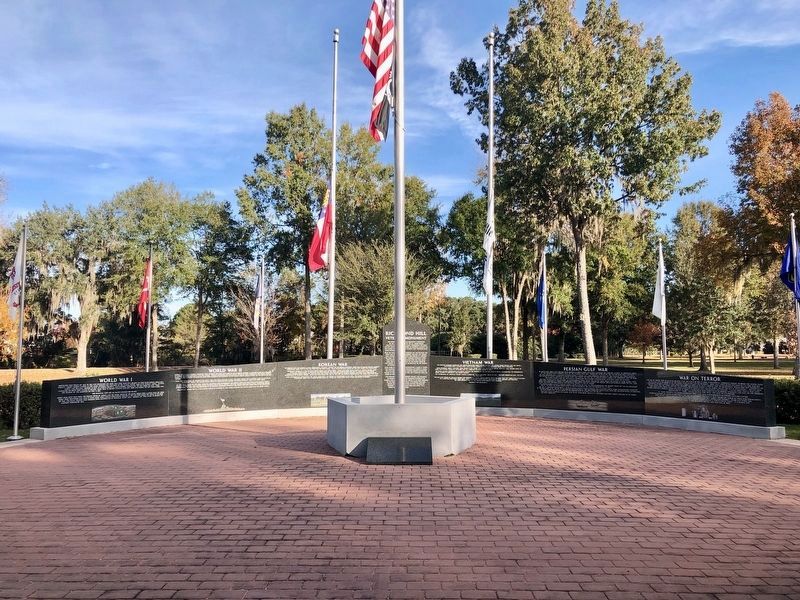
From the Revolutionary War through the War Between the States and to the War on Terrorism, the men and women who answered the call to duty have served as a beacon of light to guide this nation through turbulent times. They have risen to the challenge time and time again from the Battle of Yorktown to the bloody fields of Gettysburg to the lush Quang Tri Province to the streets of Baghdad.
Many made the ultimate sacrifice for a cause in which they believed. A cause just in principle and right in vision. The lives lost in this nation's defense should constantly remind us that freedom is not free, but is paid for with the blood of patriots.
This country’s military has fought bravely and valiantly to preserve and protect the freedoms enjoyed by its citizens and others around the world. As we look forward to the rest of the 21st century, it is certain that our service members will continue to ring the bells of freedom - with chimes heard loud and clear - in a world fraught with danger.
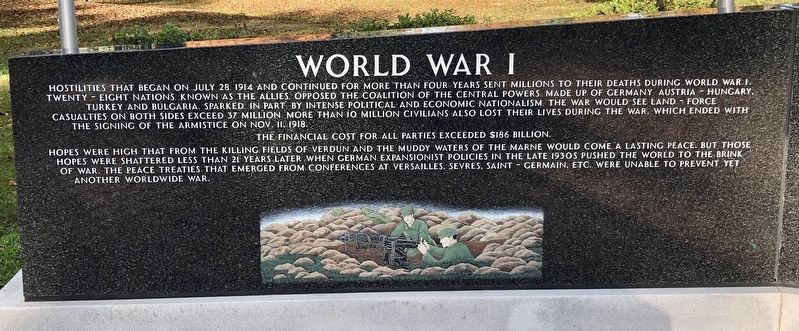
The financial cost for all parties exceeded $186 billion.
Hopes were high that from the killing fields of Verdun and the muddy waters of the Marne would come a lasting peace. But those hopes were shattered less than 21
this page online
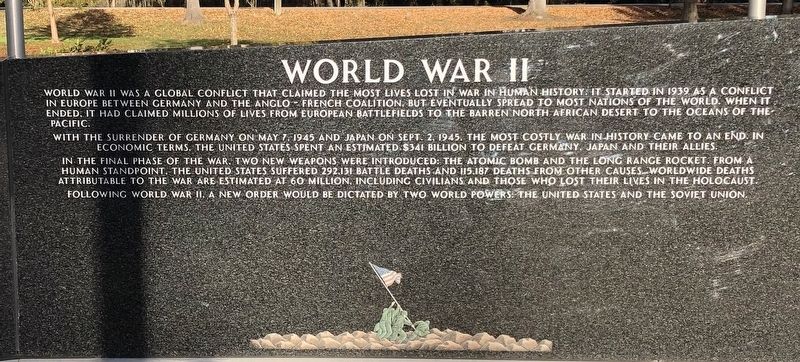
With the surrender of Germany on May 7, 1945 and Japan on Sept. 2, 1945, the most costly war in history came to an end in economic terms, the United States spent an estimated $341 billion to defeat Germany, Japan and their allies.
In the final phase of the war, two new weapons were introduced: the atomic bomb and the long range rocket. From a human standpoint, the United States suffered 292,131 battle deaths and 115,187 deaths from other causes. Worldwide deaths attributable to the war are estimated
Photographed by Mark Hilton, December 6, 2018
2. World War I portion of monument.
Following World War II, a new order would be dictated by two world powers: the United States and the Soviet Union.
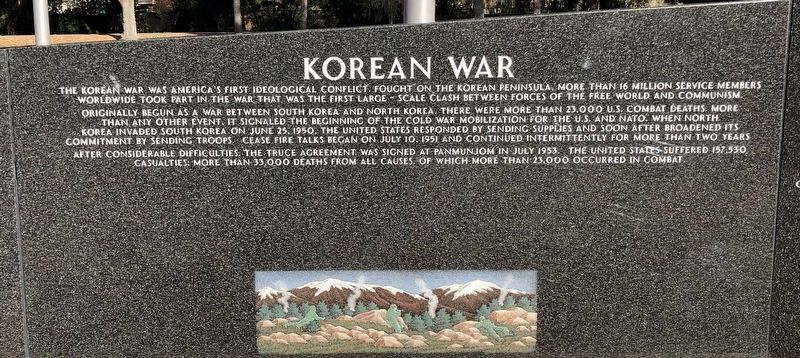
Originally begun as a war between South Korea and North Korea, there were more than 23,000 U.S. combat deaths. More than any other event, it signaled the beginning of the Cold War mobilization for the U.S. and NATO. When North Korea invaded South Korea, on June 25, 1950, the United States responded by sending supplies and soon after broadened its commitment by sending troops. Cease fire talks began on July 10, 1951 and continued intermittently for more than two years.
After considerable difficulties, the truce agreement was signed at Panmunjom in July 1953. The United States suffered 157,530 casualties: more than 33,000 deaths from all causes of which more than 23,000 occurred
Photographed by Mark Hilton, December 6, 2018
3. World War II portion of monument.
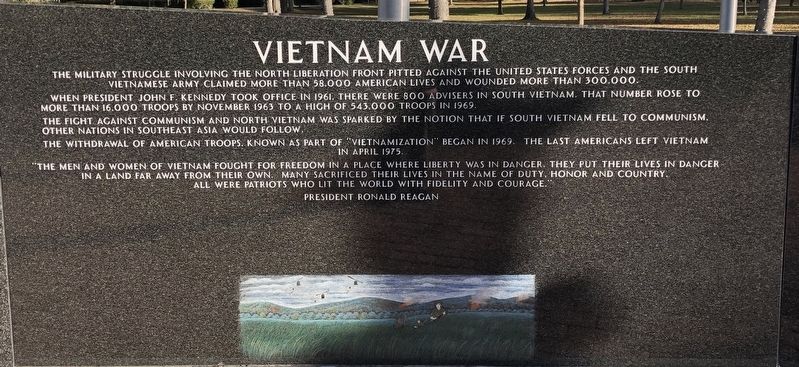
The withdrawal of American troops, known as part of “Vietnamization” began in 1969. The last Americans left Vietnam in April 1975.
“The men and women of Vietnam fought for freedom in a place where liberty was in danger. They put their lives in danger in a land far away from their own. Many sacrificed their lives in the name of duty, honor and country.
All were patriots who lit the world with fidelity and courage.”
President Ronald Reagan
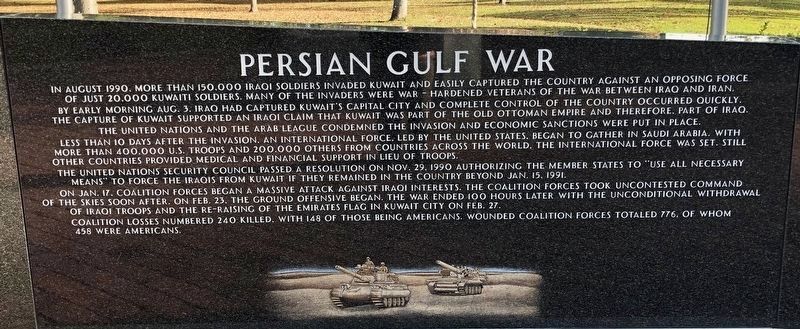
By early morning Aug. 3, Iraq had captured Kuwait’s capital city and complete control of the country occurred quickly. The capture of Kuwait supported an Iraqi claim that Kuwait was part of the old Ottoman Empire and therefore,
Photographed by Mark Hilton, December 6, 2018
4. Korean War portion of the monument.
The United Nations and the Arab League condemned the invasion and economic sanctions were put in place. Less than 10 days after the invasion, an international force, led by the United States, began to gather in Saudi Arabia. With more than 400,000 U.S. troops and 200,000 others from countries across the world, the international force was set. Still other countries provided medical and financial support in lieu of troops.
The United Nations Security Council passed a resolution on Nov. 29, 1990 authorizing the member states to “use all necessary means” to force the Iraqis from Kuwait if they remained in the country beyond Jan. 15, 1991.
On Jan. 17, Coalition Forces began a massive attack against Iraqi interests. The Coalition Forces took uncontested command of the skies soon after. On Feb. 23, the ground offensive began. The war ended 100 hours later with the unconditional withdrawal of Iraqi troops and the re-raising of the Emirates flag in Kuwait city on Feb. 27.
Photographed by Mark Hilton, December 6, 2018
5. Vietnam War portion of the monument.
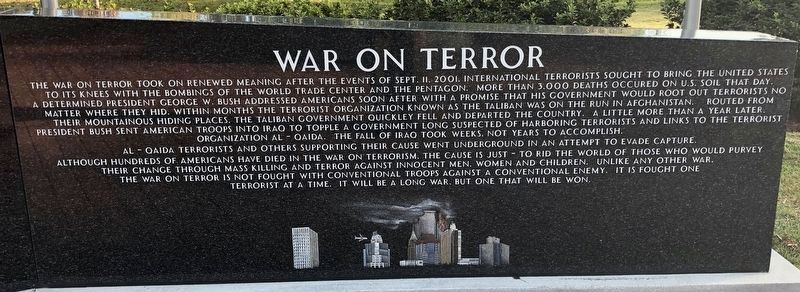
Al-Qaida terrorists and others supporting their cause went underground in an attempt to evade capture. Although hundreds of Americans have died in the War on Terrorism, the cause is just - to rid the world of those who would purvey their change through mass killing and terror against innocent men, women and children. Unlike any other war, the War on Terror is not fought with conventional troops
Photographed by Mark Hilton, December 6, 2018
6. Persian Gulf War portion of the monument.
Topics and series. This monument and memorial is listed in these topic lists: War, Korean • War, Vietnam • War, World I • War, World II. In addition, it is included in the Former U.S. Presidents: #40 Ronald Reagan, and the Former U.S. Presidents: #43 George W. Bush series lists.
Location. 31° 56.806′ N, 81° 18.358′ W. Monument is in Richmond Hill, Georgia, in Bryan County. It can be reached from Cedar Street 0.1 miles north of Richard Davis Drive, on the right when traveling north. Located within J.F. Gregory Park. Touch for map. Monument is at or near this postal address: 520 Cedar Street, Richmond Hill GA 31324, United States of America. Touch for directions.

Regionally, this memorial monument is on the Coastal Plain, on the Georgia Coast and the Golden Isles, and in Greater Savannah. It is also in the American South, specifically in the Deep South, and on the Eastern Seaboard. Globally, it is in the North Atlantic Region, North America, the Western
Photographed by Mark Hilton, December 6, 2018
7. War on Terror portion of monument.
Other nearby markers. At least 8 other markers are within walking distance of this marker: Jack Fleming Gregory, Senior (about 400 feet away, measured in a direct line); Ways Station (about 500 feet away); Robert E. Lee (about 500 feet away); J. F. Gregory (approx. 0.2 miles away); Henry Ford at Richmond Hill (approx. 0.2 miles away); a different marker also named Ways Station (approx. ¼ mile away); Rice Cultivation on the Ogeechee River (approx. 0.3 miles away); Community House (approx. 0.4 miles away). Touch for a list and map of all markers in Richmond Hill.
Photographed by Mark Hilton, December 6, 2018
8. Richmond Hill Veterans Monument
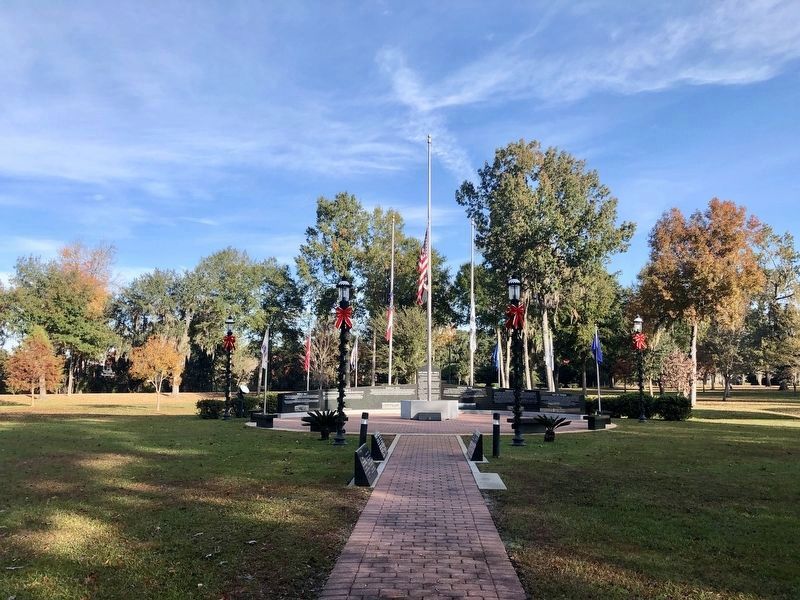
Photographed by Mark Hilton, December 6, 2018
9. Richmond Hill Veterans Monument in JF Gregory Park
Credits. This page was last revised on March 20, 2019. It was originally submitted on December 31, 2018, by Mark Hilton of Montgomery, Alabama. This page has been viewed 715 times since then and 63 times this year. Photos: 1, 2, 3, 4, 5, 6, 7, 8, 9. submitted on December 31, 2018, by Mark Hilton of Montgomery, Alabama.
