Washington in Franklin County, Missouri — The American Midwest (Upper Plains)
The Tibbe Historic District
was listed on the National Register of Historic Places
| — | March 22, 1990 | — |
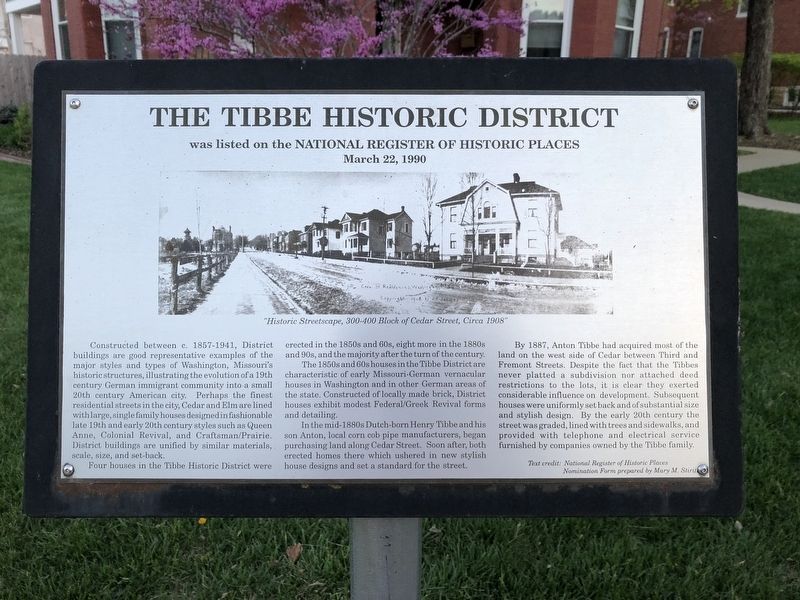
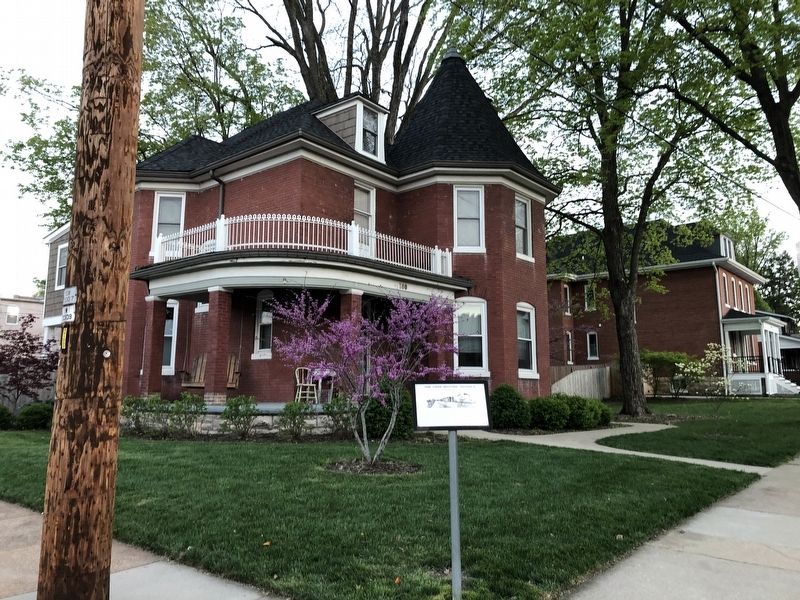
Four houses in the Tibbe Historic District were erected in the 1850s and 60s, eight more in the 1880s and 90s, and the majority after the turn of the century. The 1850s and 60s houses in the Tibbe District are characteristic of early Missouri-German vernacular houses in Washington and in other German areas of the state. Constructed of locally made brick, District houses exhibit modest Federal/Greek Revival forms and detailing.
In the mid-1880s Dutch-born Henry Tibbe and his son Anton, local corn cob pipe manufacturers, began purchasing land
this page online
By 1887, Anton Tibbe had acquired most of the land on the west side of Cedar between Third and Fremont Streets. Despite the fact that the Tibbes never platted a subdivision nor attached deed restrictions to the lots, it is clear they exerted considerable influence on development. Subsequent houses were uniformly set back and of substantial size and stylish design. By the early 20th century the street was graded, lined with trees and sidewalks, and provided with telephone and electrical service furnished by companies owned by the Tibbe family.
Topics. This historical marker is listed in these topic lists: Architecture • Immigration • Industry & Commerce. A significant historical year for this entry is 1887.
Location. 38° 33.593′ N, 91° 0.921′ W. Marker is in Washington, Missouri, in Franklin County. It is at the intersection of Cedar Street and West 3rd Street, on the left when traveling north on Cedar Street. Touch for map. Marker is at or near this postal address: 225 Cedar Street, Washington

Regionally, this marker is in the Missouri River Corridor and in Greater St. Louis. It is also in the American Midwest, in the Lewis & Clark Corridor, in the Corn Belt, and on the Santa Fe Trail Corridor. Globally, it is in North America, the Western Hemisphere, the Western World, and the Anglosphere. Historically, it finds itself in what was once the territory of the Mississippian Culture, the Louisiana Purchase, and the Antebellum South.
Other nearby markers. At least 8 other markers are within walking distance of this marker: St. Francis Borgia Convent & School (about 300 feet away, measured in a direct line); Church, Rectory, and Jesuit Hall (about 300 feet away); Notre Dame Hall (about 300 feet away); 1891 St. Francis Borgia School Building (about 300 feet away); 1935 St. Francis Borgia School Building (about 300 feet away); St. Francis Borgia Rectory (about 400 feet away); Washington Bakery (about 500 feet away); Dickbrader Hardware (about 500 feet away). Touch for a list and map of all markers in Washington.
Credits. This page was last revised on September 5, 2024. It was originally submitted on April 27, 2019, by Devry Becker Jones of Washington, District of Columbia. This page has been viewed 664 times since then and 121 times this year. Photos: 1, 2. submitted on April 27, 2019, by Devry Becker Jones of Washington, District of Columbia.
Editor’s want-list for this marker. A link to the National Register nomination form with a citation of the district's historical significance. • Can you help?
