Mouton Kitchen
La Cuisine de Maison Mouton
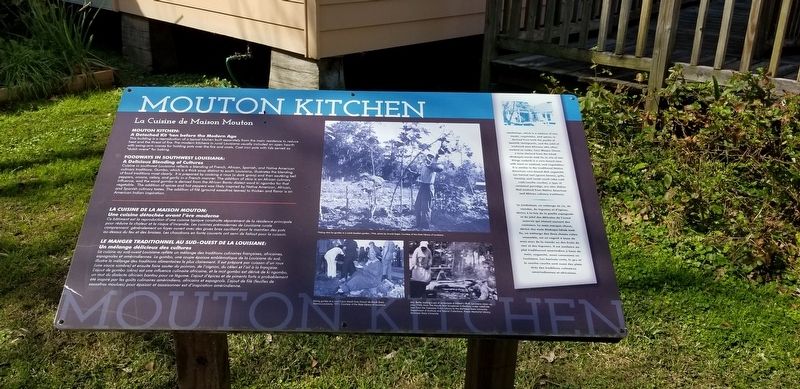
MOUTON KITCHEN:
A Detached Kitchen before the Modern Age
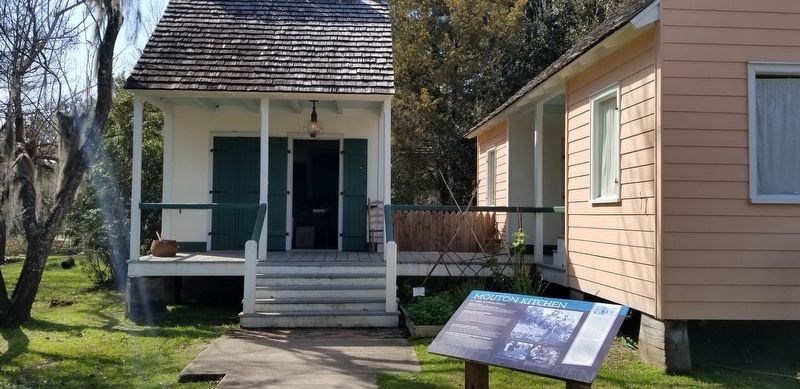
This building is a reproduction of a typical kitchen built separately from the main residence to reduce heat and the threat of fire. Pre-modern kitchens in rural Louisiana usually included an open hearth with swing-arm cranes for holding pots over the fire and coals. Cast iron pots with lids served as "dutch ovens” for baking.
FOODWAYS IN SOUTHWEST LOUISIANA:
A Delicious Blending of Cultures
Cuisine in southwest Louisiana reflects a blending of French, African, Spanish, and Native American
culinary traditions. Gumbo, which is a thick soup distinct to south Louisiana, illustrates the blending
of food traditions most clearly. It is prepared by cooking A Roux (a dark gravy) and then sautéing bell
peppers, onions, celery, and garlic in a French manner. The addition of okra is an African culinary
influence, and the word gombo is derived from the African Bantu dialect word ki ngombo for that
vegetable. The addition of spices and hot peppers was likely inspired by Native American, African,
and Spanish culinary tastes. The addition of filé (ground sassafras
this page online
------------------------------------------------------------------------------
LA CUISINE DE LA MAISON MOUTON:
Une cuisine détachée avant l'ère moderne
Ce bâtiment est la reproduction d'une cuisine typique construite séparément de la résidence principale pour réduire la chaleur et le risque d'incendie. Les cuisines prémodernes de Louisiane rurale comprennent généralement un foyer ouvert avec des grues bras oscillant pour le maintien des pots au-dessus du feu et des braises. Les chaudrons en fonte couverts ont servi de faitout pour la cuisson.
LE MANGER TRADITIONNEL AU SUD-OUEST DE LA LOUISIANE:
Un mélange délicieux des cultures
La cuisine au sud-ouest Louisiane reflète un
mélange des traditions culinaires françaises, africaines, espagnoles et amérindiennes. Le gombo,
une soupe épaisse emblématique de la Louisiane du sud,
illustre le mélange des traditions alimentaires le plus clairement. Il est préparé par cuisson d'un roux
(une sauce sombre) et ensuite faire sauter du poivron, de l'oignon, du céleri et l'ail à la française.
L'ajout de gombo
Jambalaya, which is a mixture of rice,
meats,vegetables, and spices, is
derived from both the paella of
Spanish immigrants,and the jolof of
enslaved west Africans who often
worked as cooks. Corn Maque Choux,
a term derived from the Ishak
(Atakapa) words mak tiu (a mix of two
things cooked) is a corn-based stew
with meat or seafood, and vegetables.
It is similar to the traditional Native
American corn-based dish sagamité.
Les haricot vert (green beans), grits,
hominy,and coush coush (aka cush
Cush/couche couche),
a type of
cornmeal porridge,
are also dishes
that evolved from Native American
and African culinary traditions.
-----------------------------------------------------------------------------------------
Le jambalay,
un mélange de
Topics. This historical marker is listed in this topic list: Settlements & Settlers.
Location. 30° 12.922′ N, 91° 59.68′ W. Marker is in Lafayette, Louisiana, in Lafayette Parish. It can be reached from Fisher Road near Surrey Street (State Road 728-8). Touch for map. Marker is at or near this postal address: 300 Fisher Road, Lafayette LA 70508, United States of America. Touch for directions.

Regionally, this marker is in Acadiana — Cajun Country. It is also in the American South and specifically in the Deep South. Globally, it is in North America, a Gulf of Mexico state, the Western Hemisphere, the Western World, and the Anglosphere. Historically, it finds itself in what was once New Spain, Acadia, the territory of the Mississippian Culture, the Louisiana Purchase, one of the Confederate States of America, and the Antebellum South.
Other nearby markers. At least 8 other markers are within walking distance of this marker: Mouton House (a few steps from this marker); The Forge (a few steps from this marker); School House (within shouting distance of this marker); Acadian House (within shouting distance of this marker); Buller House (within shouting distance of this marker); Beau Bassin House (within shouting distance of this marker); Trappers Cabin & Boat Shed (within shouting distance of this marker); The Presbytery (within shouting distance of this marker). Touch for a list and map of all markers in Lafayette.
More about this marker. Located on the grounds of the Vermilionville Historic Village, a living history museum. Fee is charged for access to museum grounds.
Also see . . . Vermilionville. Museum website homepage (Submitted on June 9, 2019, by Cajun Scrambler of Assumption, Louisiana.)
Credits. This page was last revised on December 25, 2023. It was originally submitted on June 9, 2019, by Cajun Scrambler of Assumption, Louisiana. This page has been viewed 535 times since then and 33 times this year. Photos: 1, 2. submitted on June 9, 2019.
