Concord in Contra Costa County, California — The American West (Pacific Coastal)
(Port Chicago) Disaster
Photographed by Barry Swackhamer, July 17, 2019
1. (Port Chicago) Disaster Marker
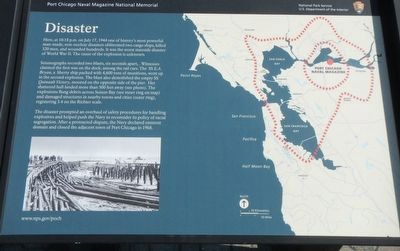
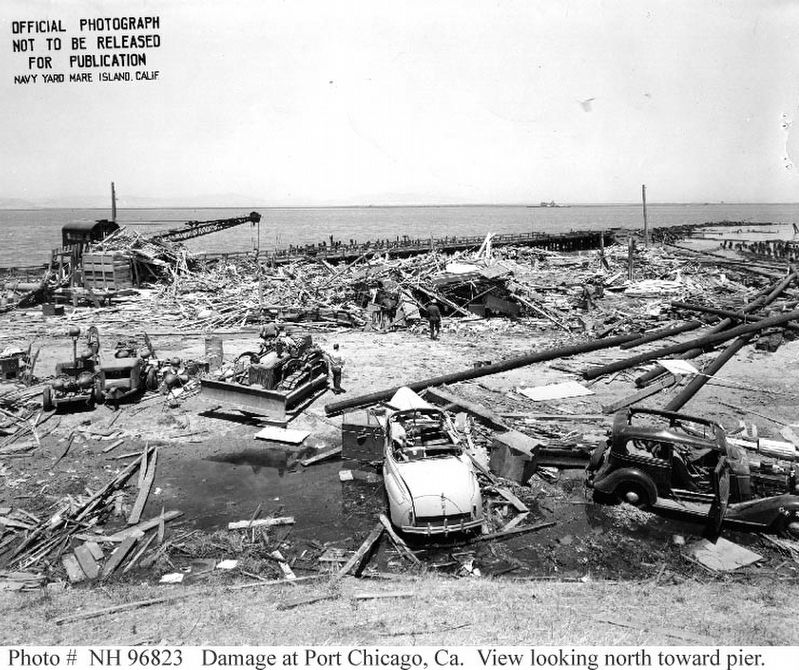
Seismographs recorded two blasts, six seconds apart. Witnesses claimed the first was on the dock, among the rail cars. The SS E.A. Bryan, a liberty ship packed with 4,600 tons of munitions, went up in the second explosion. The blast also demolished the empty SS Quinault Victory, moored on the opposite side of the pier. Her shattered hull landed more than 500 feet away (see photo). The explosion flung debris across Suisun Bay (see inner ring on map) and damaged structures in nearby towns and cities (outer ring), registering 3.4 on the Richter scale.
The disaster prompted an overhaul of safety procedures for handling explosives and helped push the Navy to reconsider its policy of racial segregation. After a protracted dispute, the Navy declared eminent domain and closed the adjacent town of Port Chicago in 1968.
Erected 2019 by National Park Service, U.S. Department
this page online
Topics. This memorial is listed in these topic lists: African Americans • Disasters • War, World II. A significant historical date for this entry is July 17, 1944.
Location. 38° 3.451′ N, 122° 1.772′ W. Memorial is in Concord, California, in Contra Costa County. It is on Port Chicago Highway. Touch for map. Memorial is at or near this postal address: 5110 Port Chicago Highway, Concord CA 94520, United States of America. Touch for directions.

Regionally, this memorial is in California’s San Francisco Bay Area and on the Coast Ranges. It is also on the American Pacific Coast. Globally, it is in North America, on the Ring of Fire, on the Pacific Rim, in the Western Hemisphere, in the Western World, and in the Anglosphere. Historically, it finds itself in what was once New Spain and also Mexico’s Alta California.
Other nearby markers. At least 8 other markers are within 5 miles of this marker, measured as the crow flies: Port Chicago Naval Magazine National Memorial (a few steps from this marker); Dangerous Work (within shouting distance of this marker); Port Chicago Naval Magazine (within shouting
Photographed by Barry Swackhamer, July 17, 2019
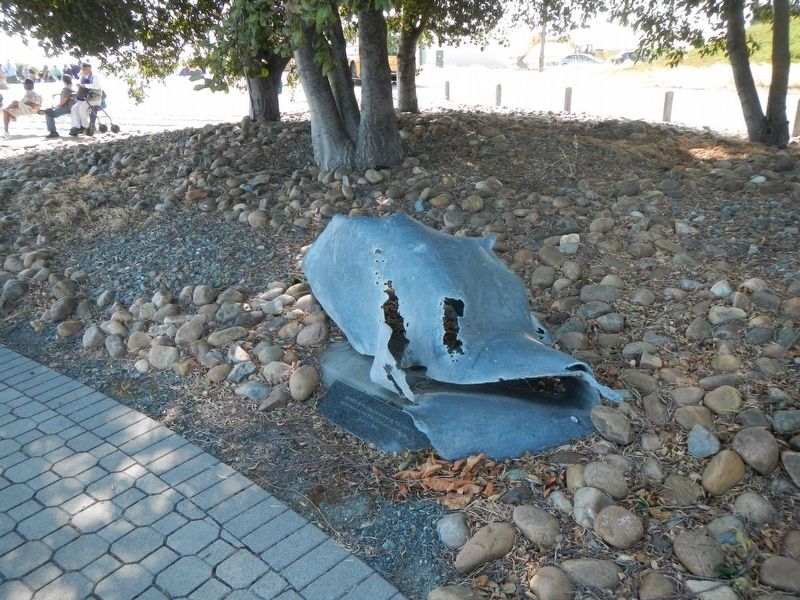
2. A piece of plating from one of ships destroyed in the Port Chicago explosion, July 17, 1944
Other markers no longer nearby. Disaster (was here, next to this marker but has been replaced with another marker now near it); Port Chicago (was within shouting distance of this marker but has been replaced with another marker now near it).
More about this memorial. Port Chicago Naval Magazine National Memorial is on the grounds of Military Ocean Terminal Concord. Access is restricted.
Also see . . . Port Chicago disaster -- Wikipedia. The Port Chicago disaster was a deadly munitions explosion that occurred on July 17, 1944, at the Port Chicago Naval Magazine in Port Chicago, California, United States. Munitions detonated while being loaded onto a cargo vessel bound for the Pacific Theater of Operations, killing 320 sailors and civilians and injuring 390 others. Most of the dead and injured were enlisted African American sailors. A
Photographed by Wikipedia
3. Damage at Port Chicago, Ca. View looking north toward pier.
Credits. This page was last revised on July 22, 2021. It was originally submitted on July 18, 2019, by Barry Swackhamer of Brentwood, California. This page has been viewed 1,214 times since then and 128 times this year. Photos: 1, 2, 3. submitted on July 18, 2019, by Barry Swackhamer of Brentwood, California.
