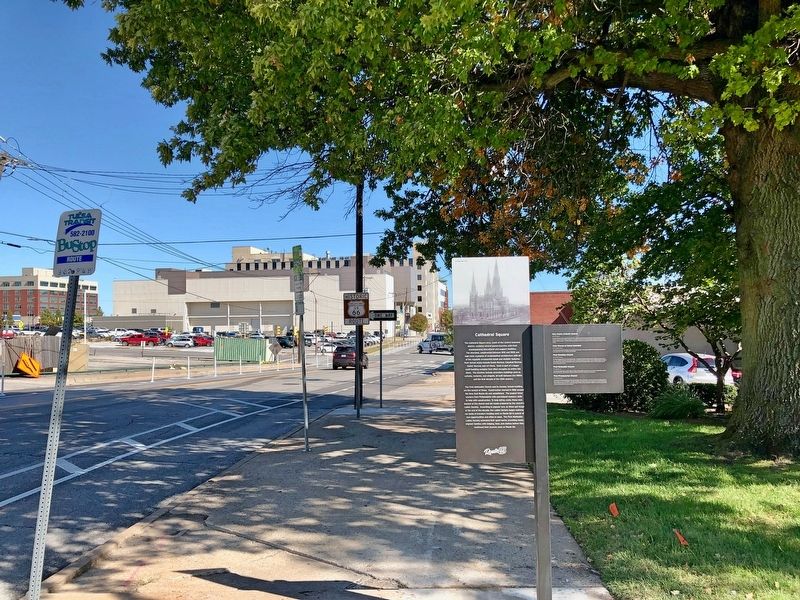
Cathedral Square
Tulsa's Historic Route 66
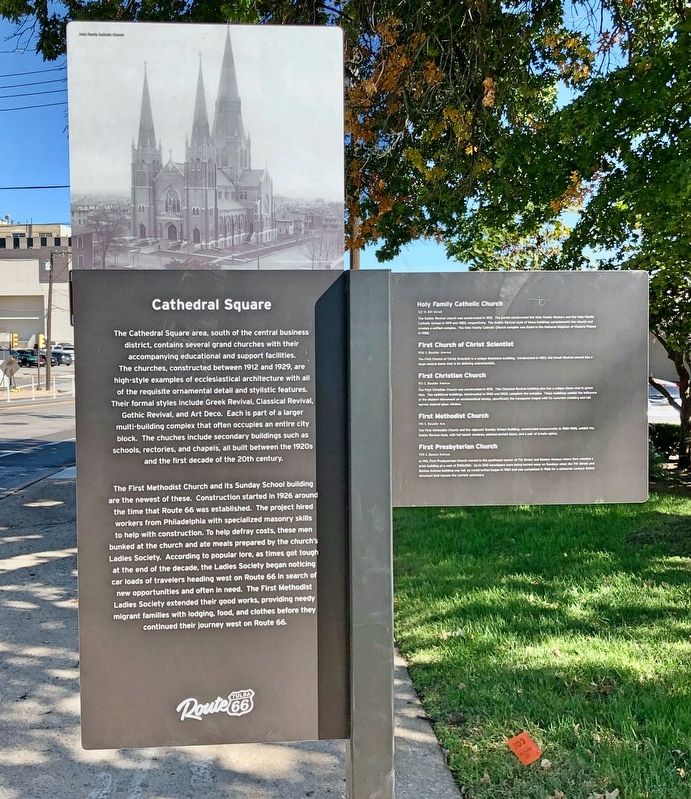
The First Methodist Church and its Sunday School building are the newest of these. Construction started in 1926 around the time that Route 66 was established. The project hired workers from Philadelphia with specialized masonry skills to help with construction. To help defray costs, these men bunked at the church and ate meals prepared by the church's Ladies Society. According to popular lore, as times got tough at the end of the decade, the Ladies
this page online
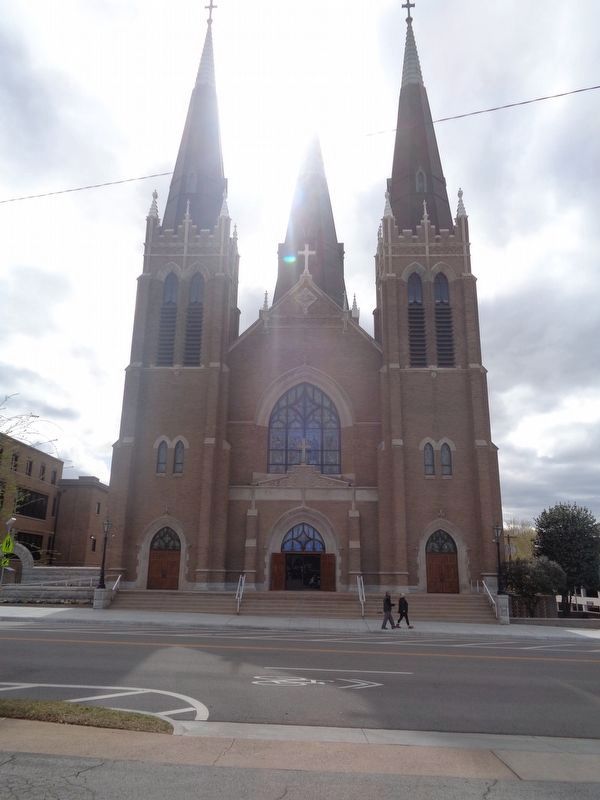
Holy Family Catholic Church
122 W. 8th Street
The Gothic Revival church was constructed in 1912. The parish constructed the Holy Family Rectory and the Holy Family Catholic School in 1919 and 1920, respectively. The Gothic Revival style of these buildings complements the church and creates a unified complex. The Holy Family Catholic Church complex was listed in the National Register of Historic Places in 1982.
First Church of Christ Scientist
906 S. Boulder Avenue
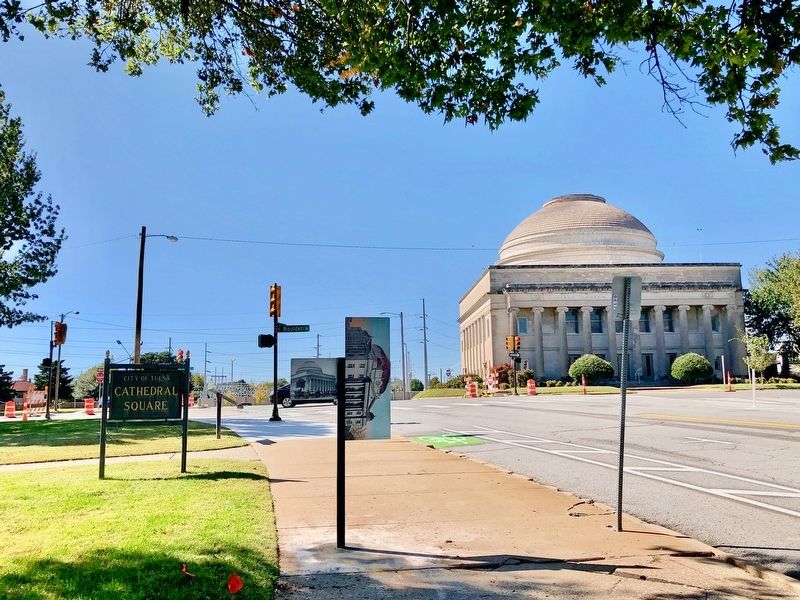
The First Church of Christ Scientist is a unique limestone building. Constructed in 1923, the Greek Revival church has a large central dome that is its defining characteristic.
First Christian Church
913 S. Boulder Avenue
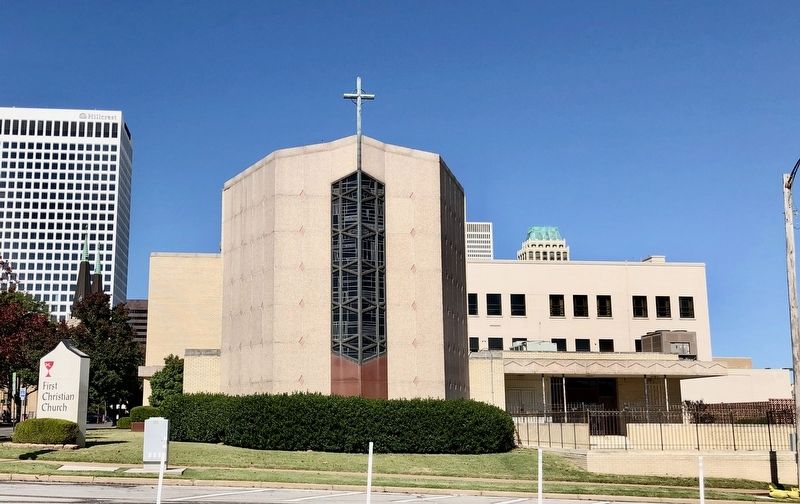
The First Christian Church was constructed in 1919. This Classical Revival building also has a unique dome clad in green tiles. Two additional buildings, constructed in 1940 and 1960, complete the complex. These buildings exhibit the influence of the Modern Movement on ecclesiastical design, specifically the hexagonal chapel with its concrete cladding and tall, narrow stained glass window.
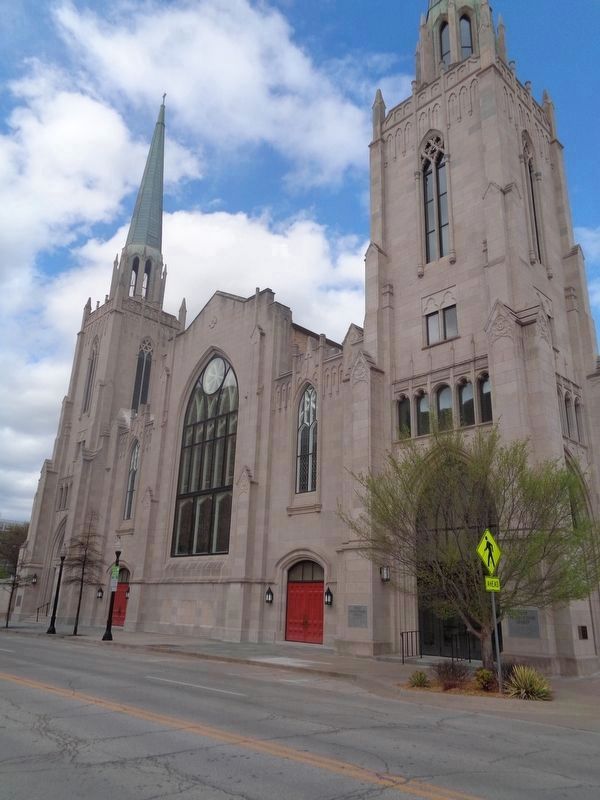
First Methodist Church
1115 S. Boulder Ave.
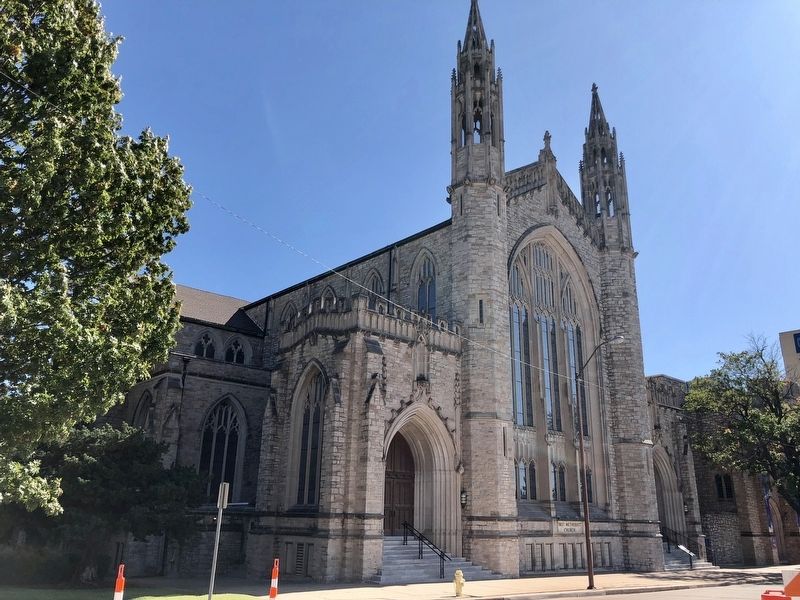
The First Methodist Church and the adjacent Sunday School Building, constructed concurrently in 1926-1928, exhibit the Gothic Revival style, with tall lancet windows, pointed arched doors, and a pair of ornate spires.
First Presbyterian Church
709 S. Boston Avenue
In 1911, First Presbyterian Church moved to the southeast corner of 7th Street and Boston Avenue where they erected a brick building at a cost of $100,000. Up to 500 worshipers were being turned away on Sundays when the 7th Street and Boston Avenue building was full, so construction began in 1924 and was completed in 1926 for a sixteenth century Gothic structure that houses the current sanctuary.
Erected 2019 by Tulsa Route 66 Commission. (Marker Number 15.)
Topics and series. This historical marker is listed in this topic list: Religion & Religious Structures. In addition, it is included in the Art Deco, and the U.S. Route 66 series lists. A significant historical year for this entry is 1912.
Location. 36° 8.778′ N, 95° 59.298′ W. Marker is in Tulsa, Oklahoma, in Tulsa County. It is in Downtown. It is at the intersection of West 10th Street and South Boulder Avenue West, on the right when traveling east on West 10th Street. Touch for map. Marker is at or near this postal address: 22 West 10th Street, Tulsa OK 74119, United States of America. Touch for directions.
Regionally,
Other nearby markers. At least 8 other markers are within walking distance of this marker: 10th Street & Main Street (about 500 feet away, measured in a direct line); Bishop's Driv-Inn (about 600 feet away); Elliott Building (approx. 0.2 miles away); First Presbyterian Church Centennial (approx. ¼ mile away); Oklahoma Natural Gas Company Building (approx. ¼ mile away); Hotel Ambassador (approx. ¼ mile away); Carlton Place Historic District (approx. 0.3 miles away); Pentane (C5H12) Molecular Model (approx. 0.3 miles away). Touch for a list and map of all markers in Tulsa.
Credits. This page was last revised on August 10, 2026. It was originally submitted on November 5, 2019, by Mark Hilton of Montgomery, Alabama. This page has been viewed 1,218 times since then and 144 times this year. Photos: 1, 2, 3, 4, 5. submitted on November 5, 2019, by Mark Hilton of Montgomery, Alabama. 6, 7. submitted on April 7, 2021, by Jason Voigt of Glen Carbon, Illinois.
