Near Fallon in Churchill County, Nevada — The American Mountains (Southwest)
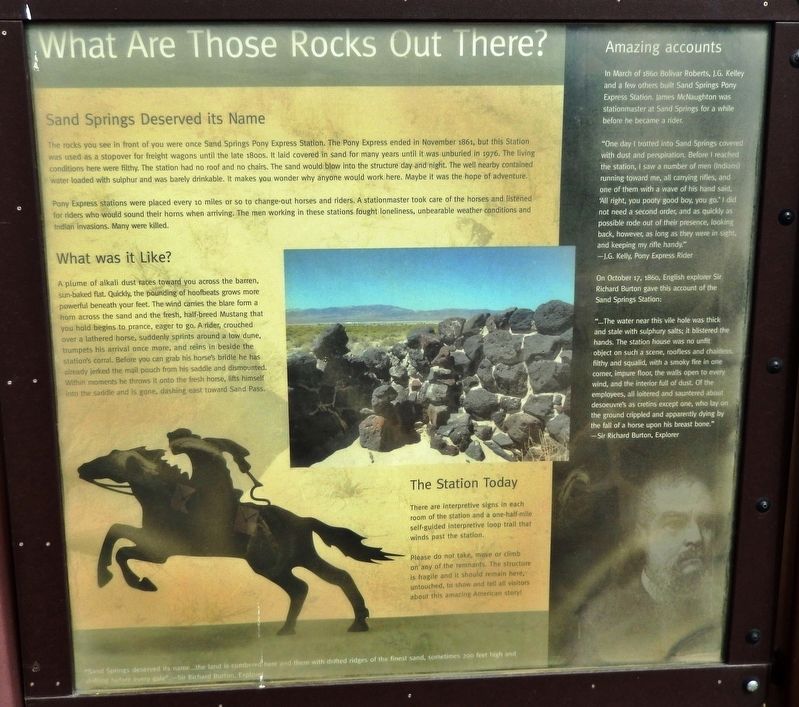
What Are Those Rocks Out There?
Photographed by Cosmos Mariner, July 29, 2014
1. What Are Those Rocks Out There? Marker
Sand Springs Deserved its Name
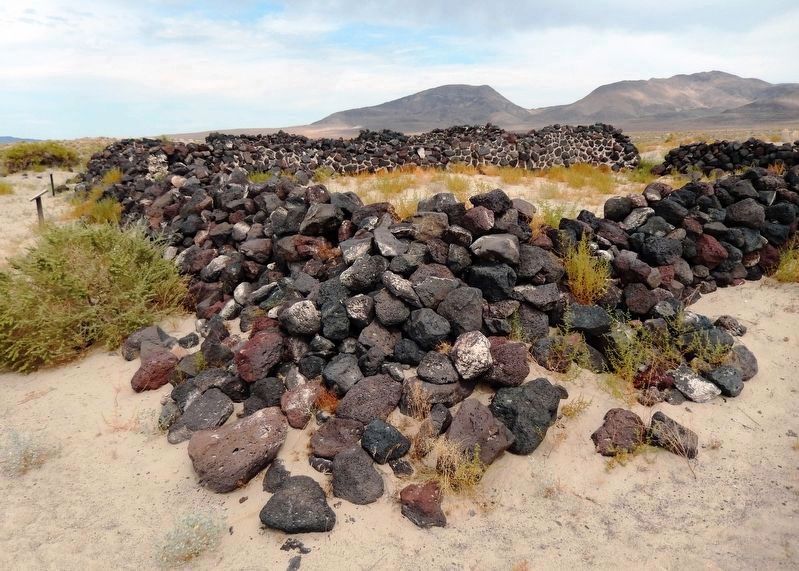
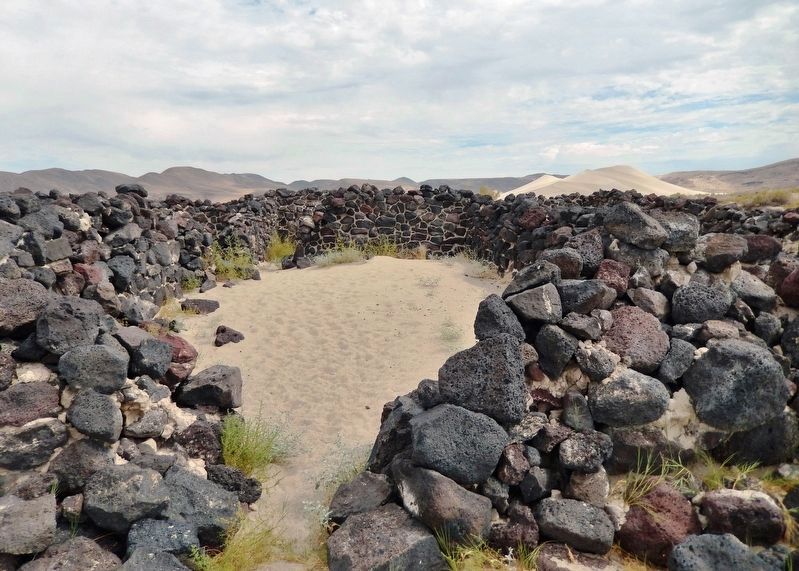
The rocks you see in front of you were once Sand Springs Pony Express Station. The Pony Express ended in November 1861, but this Station was used as a stopover for freight wagons until the late 1800s. It laid covered in sand for many years until it was unburied in 1976. The living conditions here were filthy. The station had no roof and no chairs. The sand would blow into the structure day and night. The well nearby contained water loaded with sulphur and was barely drinkable. It makes you wonder why anyone would work here. Maybe it was the hope of adventure.
Pony Express stations were placed every 10 miles or so to change-out horses and riders. A stationmaster took care of the horses and listened for riders who would sound their horns when arriving. The men working in these stations fought loneliness, unbearable weather conditions and Indian invasions. Many were killed.
What was it Like?
A plume of alkali dust races toward you across the barren, sun-baked flat. Quickly, the pounding of hoofbeats grows more powerful beneath your feet. The wind carries the blare from a horn across the sand
this page online
The Station Today
There are interpretive signs in each room of the station and a one-half-mile self-guided interpretive loop trail that winds past the station.
Please do not take, move or climb on any of the remnants. The structure is fragile and it should remain here, untouched, to show and tell all visitors about this amazing American story!
Amazing accounts
In March of 1860 Bolivar Roberts, J.G. Kelley and a few others built Sand Springs Pony Express Station. James McNaughton was stationmaster at Sand Springs for a while before he became a rider.
"One day I trotted into Sand Springs covered with dust and perspiration. Before I reached the station, I saw a number of men (Indians)
Photographed by Cosmos Mariner, July 29, 2014
2. What Are Those Rocks Out There? Marker
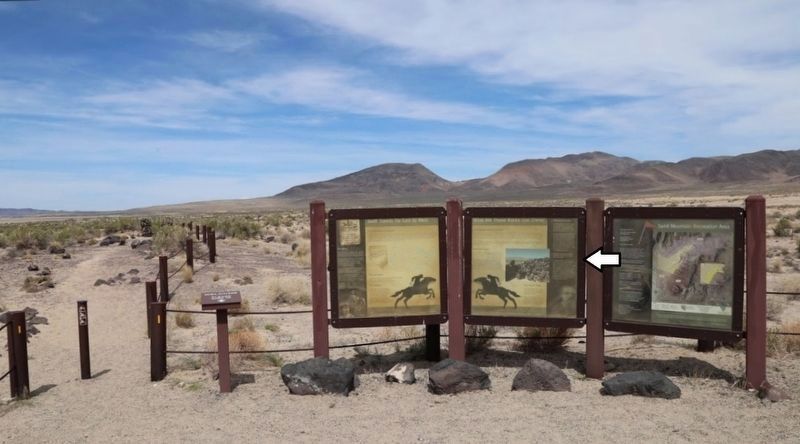
(wide view • middle panel at trailhead kiosk)
(wide view • middle panel at trailhead kiosk)
On October 17, 1860, English explorer Sir Richard Burton gave this account of the Sand Springs Station:
"...The water near this vile hole was thick and stale with sulphury salts; it blistered the hands. The station house was no unfit object on such a scene, roofless and chairless, filthy and squalid, with a smoky fire in one corner, impure floor, the walls open to every wind, and the interior full of dust. Of the employees, all loitered and sauntered about desoeuvre's as cretins except one, who lay on the ground crippled and apparently dying by the fall of a horse upon his breast bone." —Sir Richard Burton, Explorer
”Sand Springs deserved its name… the land is cumbered here and there with drifted ridges of the finest sand, sometimes 200 feet high and shifting before every gale”. —Sir
Photographed by Cosmos Mariner, July 29, 2014
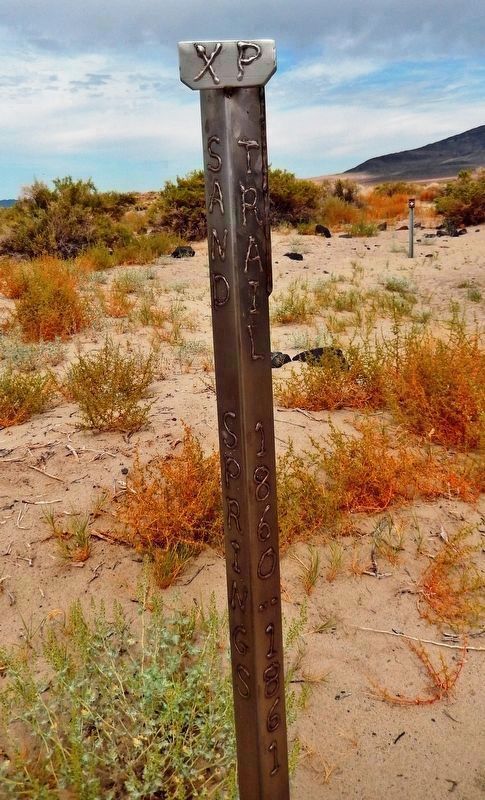
3. Sand Springs Station
(about 250 yards west of marker)
(about 250 yards west of marker)
Topics and series. This historical marker is listed in these topic lists: Communications • Industry & Commerce • Railroads & Streetcars. In addition, it is included in the Pony Express National Historic Trail series list. A significant historical year for this entry is 1860.
Location. 39° 17.426′ N, 118° 24.937′ W. Marker is near Fallon, Nevada, in Churchill County. It can be reached from Lincoln Avenue (U.S. 50) 25 miles east of Maine Street (U.S. 95), on the left when traveling east. Marker is located at the Sand Springs Pony Express Station trailhead, within Sand Mountain Recreation Area, about 25 miles east of Fallon, Nevada, and 2 miles north of US Highway 50. Touch for map. Marker is in this post office area: Fallon NV 89406, United States of America. Touch for directions.

Regionally, this marker is in Northern Nevada. It is also in the American Mountain West. Globally, it is in North America, the Western Hemisphere, the Western World, and the Anglosphere. Historically, it finds itself in what was once New Spain and also Mexico’s Alta California.
Other nearby markers. At least 8 other markers are within 9 miles of this marker, measured as the crow flies: Swift Steeds Tie East to West (here, next to this marker); Central Overland Trail - Sand Springs Station (within shouting distance of this marker); Sand Springs Pony Express Station (about 700 feet away, measured in a direct line); Sand Mountain Pony Express Station (about 800 feet away); Taking Refuge (about 800 feet away); Sand Mountain (approx. 1.1 miles away); Helicopter Antisubmarine Squadron Four Crash Site (approx. 2.4 miles away); Pony Express Route (approx. 8½ miles away). Touch for a list and map of all markers in Fallon.
Photographed by Cosmos Mariner, July 29, 2014
4. Pony Express Sand Springs Station Ruins
(about 250 yards west of marker)
(about 250 yards west of marker)
Photographed by Cosmos Mariner, July 29, 2014
5. Pony Express Sand Springs Station Ruins
(about 250 yards west of marker)
(about 250 yards west of marker)
Photographed by Cosmos Mariner, July 29, 2014
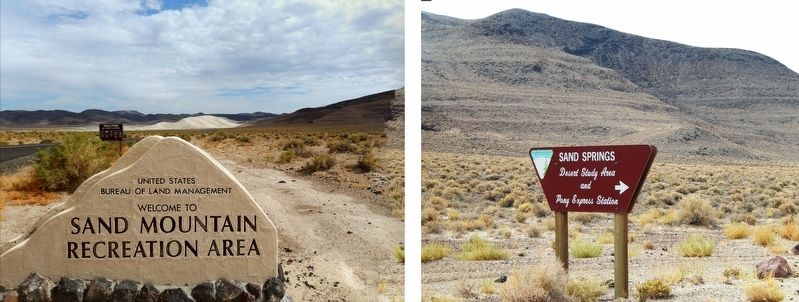
6. Follow Signs from US Highway 50
to Sand Springs Pony Express Station Trailhead
to Sand Springs Pony Express Station Trailhead
Credits. This page was last revised on December 22, 2020. It was originally submitted on November 13, 2019, by Cosmos Mariner of Cape Canaveral, Florida. This page has been viewed 670 times since then and 38 times this year. Photos: 1, 2, 3, 4, 5, 6. submitted on November 13, 2019, by Cosmos Mariner of Cape Canaveral, Florida.
