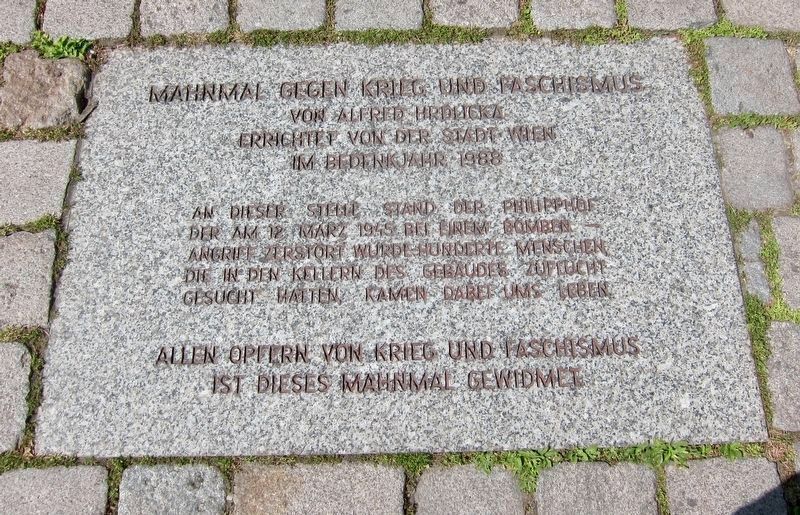
Mahnmal Gegen Krieg und Faschismus
⎯⎯⎯
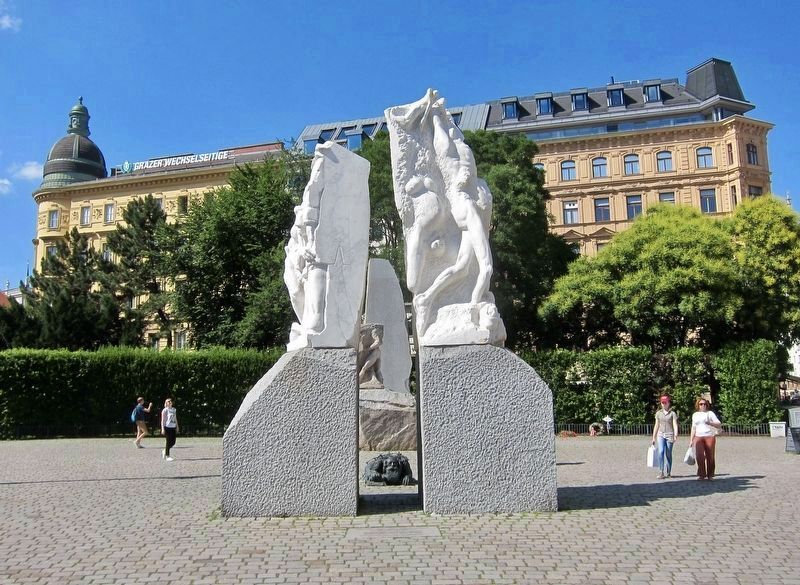
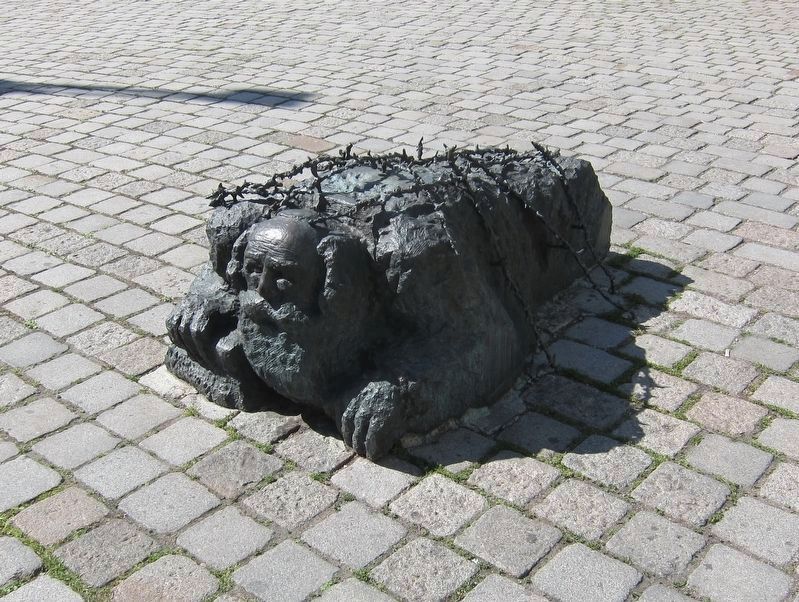
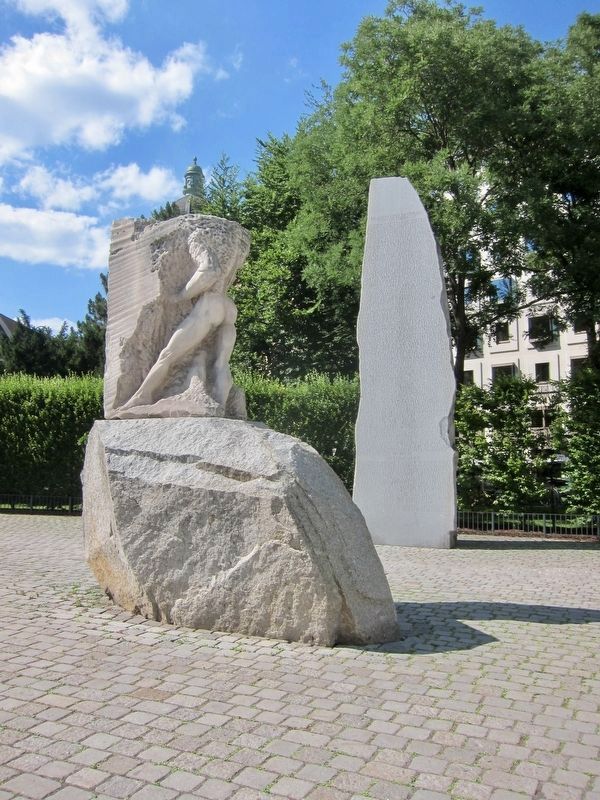
Monument against War and Fascism
Alfred Hrdlicka (1928–2009)
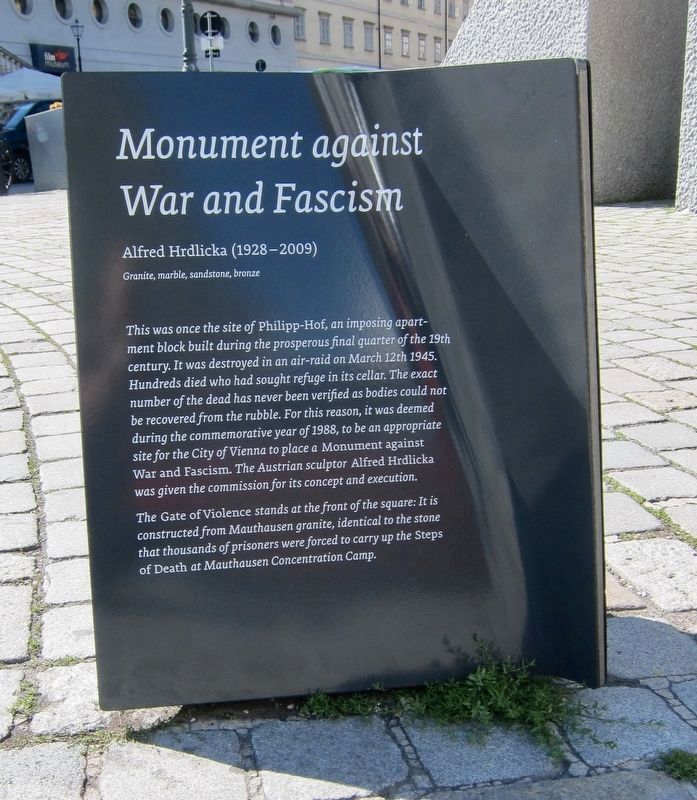

Granite, marble, sandstone, bronze
This was once the site of Philipp-Hof, an imposing apartment block built during the prosperous final quarter of the 19th century. It was destroyed in an air-raid on March 12th 1945. Hundreds died who had sought refuge in its cellar. The exact number of the dead has never been verified as bodies could not be recovered from the rubble. For this reason, it was deemed during the commemorative year of 1988, to be an appropriate site for the City of Vienna to place a Monument against War and Fascism. The Austrian sculptor Alfred Hrdlicka was given the commission for its concept and execution.
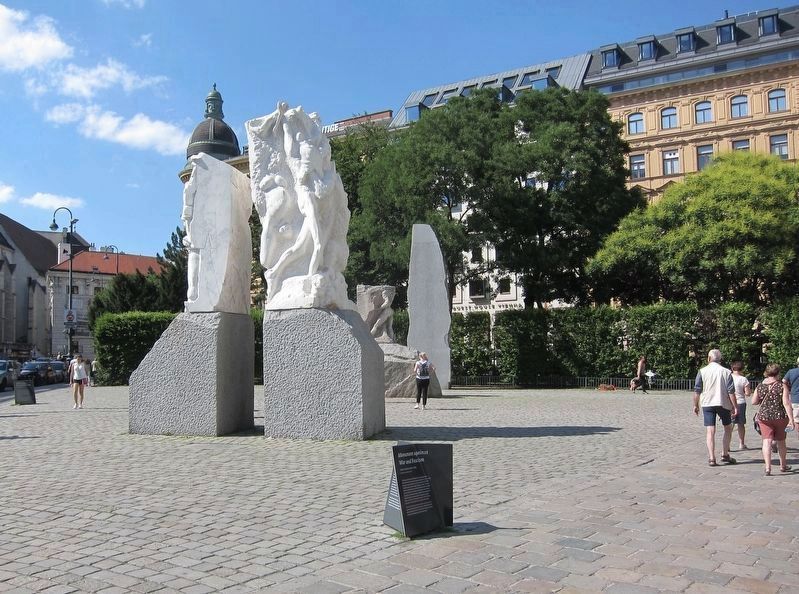
The Gate of Violence stands at the front of the square: It is constructed from Mauthausen granite, identical to the stone that thousands of prisoners were forced to carry up the Steps of Death at Mauthausen Concentration Camp.
-
An dieser Stelle stand der Philipp-Hof, ein repräsentativer
Wohnbau der Gründerzeit, der am 12. März 1945 durch
einen Bombenangriff zerstört wurde. Hunderte Menschen,
die in den Kellern Schutz gesucht hatten, fanden
An der Stirnseite des Platzes steht das Tor der Gewalt.
Es ist aus Mauthausner Granit, wie er von Tausenden Häftlingen über die Todesstiege im Steinbruch des Konzentrationslagers Mauthausen geschleppt wurde.
this page online
Topics. This memorial is listed in these topic lists: Arts, Letters, Music • War, World II. A significant historical date for this entry is March 12, 1945.
Location. 48° 12.272′ N, 16° 22.142′ E. Memorial is in Wien. It is in Innere Stadt. It is at the intersection of Augustinerstraße and Albertinaplatz, on the left when traveling south on Augustinerstraße. Touch for map. Memorial is in this post office area: Wien 1010, Austria. Touch for directions.
Regionally, it is in Europe, the European Union, Central Europe, the Schengen Area, Western Europe, and the Western World. Historically, it finds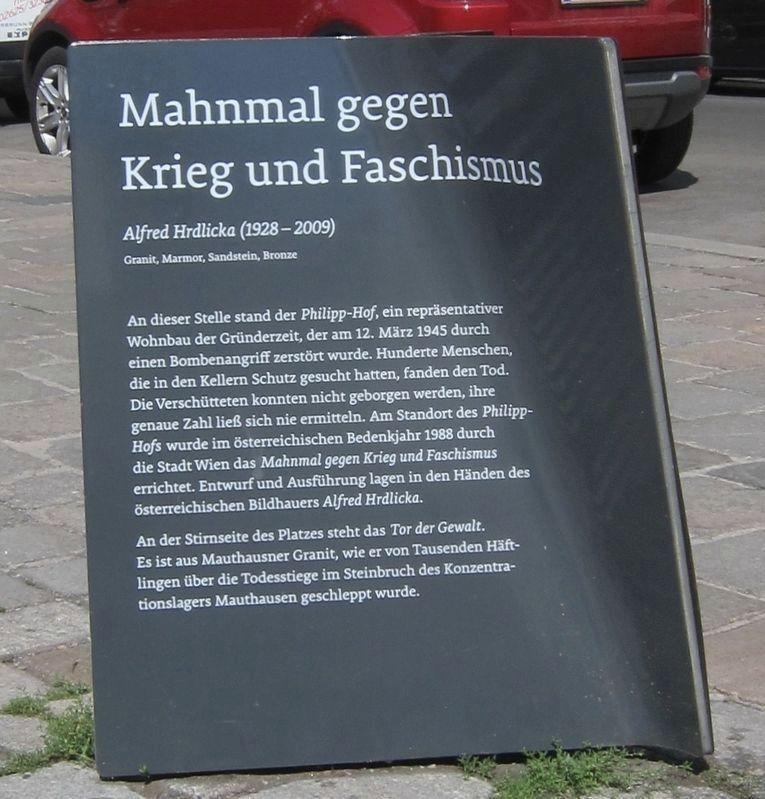
Other nearby markers. At least 8 other markers are within walking distance of this marker: Ottoman Siege of 1529 (about 150 meters away, measured in a direct line); Wiener Aero-Club (about 150 meters away); Matthias Sindelar (about 180 meters away); Leopold Auenbrugger (about 180 meters away); Mark Twain (about 180 meters away); Jan III. Sobieski (about 180 meters away); Staatsoper (about 210 meters away); Ludwig Hevesi (approx. 0.3 kilometers away). Touch for a list and map of all markers in Wien.
Also see . . .
1. Memorial against war and fascism (Wikipedia). (Submitted on February 12, 2020.)
2. Infelicitous Efficacy: Alfred Hrdlicka’s Memorial against War and Fascism(Articulo, 2019(19)). "What happens when a work permanently installed in the public space mediates a message that already at the time of its realization was outdated? What if that work furthermore carburizes the stereotypes it was meant to oppose and in fact evokes images that continue to offend those it was meant to memorialize?..." (Submitted on February 12, 2020.)
Credits. This page was last revised on February 1, 2022. It was originally submitted on February 12, 2020, by Andrew Ruppenstein of Lamorinda, California. This page has been viewed 840 times since then and 147 times this year. Photos: 1, 2, 3, 4, 5, 6, 7. submitted on February 12, 2020, by Andrew Ruppenstein of Lamorinda, California.
