Ellicott City in Howard County, Maryland — The American Northeast (Mid-Atlantic)
MaryLandscapes
Photographed by Tom Fuchs, February 25, 2006
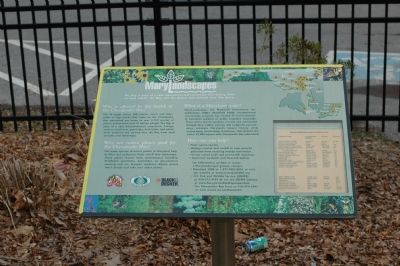
1. MaryLandscapes Marker
The Bay is part of a vast interconnected ecosystem. Everything done on land affects the Bay and the plants and animals that live there.
Who is affected by the health of the Chesapeake Bay? The 48 major rivers, 100 smaller rivers, and thousands of tiny creeks that make up the Chesapeake Bay watershed are home to over 2,700 species of plants and animals and 15 million people. The Bay is part of a vast interconnected ecosystem. Sewage, manure, fertilizers, pesticides, herbicides, and petroleum products are carried into the Bay from local streams and waterways.
Why are native plants good for the Chesapeake Bay? The many species of native plants in Maryland help to filter out pollutants from runoff into waterways. These plants require little maintenance; including fertilizers, pesticides, herbicides, or gas-powered mowing and are drought resistant. Native plants don't invade and take over other plants.
What is a MaryLandscape? MaryLandscapes, the Maryland Commission for Celebration 2000's (Maryland 2000) environmental stewardship program, has created 37 environmentally beneficial gardens in public locations statewide. These
this page online
How can you help? Plant native species. Manage erosion and runoff to help prevent pollution from reaching nearby waterways. Create raised beds and permeable walkways. Construct wetlands and forested buffers. For more information on how to create a MaryLandscapes garden, contact: Maryland 2000 at 1-877-MD2-0001 or visit the website at www.maryland2000.org; U.S. Fish and Wildlife Service (USFWS) at 410-573-4593 or see the USFWS website at www.fws.gov/r5cbfo/Bayscapes.htm ; The Chesapeake Bay Trust at 410-974-2941 or visit www2.ari.net/home/cbt/
Erected by Maryland Commission for Celebration 2000's (Maryland 2000), Open Spaces Sacred Places, and Black & Decker.
Topics. This historical marker is listed in this topic list: Horticulture & Forestry. A significant historical year for this entry is 2000.
Location. Marker has been permanently removed. It was located near 39° 16.125′ N, 76° 48.062′ W.
Photographed by Tom Fuchs
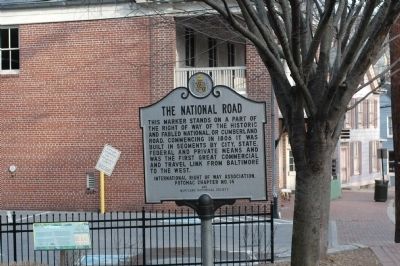
2. The National Road Marker
The MaryLandscapes marker can be seen to the left.
We have been informed that this marker is no longer there and will not be replaced. This page is an archival view of what was.
Regionally, this marker was in the Baltimore Metro Region and in Central Maryland. It was also in the American Mid-Atlantic and on the Eastern Seaboard. Globally, it was in the North Atlantic Region, North America, the Western Hemisphere, the Western World, and the Anglosphere. Historically, it found itself in what was once one of the original Thirteen Colonies and also the Antebellum South.

Other nearby markers. At least 5 other markers are within walking distance of this location: The National Road (here, next to this marker); Ellicott’s Mills (here, next to this marker); Fire House Annex (within shouting distance of this marker); a different marker also named Fells Lane Community (within shouting distance of this marker); New Fire Station & Transit Terminal (within shouting distance of this marker). Touch for a list and map of all markers in Ellicott City.
Other markers no longer nearby. The Road to Prosperity (was within shouting distance of this marker but has been confirmed missing); Old Court House, 1840: (was within shouting distance of this marker but has been confirmed missing); Fells Lane Community (was within shouting distance of this marker but has been replaced with another marker now near it).
More about this marker. All three internet web references on the marker are no longer in service.
Credits. This page was last revised on July 18, 2026. It was originally submitted on March 9, 2006, by Tom Fuchs of Greenbelt, Maryland. This page has been viewed 2,313 times since then and 32 times this year. Photos: 1. submitted on March 9, 2006, by Tom Fuchs of Greenbelt, Maryland. 2. submitted on March 3, 2006, by Tom Fuchs of Greenbelt, Maryland. • J. J. Prats was the editor who published this page.
