Fort Stoddert
| — | Mount Vernon History Trail | — |
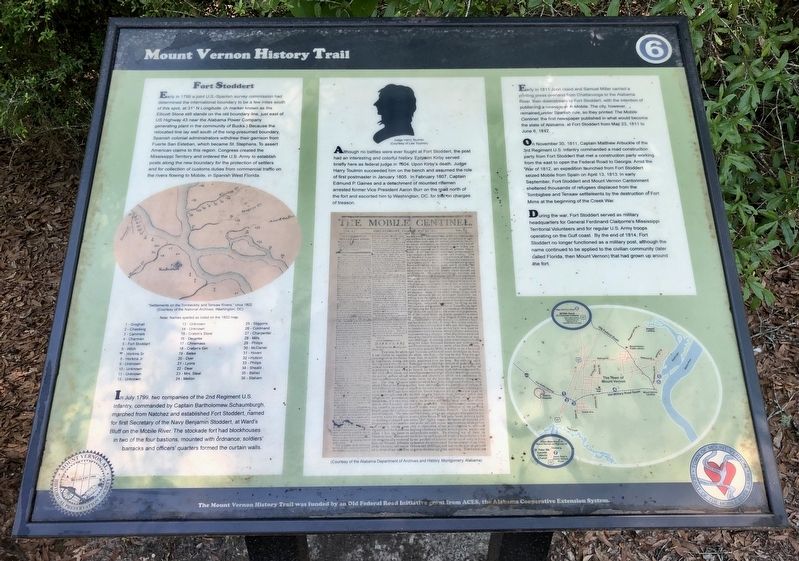
In July 1799, two companies of the 2nd Regiment U.S. Infantry, commanded by Captain Bartholomew Schaumburgh, marched from Natchez and established Fort Stoddert, named for first Secretary of the Navy Benjamin Stoddert, at Ward's Bluff on the Mobile River. The stockade fort had blockhouses in two of
this page online
Although no battles were ever fought at Fort Stoddert, the post had an interesting and colorful history. Ephraim Kirby served here briefly here as federal judge in 1804. Upon Kirby’s death, Judge Harry Toulmin succeeded him on the bench and assumed the role of first postmaster in January 1805. In February 1807, Captain Edmund P. Gaines and a detachment of mounted riflemen arrested former Vice President Aaron Burr on the road north of the fort and escorted him to Washing, DC, for trial on charges of treason.
Early in 1811 John Hood and Samuel Miller carried a printing press overland from Chattanooga to the Alabama River, then downstream to Fort Stoddert, with the intention of publishing a newspaper in Mobile. The city, however, remained under Spanish rule, so they printed The Mobile Centinel, the first newspaper published in what would become the state of Alabama, at Fort Stoddert from May 23, 1811 to June 6, 1812.
In November 30, 1811, Captain Matthew Arbuckle of the 3rd Regiment.U.S. Infantry commanded a
During the war, Fort Stoddert served as military headquarters for General Ferdinand Claiborne's Mississippi Territorial Volunteers and for regular U.S. Army troops operating on the Gulf coast. By the end of 1814, Fort Stoddert no longer functioned as a military post, although the name continued to be applied to the civilian community (later called Florida, then Mount Vernon) that had grown up around the fort.
[Map on left] "Settlements on the Tombeckby and Tensaw Rivers," circa 1802
(Courtesy of the National Archives, Washington, DC)
Erected by Town of Mount Vernon. (Marker Number 6.)
Topics. This historical marker is listed in this topic list: Forts and Castles. A significant historical date for this entry is April 13, 1813.
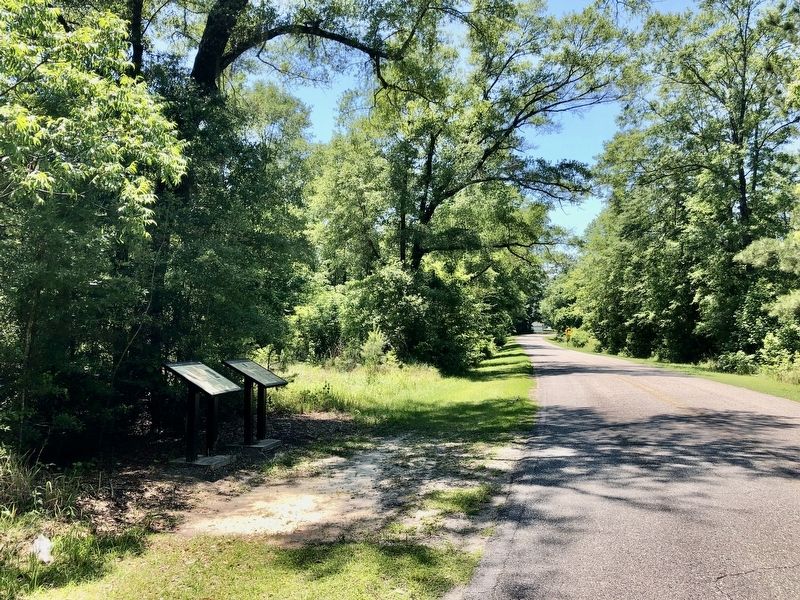
Location. 31° 5.475′ N,
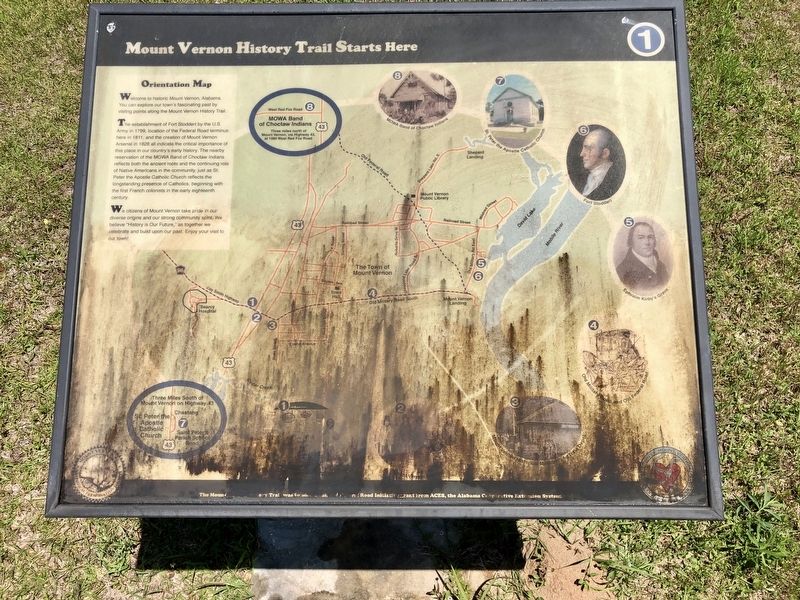

Regionally, this marker is on Alabama’s Gulf Coast, in the Mobile Bay area, and specifically in the Mobile Metropolitan Area. It is also in the American South, specifically in the Deep South, and on the Gulf Coast. Globally, it is in North America, a Gulf of Mexico state, the Western Hemisphere, the Western World, and the Anglosphere. Historically, it finds itself in what was once New Spain, the Viceroyalty of New France, the territory of the Mississippian Culture, one of the Confederate States of America, and the Antebellum South.
Other nearby markers. At least 8 other markers are within 3 miles of this marker, measured as the crow flies: Ephraim Kirby's Grave (here, next to this marker); Old Military Road and Old Federal Road (approx. ¾ mile away); Mount Vernon Historical Museum and Train Depot (approx. 2 miles away); a different marker also named Fort Stoddert (approx. 2.1 miles away); In Memory of Col. Ephraim Kirby (approx. 2.1 miles away); Mt. Vernon Federal Highway (approx. 2.1 miles away); Mt. Vernon Arsenal and Barracks / Searcy Hospital (approx. 2½ miles away); Mount Vernon Arsenal (approx. 2½ miles away). Touch for a list and map of all markers in Mt. Vernon.
Also see . . . Fortwiki article about Fort Stoddert. (Submitted on May 3, 2020, by Mark Hilton of Montgomery, Alabama.)
Credits. This page was last revised on November 17, 2020. It was originally submitted on May 3, 2020, by Mark Hilton of Montgomery, Alabama. This page has been viewed 2,188 times since then and 150 times this year. Photos: 1, 2, 3. submitted on May 3, 2020, by Mark Hilton of Montgomery, Alabama.
