Adams Morgan in Northwest Washington in Washington, District of Columbia — The American Northeast (Mid-Atlantic)
Polonaises
Fryderyk Chopin
| — | Creation | — |
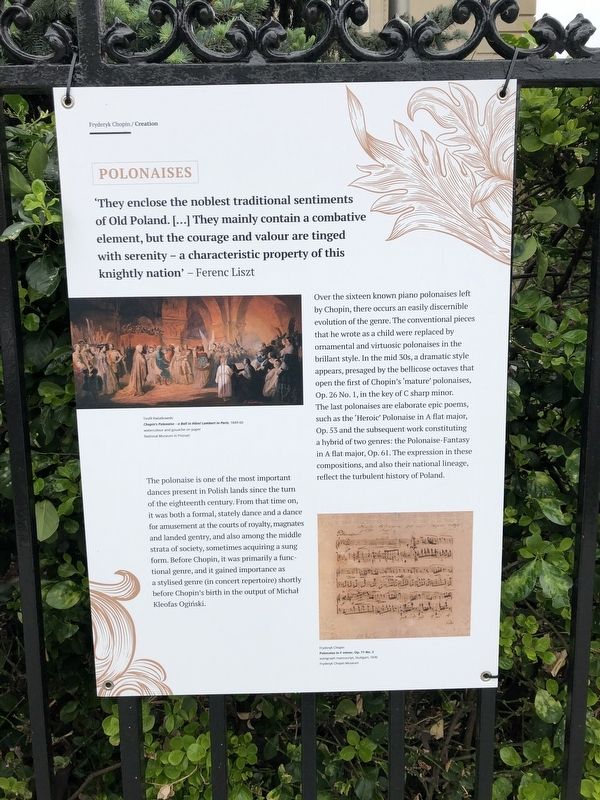
'They enclose the noblest traditional sentiments of Old Poland. […] They mainly contain a combative element, but the courage and valour are tinged with serenity – a characteristic property of this knightly nation' — Ferenc Liszt
Over the sixteen known piano polonaises left by Chopin, there occurs an easily discernible evolution of the genre. The conventional pieces that he wrote as a child were replaced by ornamental and virtuosic polonaises in the brilliant style. In the mid 30s, a dramatic style appears, presaged by the bellicose octaves that open the first of Chopin's 'mature' polonaises, Op. 26 No. 1, in the key of C sharp minor. The last polonaises are elaborate epic poems, such as the 'Heroic' Polonaise in A flat major, Op. 53 and the subsequent work constituting a hybrid of the two genres: the Polonaise-Fantasy in A flat major, Op. 61. The expression in these compositions, and also their national lineage, reflect the turbulent history of Poland.
The polonaise is one of the most important dances present in Polish lands since the turn of the eighteenth century. From that time on, it was both a formal,
this page online
Erected by Embassy of the Republic of Poland in Washington, DC; The Fryderyk Chopin Institute.
Topics. This historical marker is listed in this topic list: Arts, Letters, Music. A significant historical year for this entry is 1836.
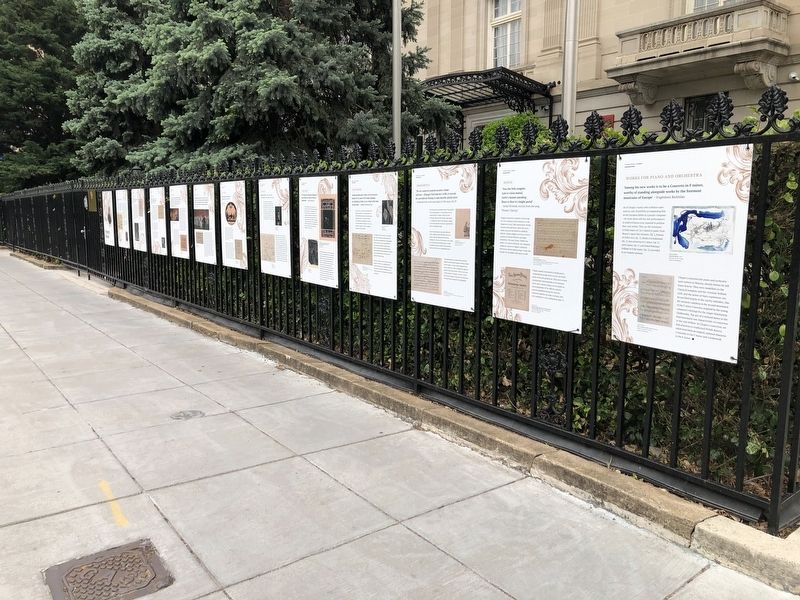
Location. Marker has been permanently removed. It was located near 38° 55.479′ N, 77° 2.198′ W. Marker was in Northwest Washington in Washington, District of Columbia. It was in Adams Morgan. It was on 16th Street Northwest just south of Fuller Street Northwest, on the right when traveling south. Touch for map. Marker was at or near this postal address: 2640 16th St NW, Washington DC 20009, United States of America.
We have been informed that this marker is no longer there and will not be replaced. This page is an archival view of what was.
Regionally,

Other nearby markers. within walking distance of this location: Touch for a list and map of all markers in Northwest Washington.
Other markers no longer nearby. Mazurkas (was here, next to this marker but has been permanently removed); The Colca Canyon w Peru - The deepest canyon in the world (was here, next to this marker but has been replaced with another marker now near it); Jacek Karpiński (was here, next to this marker but has been permanently removed); Ernest Malinowski (was here, next to this marker but has been permanently removed); On the way to the Colca Canyon (was here, next to this marker but has been replaced with another marker now near it); Solidarność (was here, next to this marker but has been replaced with another marker now near it); Maria Czaplicka (was here, next to this marker but has been permanently removed); The first run of the Colca Canyon - May/June 1981 (was here, next to this marker but has been replaced with another marker now near it); Rudolf Weigl (was here, next to this marker but has been permanently removed); Sonatas (was here, next to this marker but has been permanently removed); Henryk Arctowski (was here, next to this marker but has been permanently removed); Ignacy Łukasiewicz (was here, next to this marker but has been permanently removed); Zofia Kielan-Jaworowska (was here, next to this marker but has been permanently removed); a different marker also named The first run of the Colca Canyon - May/June 1981 (was here, next to this marker but has been replaced with another marker now near it); Waltzes (was here, next to this marker but has been permanently removed); a different marker also named The first run of the Colca Canyon - May/June 1981 (was here, next to this marker but has been replaced with another marker now near it).
More about this marker.
[Caption:]
Teofil Kwiatkowski
Chopin's Polonaise – a Ball in Hôtel Lambert in Paris, 1849-60
watercolour and gouache on paper
National Museum in Poznań
Fryderyk Chopin
Polonaise in F minor, Op. 71 No 3
autograph manuscript, Stuttgart, 1836
Fryderyk Chopin Museum
Credits. This page was last revised on January 30, 2023. It was originally submitted on May 19, 2020, by Devry Becker Jones of Washington, District of Columbia. This page has been viewed 262 times since then and 10 times this year. Photos: 1, 2. submitted on May 19, 2020, by Devry Becker Jones of Washington, District of Columbia.
