Dalton in Whitfield County, Georgia — The American South (South Atlantic)
The McCarty Subdivision
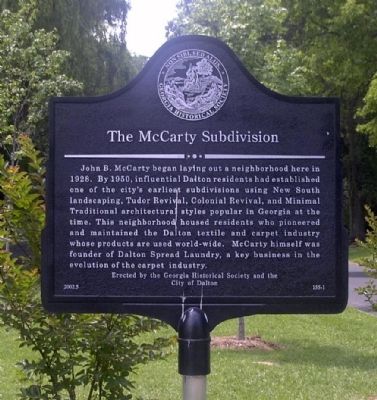
Photographed by David Seibert, May 25, 2002
1. The McCarty Subdivision Marker
Erected 2002 by The Georgia Historical Society and the City of Dalton. (Marker Number 155-1.)
Topics and series. This historical marker is listed in these topic lists: Arts, Letters, Music • Industry & Commerce • Settlements & Settlers. In addition, it is included in the Georgia Historical Society series list. A significant historical year for this entry is 1928.
Location. This marker has been replaced by another marker nearby. It was located near 34° 45.677′ N, 84° 58.37′ W. Marker was in Dalton, Georgia, in Whitfield County. It was at the intersection of West Walnut Avenue
this page online

Regionally, this marker was in Georgia’s Mountains. It was also in the American South, specifically in the Deep South, in Appalachia, and specifically in Southern Appalachia. Globally, it was in North America, the Western Hemisphere, the Western World, and the Anglosphere. Historically, it found itself in what was once the original Cherokee Nation, the territory of the Mississippian Culture, one of the original Thirteen Colonies, one of the Confederate States of America, and the Antebellum South.
Other nearby markers. At least 8 other markers are within walking distance of this location: The McCarty Neighborhood (here, next to this marker); The Blunt House (approx. 0.4 miles away); Dalton Confederate Cemetery (approx. 0.6 miles away); Confederate Cemetery (approx. 0.6 miles away); Dalton Confederate Memorial (approx. 0.6 miles away); Campaign for Atlanta: Johnston's Review (approx. 0.6 miles away); The Mechanization of the Bedspread Industry
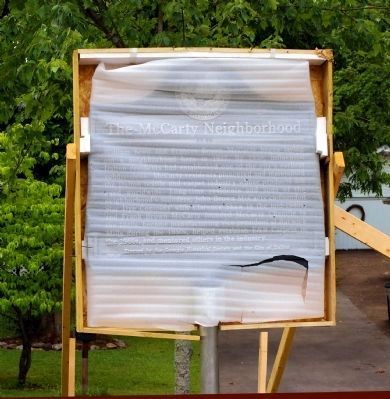
Photographed by David Seibert, June 30, 2008
2. The McCarty Neighborhood Marker prior to dedication.
This marker replaced "The McCarty Subdivision" marker. It reads,
William Scott and Frances Brown McCarty began laying out a neighborhood here in 1927. By 1950, influential Dalton residents had established one of the city's earliest subdivision. McCarty residents pioneered and maintained the Dalton textile and carpet industry whose products are used worldwide. Long-time residents and sons of the neighborhood's founders, John Brown McCarty co-founded Star Dye Company with Clarence Shaw in the mid-1940s, and Frank Brown McCarty founded McCarty Chenille in the 1940s, became manufacturing vice president at Barwick Mills during the 1950s, helped establish E&B Carpets in the 1960s, and mentored others in the industry.
William Scott and Frances Brown McCarty began laying out a neighborhood here in 1927. By 1950, influential Dalton residents had established one of the city's earliest subdivision. McCarty residents pioneered and maintained the Dalton textile and carpet industry whose products are used worldwide. Long-time residents and sons of the neighborhood's founders, John Brown McCarty co-founded Star Dye Company with Clarence Shaw in the mid-1940s, and Frank Brown McCarty founded McCarty Chenille in the 1940s, became manufacturing vice president at Barwick Mills during the 1950s, helped establish E&B Carpets in the 1960s, and mentored others in the industry.
Another marker is no longer nearby. 600 Block of McCamy Street (was approx. 0.4 miles away but has been permanently removed).
More about this marker. The marker was removed in early 2008, replaced by a new Georgia Historical Society marker titled "The McCarty Neighborhood." The new marker, numbered 151-3 in error, has a slightly different text with more detailed information on John McCarty's background. It should have been numbered 155-3.
Related marker. Click here for another marker that is related to this marker.
Credits. This page was last revised on January 4, 2020. It was originally submitted on January 17, 2009, by David Seibert of Sandy Springs, Georgia. This page has been viewed 1,193 times since then and 36 times this year. Photos: 1, 2. submitted on January 17, 2009, by David Seibert of Sandy Springs, Georgia. • Kevin W. was the editor who published this page.
