Decatur in Morgan County, Alabama — The American South (East South Central)
African American Heritage in Old Town Decatur, Alabama
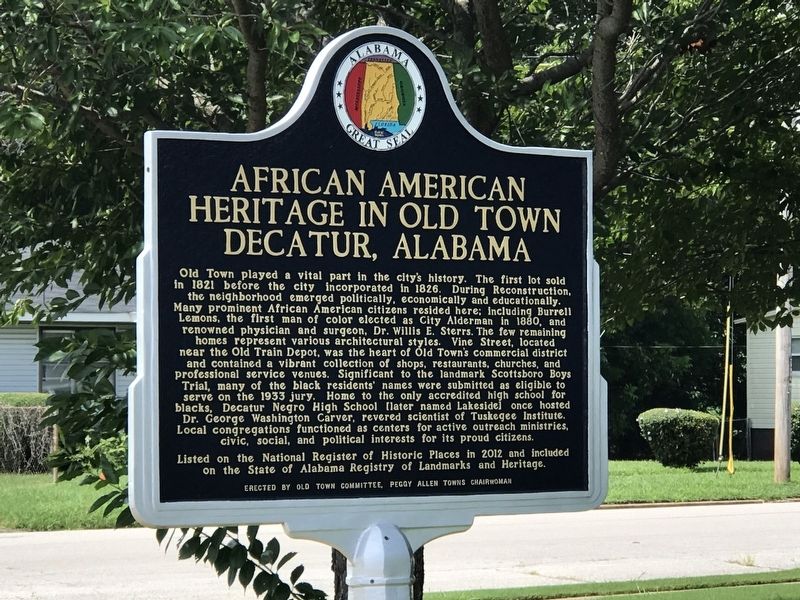
Photographed by Duane and Tracy Marsteller, August 2, 2020
1. African American Heritage in Old Town Decatur, Alabama Marker
Old Town played a vital part in the city's history. The first lot sold in 1821 before the city incorporated in 1826. During Reconstruction, the neighborhood emerged politically, economically and educationally. Many prominent African American citizens resided here; including Burrell Lemons, the first man of color elected as City Alderman in 1880, and renowned physician and surgeon, Dr. Willis E. Sterrs. The few remaining homes represent various architectural styles. Vine Street, located near the Old Train Depot, was the heart of Old Town's commercial district and contained a vibrant collection of shops, restaurants, churches, and professional service venues. Significant to the landmark Scottsboro Boys Trial, many of the black residents' names were submitted as eligible to serve on the 1933 jury. Home to the only accredited high school for blacks, Decatur Negro High School [later named Lakeside] once hosted Dr. George Washington Carver, revered scientist of Tuskegee Institute. Local congregations functioned as centers for active outreach ministries, civic, social, and political interests for its proud citizens.
Listed on the National Register of Historic Places in 2012 and included on the State of Alabama Registry of Landmarks and Heritage.
Erected 2016
this page online
Topics. This historical marker is listed in these topic lists: African Americans • Architecture • Industry & Commerce • Settlements & Settlers. A significant historical year for this entry is 1821.
Location. This marker has been replaced by another marker nearby. 34° 36.831′ N, 86° 59.241′ W. Marker has been damaged. Marker is in Decatur, Alabama, in Morgan County. It is at the intersection of Vine Street Northwest and Sycamore Street Northwest, on the right when traveling north on Vine Street Northwest. Touch for map. Marker is at or near this postal address: 782 Sycamore St NW, Decatur AL 35601, United States of America. Touch for directions.

Regionally, this marker is in North Alabama. It is also in the American South, specifically in the Deep South, in Appalachia, and specifically in Southern Appalachia. Globally, it is in North America, a Gulf of Mexico state, the Western Hemisphere, the Western World, and the Anglosphere. Historically, it finds itself in what was once the original Cherokee Nation, the territory of the Mississippian Culture, one of the Confederate States of America,
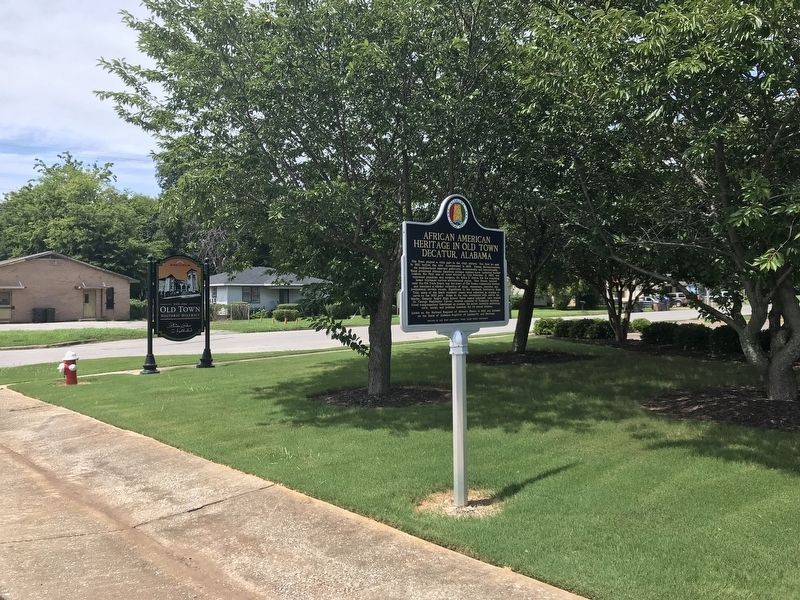
Photographed by Duane and Tracy Marsteller, August 2, 2020
2. African American Heritage in Old Town Decatur, Alabama Marker
Other nearby markers. At least 8 other markers are within walking distance of this location: Old Town Historic District (a few steps from this marker); Old Decatur Historic District / Historic Depot (about 300 feet away, measured in a direct line); First Railroad (about 300 feet away); First Missionary Baptist Church (about 400 feet away); “An Affair Most Important to Us” - The Federal Right, October 27-28, 1864 (about 500 feet away); Daisy Nolan (about 500 feet away); Parker-Hayes Boarding House and Tourist Home (about 700 feet away); Dancy-Polk House (circa 1829) (about 700 feet away). Touch for a list and map of all markers in Decatur.
Also see . . .
1. African American historical marker destroyed in Old Town Decatur (WHNT.com). Apparently a vehicle hit the marker but did not stop. It was broken at the pole mounting. A spokesperson for the Decatur Preservation Society said it’s going to take about a year to get a new marker and would cost thousands of dollars to replace. (Submitted on March 25, 2025, by Mark Hilton of Montgomery, Alabama.)
2. The African American heritage historical marker that was destroyed last month has been replaced. (Submitted on April 18, 2025, by Mark Hilton of Montgomery, Alabama.)
Credits. This page was last revised on April 18, 2025. It was originally submitted on August 4, 2020, by Duane and Tracy Marsteller of Murfreesboro, Tennessee. This page has been viewed 2,054 times since then and 128 times this year. Photos: 1, 2. submitted on August 4, 2020, by Duane and Tracy Marsteller of Murfreesboro, Tennessee. • Mark Hilton was the editor who published this page.
