
Lincoln Recuperates
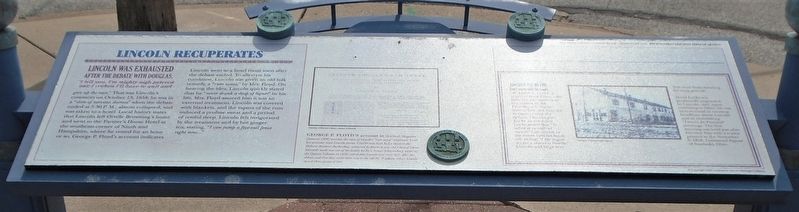
after the debate with Douglas.
"I tell you, I'm mighty nigh petered out; I reckon I'll have to quit and give up the race."
That was Lincoln's comment on October 13, 1858; he was in a "state of nervous distress" when the debate ended at 5:30 P.M., almost collapsed, and was taken to a hotel. Local history states that Lincoln left Orville Browning's home and went to the Farmer's Home Hotel at the southeast corner of Ninth and Hampshire, where he rested for an hour or so. George P. Floyd's account indicates Lincoln went to a hotel room soon after the debate ended. To alleviate his condition, Lincoln was given an old folk remedy, a "rum sweat," by Mrs. Floyd. On hearing the idea, Lincoln quickly stated that he "never drank a drop of liquor" in his life. Mrs. Floyd assured him it was an external treatment. Lincoln was covered with blankets, and the vapors of the rum induced a profuse sweat and a period of restful sleep. Lincoln felt invigorated by the treatment and by hot ginger tea, stating, "I can jump a five-rail fence right now..."
GEORGE P. FLOYD'S account in
this page online
LINCOLN SAT IN THE hotel room with his boots off. David R. Locke, a reporter from Ohio, who later became famous as the author of the Petroleum V. Nasby letters, first met Lincoln in Quincy after the debate. Lincoln gave Locke an interview. Locke stated that "he talked to me without reserve." Lincoln sat in the room with his boots off, saying, "I like to give my feet a chance to breathe." Lincoln had large feet that tired from standing for long periods.
David Locke was profoundly impressed by Lincoln; and, upon returning to Ohio, he was instrumental in creating headlines about Lincoln and in establishing "Lincoln for President" meetings. The first
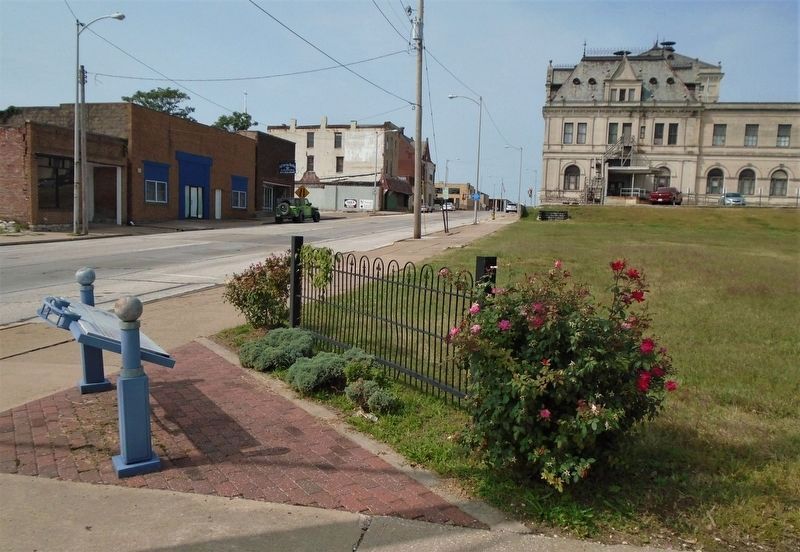
Erected 2008 by Looking for Lincoln Heritage Coalition and Refreshment Services Pepsi of Quincy.
Topics and series. This historical marker is listed in this topic list: Government & Politics. In addition, it is included in the Former U.S. Presidents: #16 Abraham Lincoln, and the Looking for Lincoln series lists. A significant historical date for this entry is October 13, 1858.
Location. 39° 55.996′ N, 91° 24.108′ W. Marker is in Quincy, Illinois, in Adams County. It is at the intersection of Hampshire Street and 9th Street, on the left when traveling east on Hampshire Street. Touch for map. Marker is in this post office area: Quincy IL 62301, United States of America. Touch for directions.

Regionally, this marker is in Central Illinois. It is also in the American Midwest, in the Corn Belt, and in the Great River Road Region. Globally, it is in North America, the Western Hemisphere, the Western World, and the Anglosphere. Historically, it finds itself in what was once the territory of the Mississippian Culture and also the Northwest Territory.
Other nearby markers. At least 8 other markers are within walking distance of this marker: Ernest M. Wood Office and Studio (about 400 feet away, measured in a direct line); Warm, Sincere Friendship (about 500 feet away); Lincoln's Confidante (about 500 feet away); The J. H. Brockschmidt Building (about 600 feet away); Original Site of Quincy College (about 700 feet away); Original Site of St. Peter Church (about 700 feet away); St. John's Episcopal Church (about 700 feet away); The Browning House (about 800 feet away). Touch for a list and map of all markers in Quincy.
Also see . . .
1. Looking for Lincoln National Heritage Area. Enjoy Illinois entry (Submitted on September 27, 2020, by William Fischer, Jr. of Reynoldsburg, Ohio.)
2. Looking for Lincoln National Heritage Area on Facebook. (Submitted on September 27, 2020, by William Fischer, Jr. of Reynoldsburg, Ohio.)
Credits. This page was last revised on February 14, 2021. It was originally submitted on September 27, 2020, by William Fischer, Jr. of Reynoldsburg, Ohio. This page has been viewed 340 times since then and 24 times this year. Photos: 1, 2. submitted on September 27, 2020, by William Fischer, Jr. of Reynoldsburg, Ohio.
