
West Savannah in Chatham County, Georgia — The American South (South Atlantic)
Commercial Development of Western Savannah
Photographed by Tim Fillmon, July 18, 2020
1. Commercial Development of Western Savannah Marker
Inscription.
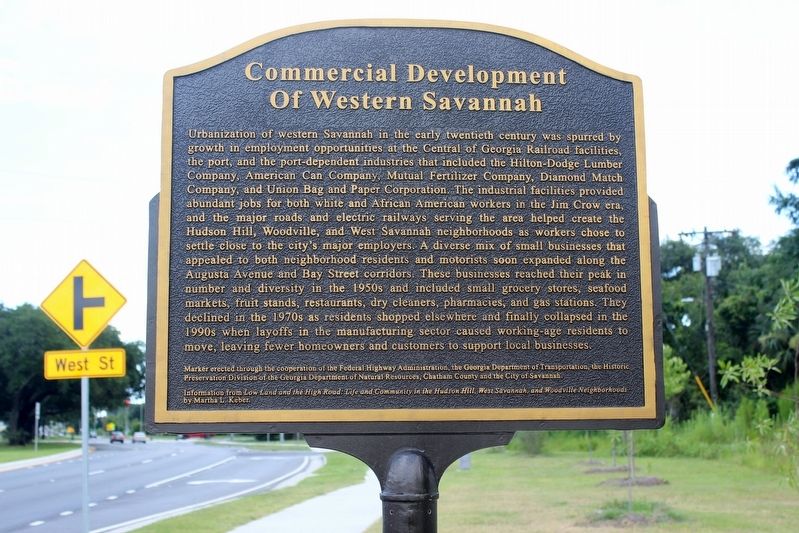
Commercial Development of Western Savannah. . Urbanization of western Savannah in the early twentieth century was spurred by growth in employment opportunities at the Central of Georgia Railroad facilities, the port, and the port-dependent industries that included the Hilton-Dodge Lumber Company, American Can Company, Mutual Fertilizer Company, Diamond Match Company, and Union Bag and Paper Corporation. The industrial facilities provided abundant jobs for both white and African American workers in the Jim Crow era, and the major roads and electric railways serving the area helped create the Hudson Hill, Woodville, and West Savannah neighborhoods as workers chose to settle close to the city's major employers. A diverse mix of small businesses that appealed to both neighborhood residents and motorists soon expanded along the Augusta Avenue and Bay Street corridors. These businesses reached their peak in number and diversity in the 1950s and included small grocery stores, seafood markets, fruit stands, restaurants, dry cleaners, pharmacies, and gas stations. They declined in the 1970s as residents shopped elsewhere and finally collapsed in the 1990s when layoffs in the manufacturing sector caused working-age residents to move, leaving fewer homeowners and customers to support local businesses., Information from Low Land and the High Road: Life and Community in the Hudson Hill, West Savannah, and Woodville Neighborhoods, by Martha L. Keber
Urbanization of western Savannah in the early twentieth century was spurred by growth in employment opportunities at the Central of Georgia Railroad facilities, the port, and the port-dependent industries that included the Hilton-Dodge Lumber Company, American Can Company, Mutual Fertilizer Company, Diamond Match Company, and Union Bag and Paper Corporation. The industrial facilities provided abundant jobs for both white and African American workers in the Jim Crow era, and the major roads and electric railways serving the area helped create the Hudson Hill, Woodville, and West Savannah neighborhoods as workers chose to settle close to the city's major employers. A diverse mix of small businesses that appealed to both neighborhood residents and motorists soon expanded along the Augusta Avenue and Bay Street corridors. These businesses reached their peak in number and diversity in the 1950s and included small grocery stores, seafood markets, fruit stands, restaurants, dry cleaners, pharmacies, and gas stations. They declined in the 1970s as residents shopped elsewhere and finally collapsed in the 1990s when layoffs in the manufacturing sector caused working-age residents to move, leaving fewer homeowners and customers to support local businesses.
Information from Low Land and the High Road: Life and Community in the Hudson
Click or scan to see this page online
Hill, West Savannah, and Woodville Neighborhoods, by Martha L. Keber
Erected by Marker erected through the cooperation of the Federal Highway Administration, the Georgia Department of Transportation, the Historic Preservation Division of the Georgia Department of Natural Resources, Chatham County and the City of Savannah.
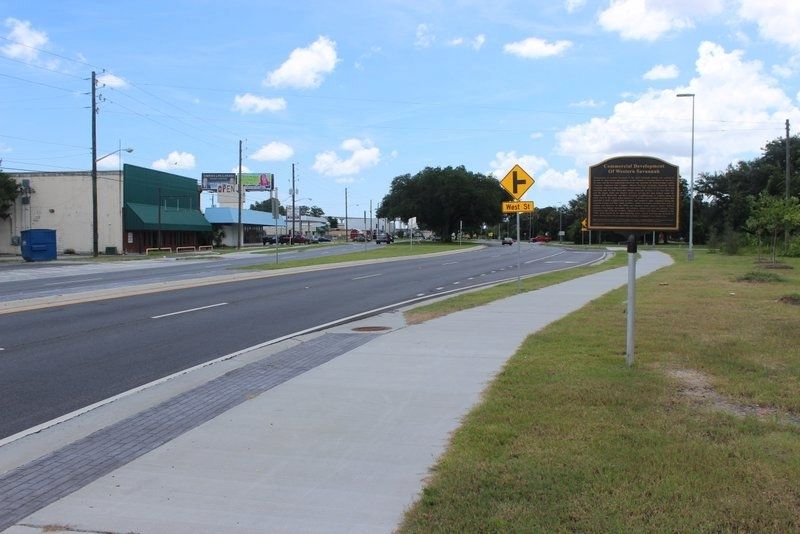
Location. 32° 5.282′ N, 81° 7.085′ W. Marker is in Savannah, Georgia, in Chatham County. It is in West Savannah. It is at the intersection of West Bay Street (Georgia Route 25 Conn) and Millen Street, on the right when traveling east on West Bay Street. Touch for map. Marker is in this post office area: Savannah GA 31415, United States of America. Touch for directions.

Regionally, this marker is in the Coastal Plain and on the Georgia Coast and the Golden Isles. It is also in the American South and specifically in the Deep South. Globally, it is in the North Atlantic Region, North America, the Western Hemisphere, the Western World, and the Anglosphere. Historically, it finds itself in what was once New Spain, the territory of the Mississippian Culture, one of the original Thirteen Colonies, one of the Confederate States of America, and the Antebellum South.
Credits. This page was last revised on February 8, 2023. It was originally submitted on September 28, 2020, by Tim Fillmon of Webster, Florida. This page has been viewed 483 times since then and 25 times this year. Photos:1, 2. submitted on September 28, 2020, by Tim Fillmon of Webster, Florida.
