Worthington in Nobles County, Minnesota — The American Midwest (Upper Plains)
Dayton House ⎯⎯⎯ George D. Dayton
Photographed by Cosmos Mariner, August 19, 2014
1. Dayton House (marker south side)
Inscription.
Dayton House, also, George D. Dayton. .
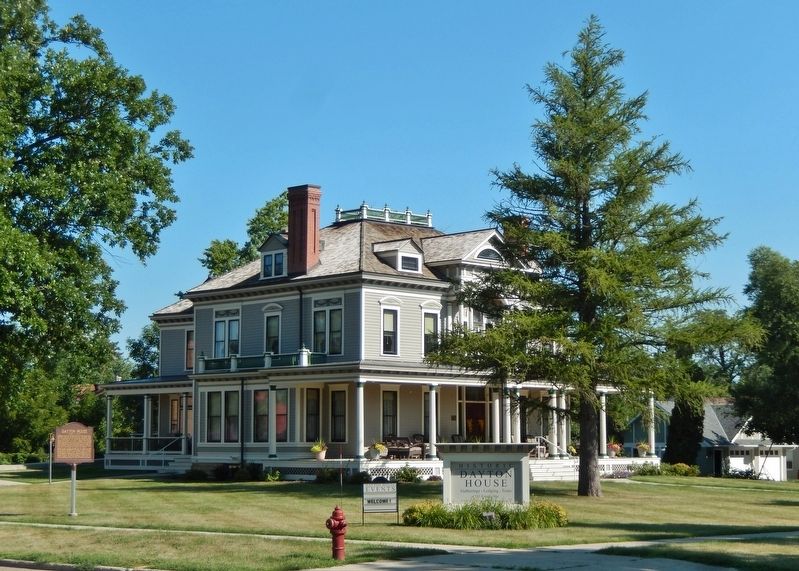
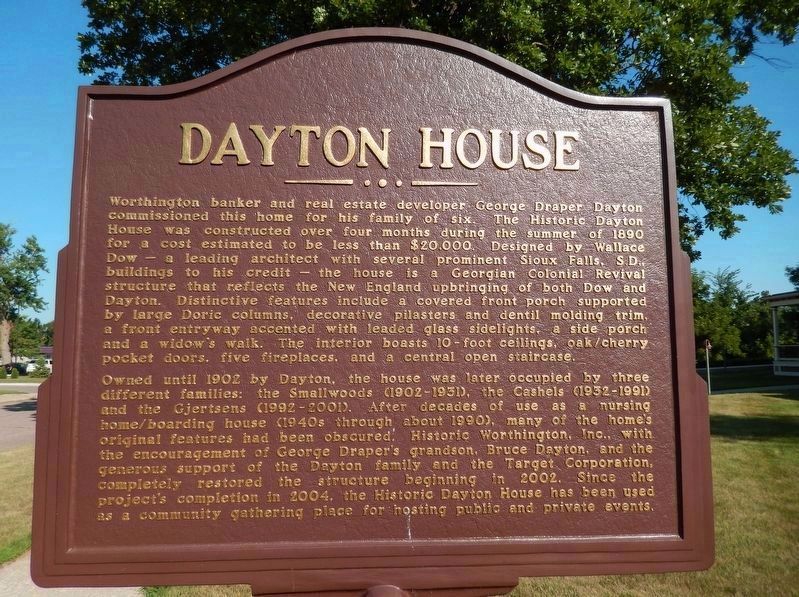
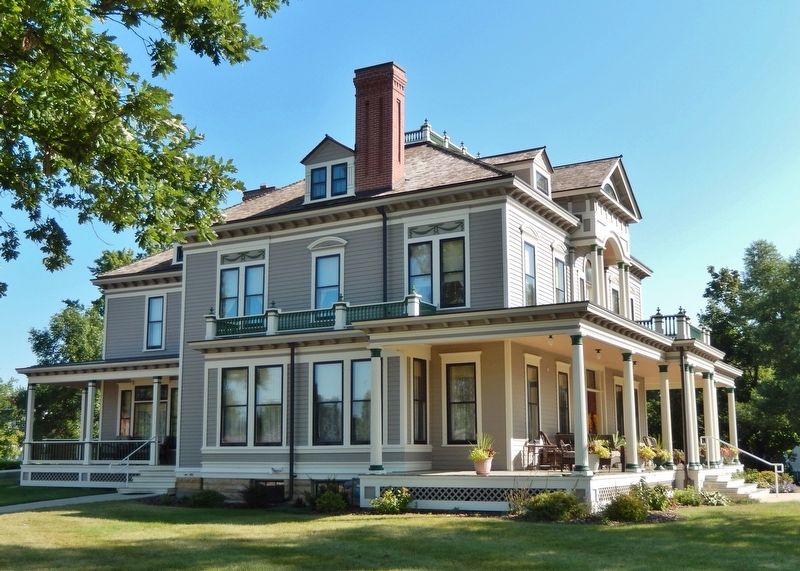
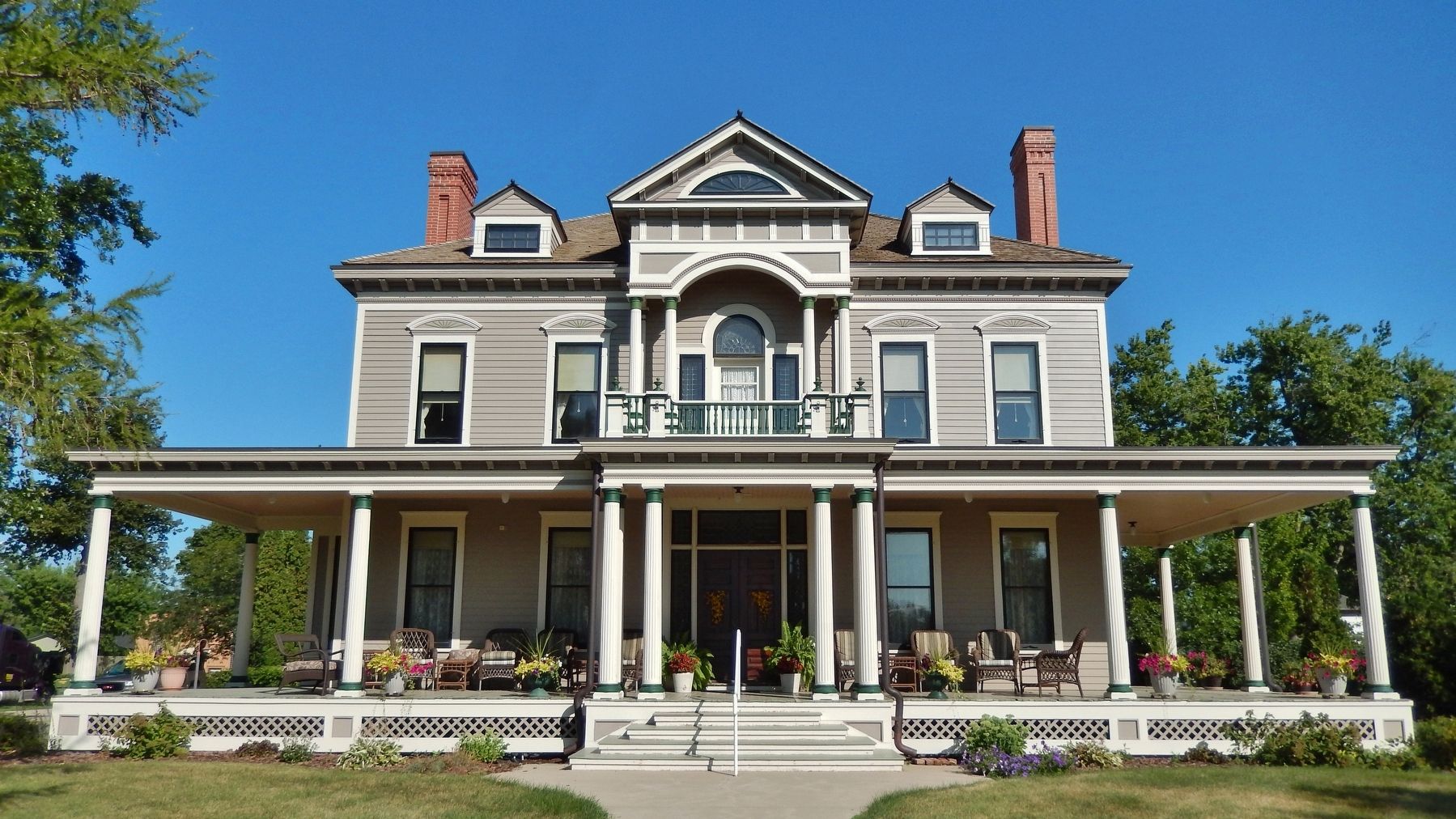
Dayton House (marker south side) . . . . Worthington banker and real estate developer George Draper Dayton commissioned this home for his family of six. The Historic Dayton House was constructed over four months during the summer of 1890 for a cost estimated to be less than $20,000. Designed by Wallace Dow , a leading architect with several prominent Sioux Falls, S.D., buildings to his credit , the house is a Georgian Colonial Revival structure that reflects the New England upbringing of both Dow and Dayton. Distinctive features include a covered front porch supported by large Doric columns, decorative pilasters and dentil molding trim, a front entryway accented with leaded glass sidelights, a side porch and a widows walk. The interior boasts 10-foot ceilings, oak/cherry pocket doors, five fireplaces, and a central open staircase., Owned until 1902 by Dayton, the house was later occupied by three different families: the Smallwoods (1902-1931), the Cashels (1932-1991) and the Gjertsens (1992-2001). After decades of use as a nursing home/boarding house (1940s through about 1990), many of the homes original features had been obscured. Historic Worthington, Inc., with the encouragement of George Drapers grandson, Bruce Dayton, and the generous support of the Dayton family and the Target Corporation, completely restored the structure beginning in 2002. Since the projects completion in 2004, the Historic Dayton House has been used as a community gathering place for hosting public and private events.,
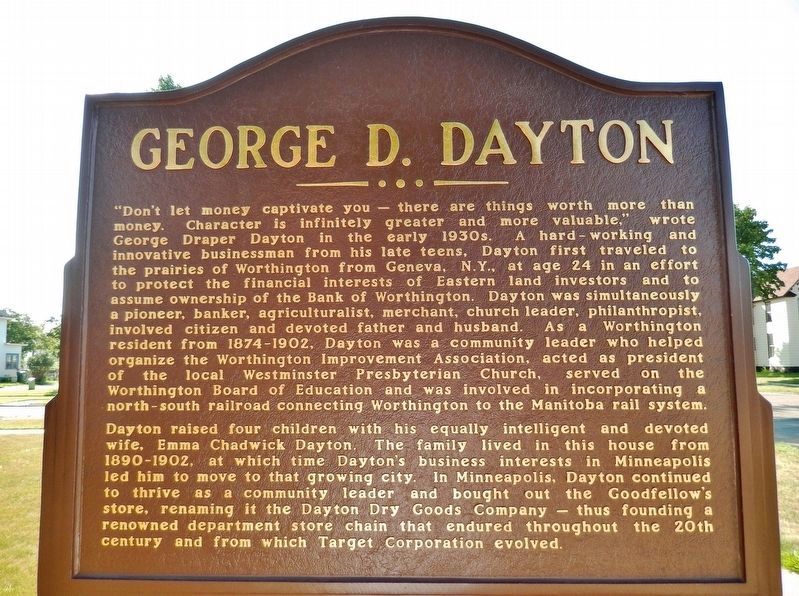
George D. Dayton (marker north side) . . . . "Don't let money captivate you there are things worth more than money. Character is infinitely greater and more valuable," wrote George Draper Dayton in the early 1930s. A hard-working and innovative businessman from his late teens, Dayton first traveled to the prairies of Worthington from Geneva, N.Y., at age 24 in an effort to protect the financial interests of Eastern land investors and to assume ownership of the Bank of Worthington. Dayton was simultaneously a pioneer, banker, agriculturalist, merchant, church leader, philanthropist, involved citizen and devoted father and husband. As a Worthington resident from 1874-1902, Dayton was a community leader who helped organize the Worthington Improvement Association, acted as president of the local Westminster Presbyterian Church, served on the Worthington Board of Education and was involved in incorporating a north-south railroad connecting Worthington to the Manitoba rail system., Dayton raised four children with his equally intelligent and devoted wife, Emma Chadwick Dayton. The family lived in this house from 1890-1902, at which time Dayton's business interests in Minneapolis led him to move to that growing city. In Minneapolis, Dayton continued to thrive as a community leader and bought out the Goodfellow's store, renaming it the Dayton Dry Goods Company , thus founding a renowned department store chain that endured throughout the 20th century and from which Target Corporation evolved.
Dayton House (marker south side)
Worthington banker and real estate developer George Draper Dayton commissioned this home for his family of six. The Historic Dayton House was constructed over four months during the summer of 1890 for a cost estimated to be less than $20,000. Designed by Wallace Dow — a leading architect with several prominent Sioux Falls, S.D., buildings to his credit — the house is a Georgian Colonial Revival structure that reflects the New England upbringing of both Dow and Dayton. Distinctive features include a covered front porch supported by large Doric columns, decorative pilasters and dentil molding trim, a front entryway accented with leaded glass sidelights, a side porch and a widows walk. The interior boasts 10-foot ceilings, oak/cherry pocket doors, five fireplaces, and a central open staircase.
Owned until 1902 by Dayton, the house was later occupied by three different families: the Smallwoods (1902-1931), the Cashels (1932-1991) and the Gjertsens (1992-2001). After decades of use as a nursing home/boarding house (1940s through about 1990), many of the homes original features
Click or scan to see this page online
had been obscured. Historic Worthington, Inc., with the encouragement of George Drapers grandson, Bruce Dayton, and the generous support of the Dayton family and the Target Corporation, completely restored the structure beginning in 2002. Since the projects completion in 2004, the Historic Dayton House has been used as a community gathering place for hosting public and private events.
George D. Dayton (marker north side)
"Don't let money captivate you there are things worth more than money. Character is infinitely greater and more valuable," wrote George Draper Dayton in the early 1930s. A hard-working and innovative businessman from his late teens, Dayton first traveled to the prairies of Worthington from Geneva, N.Y., at age 24 in an effort to protect the financial interests of Eastern land investors and to assume ownership of the Bank of Worthington. Dayton was simultaneously a pioneer, banker, agriculturalist, merchant, church leader, philanthropist, involved citizen and devoted father and husband. As a Worthington resident from 1874-1902, Dayton was a community leader who helped organize the Worthington Improvement Association,
Photographed by Cosmos Mariner, August 19, 2014
2. George D. Dayton (marker north side)
acted as president of the local Westminster Presbyterian Church, served on the Worthington Board of Education and was involved in incorporating a north-south railroad connecting Worthington to the Manitoba rail system.
Dayton raised four children with his equally intelligent and devoted wife, Emma Chadwick Dayton. The family lived in this house from 1890-1902, at which time Dayton's business interests in Minneapolis led him to move to that growing city. In Minneapolis, Dayton continued to thrive as a community leader and bought out the Goodfellow's store, renaming it the Dayton Dry Goods Company — thus founding a renowned department store chain that endured throughout the 20th century and from which Target Corporation evolved.
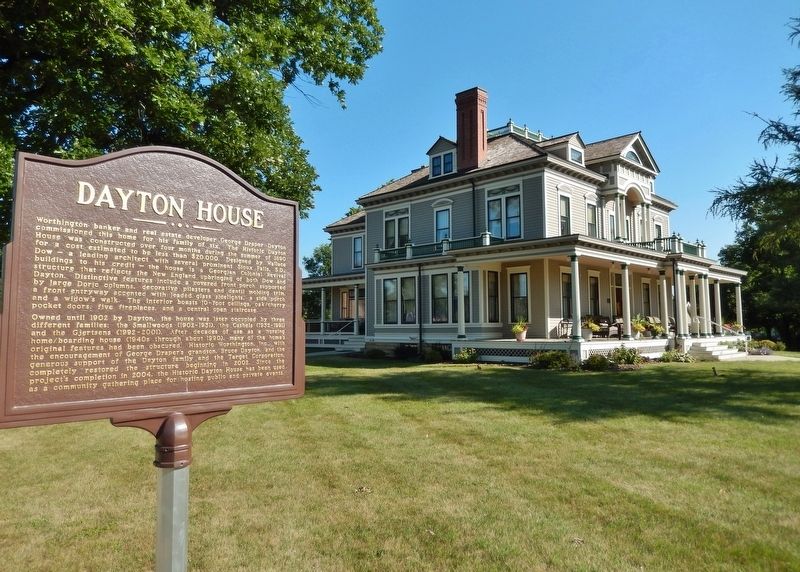
Location. 43° 37.373′ N, 95° 35.637′ W. Marker is in Worthington, Minnesota, in Nobles County. It is on 13th Street just north of 4th Avenue, on the right when traveling north. Marker is located near the sidewalk, overlooking
Photographed by Cosmos Mariner, August 19, 2014
3. Dayton House / George D. Dayton Marker

(Dayton House in background)
the southwest corner of the Dayton House. Touch for map. Marker is at or near this postal address: 1311 4th Avenue, Worthington MN 56187, United States of America. Touch for directions.
Regionally, this marker is in Southwest Minnesota. It is also in the American Midwest and in the Corn Belt. Globally, it is in North America, the Western Hemisphere, the Western World, and the Anglosphere. Historically, it finds itself in what was once Ruperts Land, the territory of the Mississippian Culture, and the Louisiana Purchase.
Regarding Dayton House / George D. Dayton. National Register of Historic Places #03001336.
Also see . . . 1. The Historic Dayton House. It is unique both in the time of its grand appearance in a small prairie town in the late 1800s and in its ownership for well over a century. Three families related through business, blood, and marriage — the Daytons, the Smallwoods, and the Cashels — owned and lived in the house over time. (Submitted on October 12, 2020, by Cosmos Mariner of Cape Canaveral, Florida.)
2. George Draper Dayton (Wikipedia). His family was one of average means and he had hoped to become a minister, but was lured into the business world. He married Emma Chadwick in 1878 and began buying farm mortgages in southwest Minnesota. In 1883 he and his family moved to Worthington, Minnesota where he was able to build wealth in the growing economy. (Submitted on October 12, 2020, by Cosmos Mariner of Cape Canaveral, Florida.)
Photographed by Cosmos Mariner, August 19, 2014
5. George D. Dayton House (west elevation)
Photographed by Cosmos Mariner, August 19, 2014
6. Dayton House (front/south elevation)
Credits. This page was last revised on August 6, 2021. It was originally submitted on October 12, 2020, by Cosmos Mariner of Cape Canaveral, Florida. This page has been viewed 788 times since then and 26 times this year. Photos:1, 2, 3, 4, 5, 6. submitted on October 12, 2020, by Cosmos Mariner of Cape Canaveral, Florida.