Chester in Liberty County, Montana — The American West (Mountains)
A Pleistocene Wonderland
Photographed by Barry Swackhamer, August 22, 2020
1. A Pleistocene Wonderland Marker
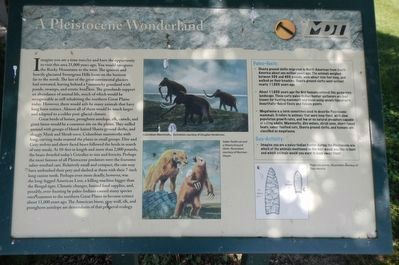
Captions: (top center) Columbian Mammoths; (bottom center) Saber-Toothed cat and a Shasta Ground Sloth; (bottom right) Projectile points; Clovis (L), Folsom ®.
Great herds of horses, pronghorn antelope, elk, camels, and giant bison would be a common site on the plains. The milled around with groups of blond-haired Shasta ground sloths, and shaggy Musk and Shrub oxen. Columbian mammoths with long, curving tusks roamed the plains in small groups. Dire and Gray wolves and short-faced bears followed the herds in search of easy meals. At 10-feet in length and more than 2,000 pounds the bears dwarfed today's Grizzlies in size
this page online
Paleo-Facts:
Shasta ground sloths migrated to North America from South America about one million years ago. The animals weighted between 300 and 400 pounds, were about nine feet long, and walked on their knuckles. Shasta ground sloths went extinct nearly 11,000 years ago.
About 11,000 years ago the first humans entered this game-rich landscape. These early paleo-Indian hunter-gatherers are best known for hunting mammoths and bison using spears tipped with beautifully-flaked Clovis and Folsom points.
Megafauna
Photographed by Barry Swackhamer, August 22, 2020
2. A Pleistocene Wonderland Marker
Geo-Activity:
Imagine you are a paleo-Indian hunter during the Pleistocene era, which of the animals mentioned in the text would you like to hunt and which animals would you what to keep away from?
Erected by Montana Department of Transportation.
Topics. This historical marker is listed in these topic lists: Animals • Paleontology.
Location. 48° 30.848′ N, 110° 57.621′ W. Marker is in Chester, Montana, in Liberty County. It is on Washington Avenue (U.S. 2) near 3rd Street East, on the left when traveling east. The marker is in Lions Park Rest Area. Touch for map. Marker is at or near this postal address: 313 Washington Avenue, Chester MT 59522, United States of America. Touch for directions.

Regionally, this marker is in the American Mountain West and in the Lewis & Clark Corridor. Globally, it is in North America, the Western Hemisphere, the Western World, and the Anglosphere. Historically, it finds itself in what was once Rupert’s Land and also the Louisiana Purchase.
Other nearby markers. At least 2 other markers are within 5 miles of this marker, measured as the crow flies: First State Bank of Chester (approx. 0.2 miles away); The Sweet Grass Hills (approx. 5.1 miles away).
Additional commentary.
1. Nature Marker
While this entry has been included in the Database, signage exclusively interpreting natural history are no longer included in general.
— Submitted December 27, 2024, by Devry Becker Jones of Washington, District of Columbia.
Credits. This page was last revised on December 27, 2024. It was originally submitted on December 2, 2020, by Barry Swackhamer of Brentwood, California. This page has been viewed 443 times since then and 43 times this year. Photos: 1, 2. submitted on December 2, 2020, by Barry Swackhamer of Brentwood, California.
