Downtown Austin in Travis County, Texas — The American South (West South Central)
Post Reconstruction Challenges and Achievements
1877-1954
Photographed by Larry D. Moore, December 16, 2020
1. Post Reconstruction Challenges and Achievements Marker
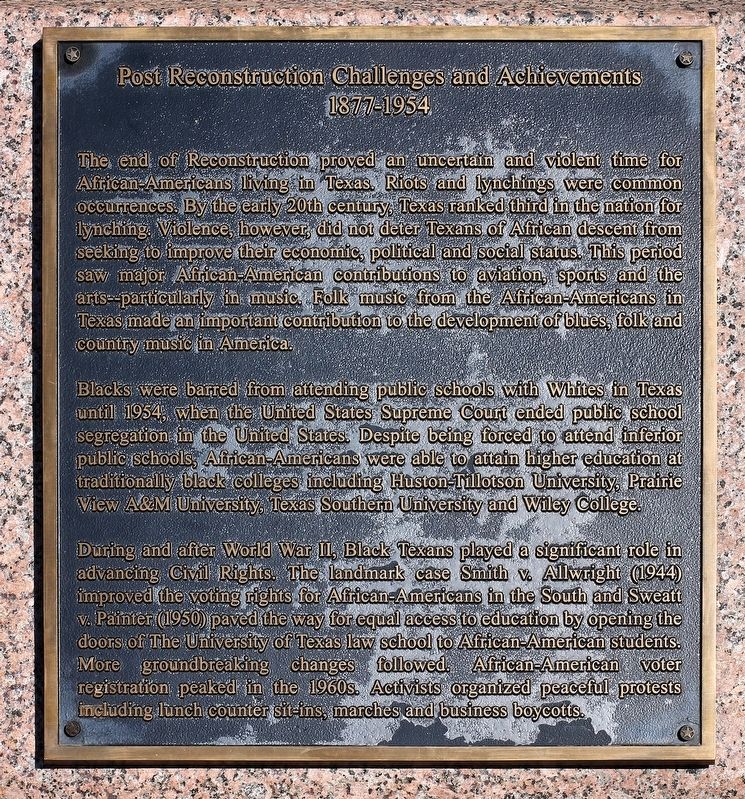
The end of Reconstruction proved an uncertain and violent time for African-Americans living in Texas. Riots and lynchings were common occurrences. By the early 20th century, Texas ranked third in the nation for lynching. Violence, however, did not deter Texans of African descent from seeking to improve their economic, political and social status. This period saw major African-American contributions to aviation, sports and the arts--particularly in music. Folk music from the African-Americans in Texas made an important contribution to the development of blues, folk and country music in America.
Blacks were barred from attending public schools with Whites in Texas until 1954, when the United States Supreme Court ended public school segregation in the United States. Despite being forced to attend inferior public schools, Africans-Americans were able to attain higher education at traditionally black colleges including Huston-Tillotson University, Prairie View A&M University, Texas Southern University and Wiley College.
During and after World War I, Black Texans played a significant role in advancing Civil Rights. The
this page online
Erected 2016 by the Texas African American History Memorial Foundation.
Topics. This historical marker is listed in this topic list: African Americans. A significant historical year for this entry is 1954.
Location. 30° 16.397′ N, 97° 44.488′ W. Marker is in Austin, Texas, in Travis County. It is in Downtown Austin. It is at the intersection of West 11th Street and Congress Avenue, on the right when traveling west on West 11th Street. The marker is on the grounds of the Texas State Capitol. Touch for map. Marker is in this post office area: Austin TX 78701, United States of America. Touch for directions.

Regionally, this marker is in Central Texas. It is also in the American
Photographed by Larry D. Moore, December 16, 2020
2. Texas African American History Memorial
Other nearby markers. At least 8 other markers are within walking distance of this marker: Major Achievements (here, next to this marker); Reconstruction and the Post Slavery Experience (here, next to this marker); Civil War, Emancipation and Juneteenth (here, next to this marker); Slavery During the Republic and Early Statehood (here, next to this marker); Hendrick Arnold and Samuel McCulloch, Jr. (here, next to this marker); Slavery During the Mexican National Era (here, next to this marker); The 21st Century (here, next to this marker); First Contact and the Spanish Colonial Era (here, next to this marker). Touch for a list and map of all markers in Austin.
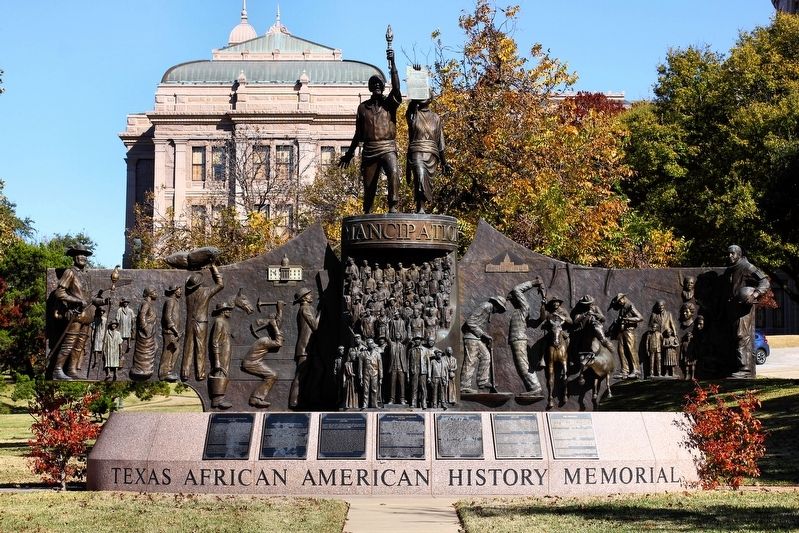
More about this marker. The marker is one of ten markers on the Texas African American History Memorial. The monument honors the many contributions of African Americans in Texas. The markers trace the history of African Americans from the 1500s to the present.
Credits. This page was last revised on February 1, 2023. It was originally submitted on December 20, 2020, by Larry D. Moore of Del Valle, Texas. This page has been viewed 303 times since then and 36 times this year. Photos: 1, 2. submitted on December 20, 2020, by Larry D. Moore of Del Valle, Texas.
