Miles City in Custer County, Montana — The American West (Mountains)
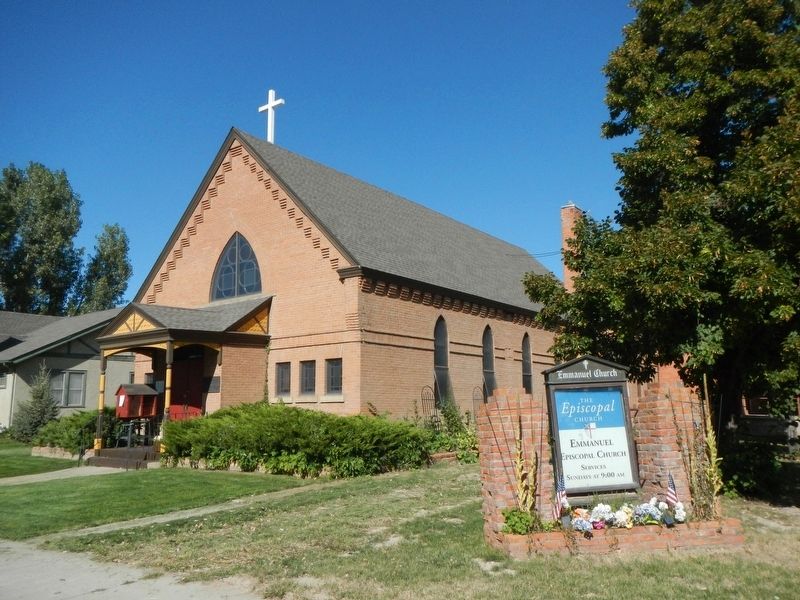
Emmanuel Church
Carriage House Historic District
Photographed by Barry Swackhamer, September 11, 2020
1. Emmanuel Church Marker
Inscription.
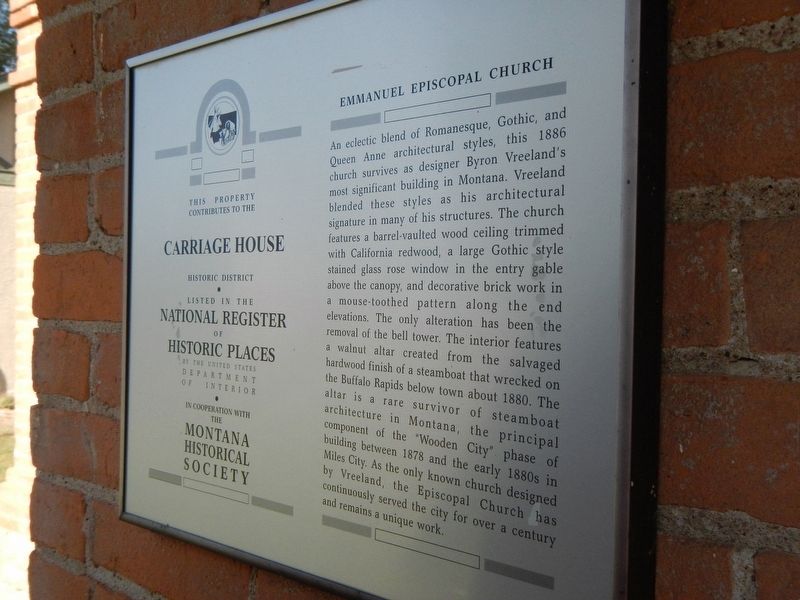
Emmanuel Church. Carriage House Historic District. An eclectic blend of Romanesque, Gothic, and Queen Anne architectural styles, this 1886 church survives as designer Byron Vreelands most significant building in Montana. Vreeland blended these styles as his architectural signature in many of his structures. The church features a barrel-vaulted wood ceiling trimmed with California redwood, a large Gothic style stained glass rose window in the entry gable above the canopy, and decorative brick work in a mouse-toothed pattern along the end elevations. The only alteration has been the removal of the bell tower. The interior features a walnut altar created from the salvaged hardwood finish of a steamboat that wrecked on the Buffalo Rapids below town about 1880. The altar is a rare survivor of steamboat architecture in Montana, the principal component of the “Wooden City” phase of building between 1878 and the early 1880s in Miles City. As the only known church designed by Vreeland, the Episcopal Church has continuously served the city for over a century and remains a unique work.
An eclectic blend of Romanesque, Gothic, and Queen Anne architectural styles, this 1886 church survives as designer Byron Vreelands most significant building in Montana. Vreeland blended these styles as his architectural signature in many of his structures. The church features a barrel-vaulted wood ceiling trimmed with California redwood, a large Gothic style stained glass rose window in the entry gable above the canopy, and decorative brick work in a mouse-toothed pattern along the end elevations. The only alteration has been the removal of the bell tower. The interior features a walnut altar created from the salvaged hardwood finish of a steamboat that wrecked on the Buffalo Rapids below town about 1880. The altar is a rare survivor of steamboat architecture in Montana, the principal component of the “Wooden City” phase of building between 1878 and the early 1880s in Miles City. As the only known church designed by Vreeland, the Episcopal Church has continuously served the city for over a century and remains a unique work.
Location. 46° 24.619′ N, 105° 50.749′ W. Marker is in Miles City, Montana, in Custer County. It is at the intersection of North 11th Street and Palmer Street, on the right when traveling north on North 11th Street. Touch for map. Marker is at or near this postal address: 204 North 11th Street, Miles City MT 59301, United States of America. Touch for directions.

Regionally, this marker is in Southeast Montana, in Custer Country and in the Powder River Basin. It is also in the American Mountain West, in the Lewis & Clark Corridor, on the prairies, on the Great Plains, and specifically on the Northern Plains. Globally, it is in North America, the Western Hemisphere, the Western World, and the Anglosphere. Historically, it finds itself in what was once Ruperts Land and also the Louisiana Purchase.
Photographed by Barry Swackhamer, September 11, 2020
2. Emmanuel Church Marker
The marker is on the porch to the left of the entrance.
Photographed by Barry Swackhamer, September 11, 2020
3. Emmanuel Church Marker
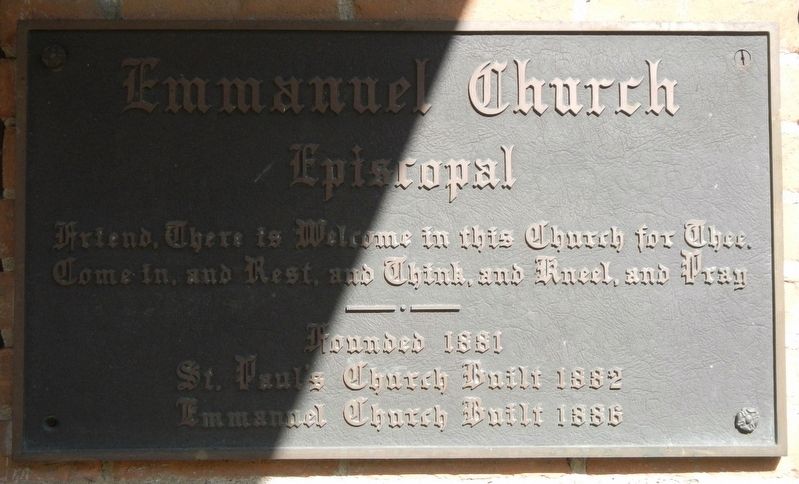
Episcopal
Friend, There is Welcome in this Church for Thee,
Come in and Rest, and Think, and Kneel, and Pray
Founded 1881
St. Paul's Church Built 1882
Emmanuel Church Built 1886
Credits. This page was last revised on January 3, 2021. It was originally submitted on January 3, 2021, by Barry Swackhamer of Brentwood, California. This page has been viewed 376 times since then and 16 times this year. Photos:1, 2, 3. submitted on January 3, 2021, by Barry Swackhamer of Brentwood, California.