Billings in Yellowstone County, Montana — The American West (Mountains)
Losekamp Block
Billings Old Town Historic District
Photographed by Barry Swackhamer, September 15, 2020
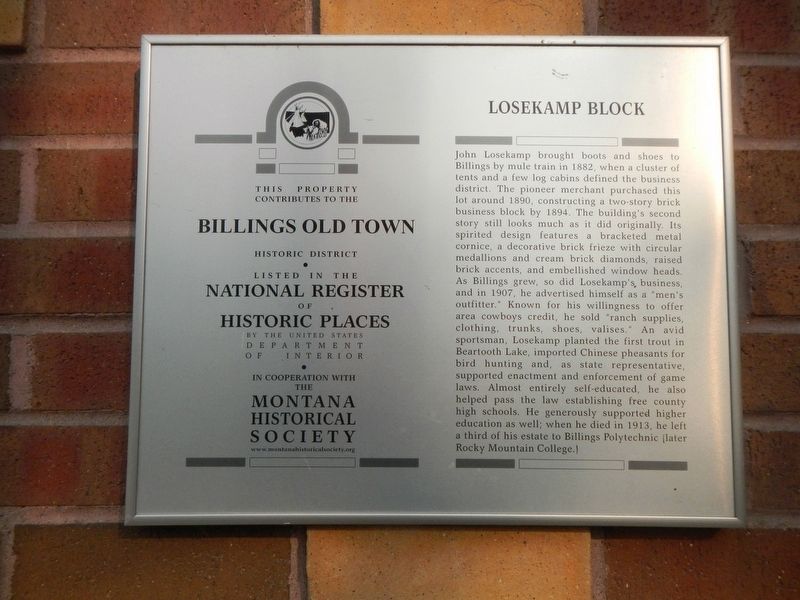
1. Losekamp Block Marker
Inscription.
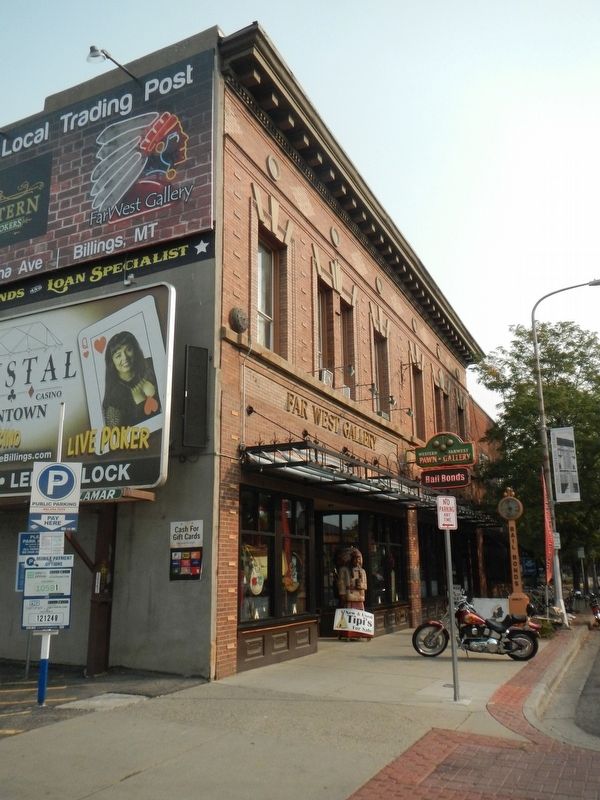
John Losekamp brought boots and shoes to Billings by mule train in 1882, when a cluster of tents and a few log cabins defined the business district. The pioneer merchant purchased this lot around 1890, constructing a two- story brick business block by 1894. The building’s second story still looks much as it did originally. Its spirited design features a bracketed metal cornice, a decorative brick frieze with circular medallions and cream brick diamonds, raised brick accents, and embellished window heads. As Billings grew, so did Losekamp’s business, and in 1907, he advertised himself as a “men’s outfitter.” Known for his willingness to offer area cowboys credit, he sold “ranch supplies, clothing, trunks, shoes, valises.” An avid sportsman, Losekamp planted the first trout in Beartooth Lake, imported Chinese pheasants for bird hunting and, as state representative, supported enactment and enforcement of game laws. Almost entirely self-educated, he also helped pass the law establishing free county high schools. He generously supported higher education as well; when he died in 1913, he left a third of
Click or scan to see this page online
his estate to Billings Polytechnic (later Rocky Mountain College.)
Location. 45° 46.857′ N, 108° 30.346′ W. Marker is in Billings, Montana, in Yellowstone County. It is on Montana Avenue (Business Interstate 90) near North 29th Street, on the left when traveling east. Touch for map. Marker is at or near this postal address: 2817 Montana Avenue, Billings MT 59101, United States of America. Touch for directions.
Regionally, this marker is in Yellowstone Country. It is also in the American Mountain West and in the Lewis & Clark Corridor. Globally, it is in North America, the Western Hemisphere, the Western World, and the Anglosphere. Historically, it finds itself in what was once Rupert’s Land and also the Louisiana Purchase.
Other nearby markers. At least 8 other markers are within walking distance of this
Photographed by Barry Swackhamer, September 15, 2020
Photographed by Barry Swackhamer, September 15, 2020
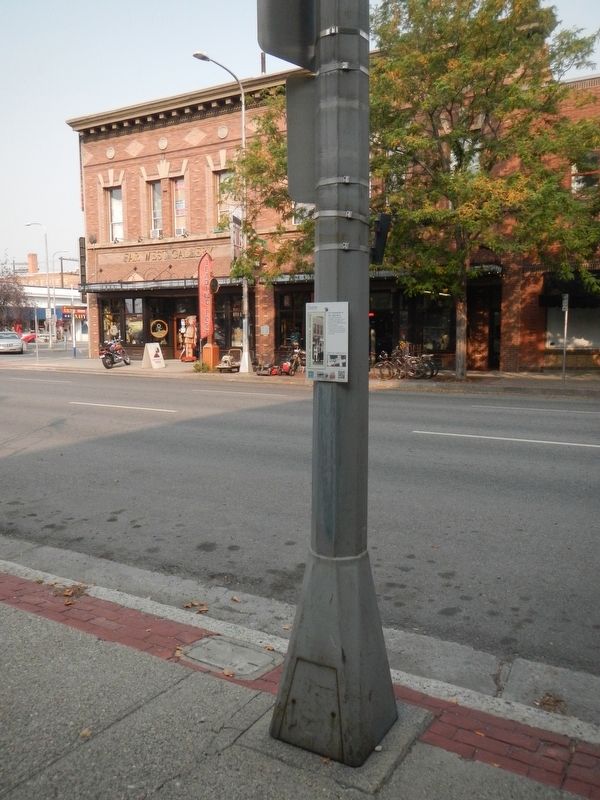
3. Losekamp Block, visible in the background
Credits. This page was last revised on February 1, 2021. It was originally submitted on February 1, 2021, by Barry Swackhamer of Brentwood, California. This page has been viewed 1,190 times since then and 856 times this year. Photos:1, 2, 3. submitted on February 1, 2021, by Barry Swackhamer of Brentwood, California.