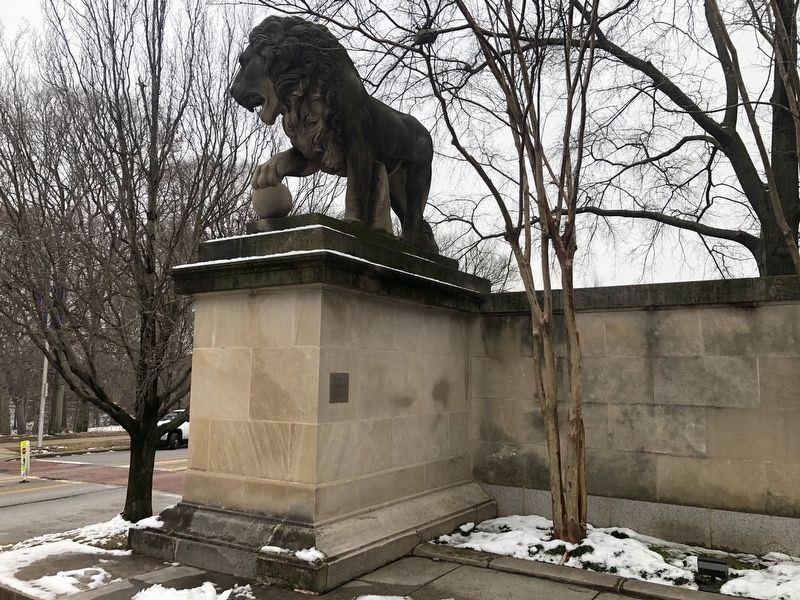
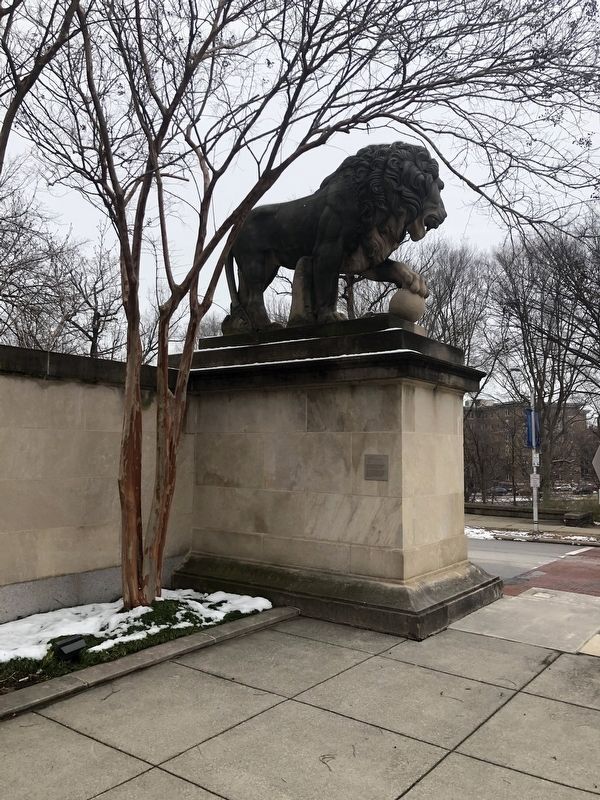
Lion
c. 1929, Limestone
| — | Charles Klutch, American, 1871-1951, after Adolph A. Weinman, American, 1870-1952 | — |
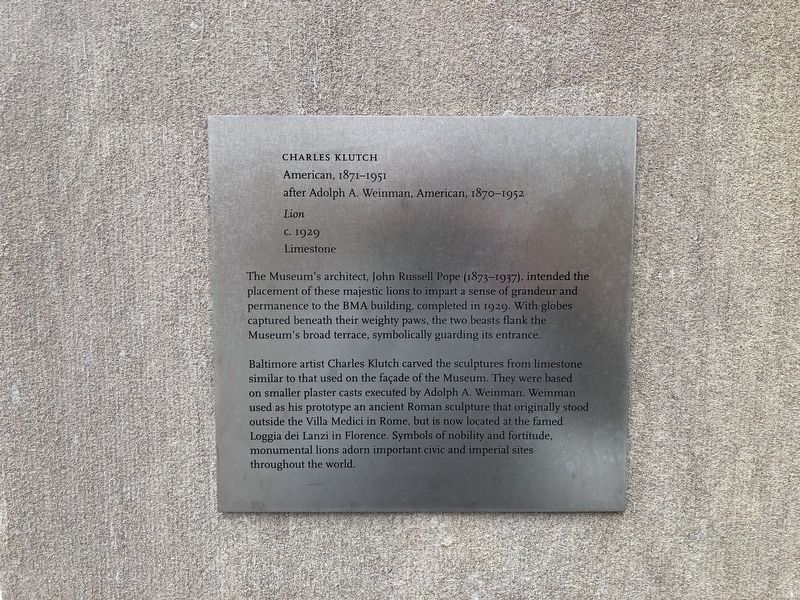
The Museum's architect, John Russell Pope (1873-1937), intended the placement of these majestic lions to impart a sense of grandeur and permanence to the BMA building, completed in 1929. With globes captured beneath their weighty paws, the two beasts flank the Museum's broad terrace, symbolically guarding its entrance.
Baltimore artist Charles Klutch carved the sculptures from limestone similar to that used on the façade of the Museum. They were based on smaller plaster casts executed by Adolph A. Weinman. Weinman used as his prototype an ancient Roman sculpture that originally stood outside the Villa Medici in Rome, but is now located at the famed Loggia dei Lanzi in Florence. Symbols of nobility and fortitude, monumental lions adorn important civic and imperial sites throughout the world.
Erected by Baltimore Museum of Art.
Topics. This historical marker is listed in these topic lists: Animals • Architecture • Arts, Letters, Music. A significant historical year for this entry is 1929.
Location. 39° 19.51′ N, 76° 37.179′ W. Marker is in Baltimore, Maryland. It is in Johns Hopkins Homewood. It can be reached
this page online

Regionally, this marker is in Central Maryland. It is also in the American Mid-Atlantic, in the Chesapeake Bay Region, and on the Eastern Seaboard. Globally, it is in the North Atlantic Region, North America, the Western Hemisphere, the Western World, and the Anglosphere. Historically, it finds itself in what was once one of the original Thirteen Colonies and also the Antebellum South.
Other nearby markers. At least 8 other markers are within walking distance of this marker: Spring House or Dairy - c. 1812 (within shouting distance of this marker); Joseph Beuys Tree Partnership (within shouting distance of this marker); Harriet Tubman Grove (about 300 feet away); Robert E. Lee and Thomas. J. “Stonewall” Jackson Monument (about 300 feet away); Chapin A. Harris (about 400 feet away); Charles Street at Wyman Park Dell (about 500 feet away); Wyman Park Dell (about 500 feet away); a different marker
Another marker is no longer nearby. Lee Jackson Monument (was about 300 feet away, measured in a direct line but has been replaced with another marker now near it).
Additional keywords. Lion
Credits. This page was last revised on February 16, 2021. It was originally submitted on February 15, 2021, by Devry Becker Jones of Washington, District of Columbia. This page has been viewed 737 times since then and 72 times this year. Photos: 1, 2, 3. submitted on February 15, 2021, by Devry Becker Jones of Washington, District of Columbia.
