Rock Hill in York County, South Carolina — The American South (South Atlantic)
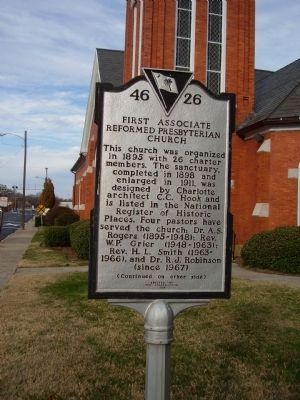
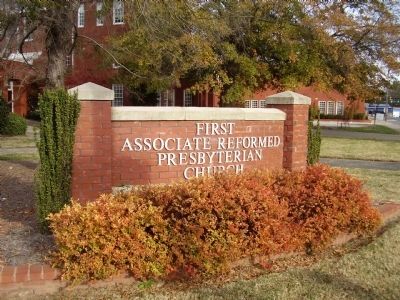
First Associate Reformed Presbyterian Church
⎯⎯⎯
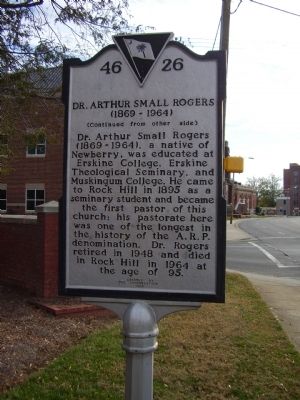
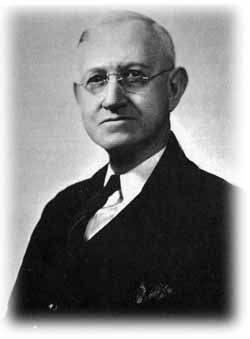
Dr. Arthur Small Rogers
(1869 - 1964)
Photographed by Stanley and Terrie Howard, October 12, 2008
1. First Associate Reformed Presbyterian Church Marker
First Associate Reformed Presbyterian Church. This church was organized in 1895 with 26 charter members. The sanctuary, completed in 1898 and enlarged in 1911, was designed by Charlotte architect C.C. Hook and is listed in the National Register of Historic Places. Four pastors have served the church: Dr. A.S. Rogers (1895-1948); Rev. W.P. Grier (1948-1963); Rev. H.L. Smith (1963-1966), and Dr. R.J. Robinson (since 1967).
Dr. Arthur Small Rogers (1869-1964). Dr. Arthur Small Rogers (1869-1964), a native of Newberry, was educated at Erskine College, Erskine Theological Seminary, and Muskingum College. He came to Rock Hill in 1895 as a seminary student and became the first pastor of this church; his pastorate here was one of the longest in the history of the A.R.P. denomination. Dr. Rogers retired in 1948 and died in Rock Hill in 1964 at the age of 95.
Erected 1996 by South Carolina Department of Archives and History, sponsored by the Congretion of First Associate Reformed Presbyterian Church. (Marker Number 46-26.)
Topics and series. This historical marker is listed in this topic list: Religion & Religious Structures.
this page online
Location. 34° 55.583′ N, 81° 1.445′ W. Marker is in Rock Hill, South Carolina, in York County. It is at the intersection of South Oakland Avenue and East White Street (South Carolina Highway 245), on the right when traveling north on South Oakland Avenue. Touch for map. Marker is at or near this postal address: 201 East White Street, Rock Hill SC 29732, United States of America. Touch for directions.

Regionally, this marker is in the Midlands and in the Olde English District. It is also in the American South and specifically in the Deep South. Globally, it is in North America, the Western Hemisphere, the Western World, and the Anglosphere. Historically, it finds itself in what was once the original Cherokee Nation, the territory of the Mississippian Culture, one of the original Thirteen Colonies, one of the Confederate States of America, and the Antebellum South.
Other nearby markers. At least 10 other markers are within walking distance of this marker: Episcopal Church of Our Saviour (within
Photographed by Stanley and Terrie Howard, October 12, 2008
2. Dr. Arthur Small Rogers Marker
More about this marker. The First Associate Reformed Presbyterian Church is located in the Rock Hill Downtown Historic District.
Also see . . . Rock Hill Downtown Historic District. The Rock Hill Downtown Historic District contains twelve contributing buildings that are of importance to the growth and development of the City of Rock Hill. (Submitted on January 17, 2010, by Brian Scott of Anderson, South Carolina.)
Additional commentary.
1. First Associate Reformed Presbyterian Church, 201 East White Street
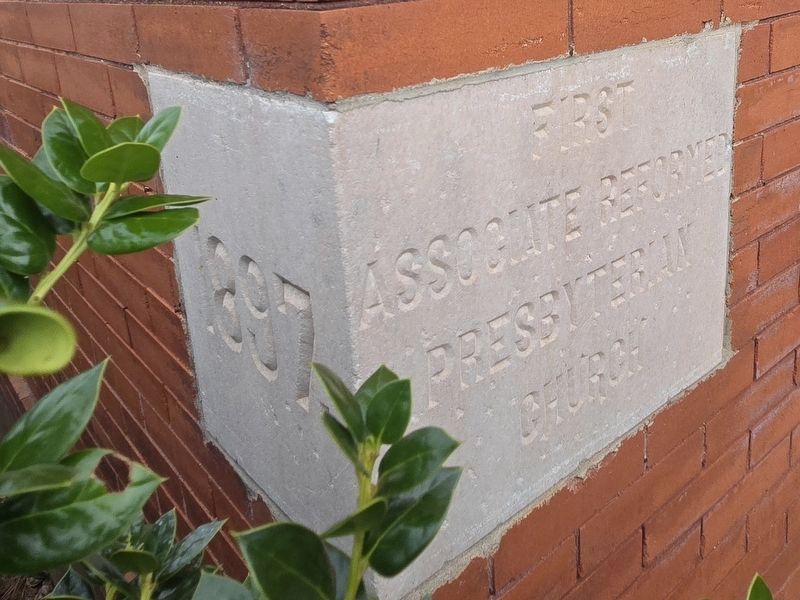
This congregation, organized in 1895, built the sanctuary in 1897-98. In
Photographed by Stanley and Terrie Howard, October 12, 2008
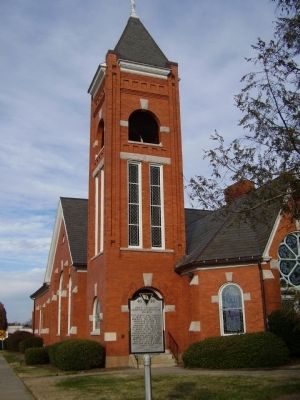
3. First Associate Reformed Presbyterian Church
Photographed by Stanley and Terrie Howard, October 12, 2008
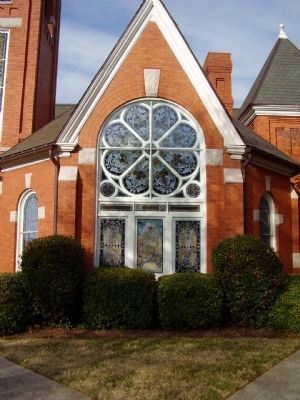
4. First Associate Reformed Presbyterian Church
— Submitted January 17, 2010, by Brian Scott of Anderson, South Carolina.
Photographed by Stanley and Terrie Howard, October 12, 2008
5. First Associate Reformed Presbyterian Church
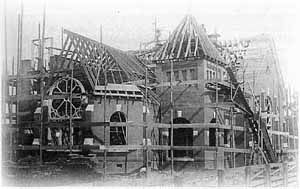
circa 1898
6. First Associate Reformed Presbyterian Church
Funds were raised throughout the denomination, with many churches and individuals giving gifts for the construction of the church.
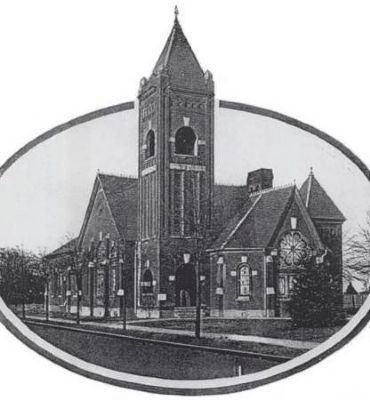
Rock Hill, South Carolina: Gateway to the New South by J. Edward Lee, Anne E. Beard
7. First Associate Reformed Presbyterian Church
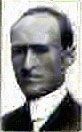
Courtesy of Charlotte-Mecklenburg Historic Landmarks Commission, 2009
8. Architect Charles Christian Hook
Courtesy of First Associate Reformed Presbyterian Church
9. Dr. Arthur Small Rogers
(1869-1964)
(1869-1964)
Upon graduation from the Seminary in the spring of 1896, Arthur Rogers was called to serve a term of five years as pastor of the young Rock Hill church. He almost immediately began planning for the construction of a church building.

Photographed by Mark Parker, September 25, 2025
10. Close-up First Associate Reformed Presbyterian Church marker side

Photographed by Mark Parker, September 25, 2025
11. Close-up Dr. Arthur Small Rogers Marker side
Photographed by Mark Parker, September 25, 2025
12. First Associate Reformed Presbyterian Church 1897 cornerstone
Credits. This page was last revised on January 25, 2026. It was originally submitted on March 5, 2009, by Stanley and Terrie Howard of Greer, South Carolina. This page has been viewed 1,901 times since then and 43 times this year. Photos: 1, 2, 3, 4, 5. submitted on March 5, 2009, by Stanley and Terrie Howard of Greer, South Carolina. 6. submitted on March 6, 2009, by Stanley and Terrie Howard of Greer, South Carolina. 7. submitted on January 17, 2010, by Brian Scott of Anderson, South Carolina. 8, 9. submitted on March 6, 2009, by Stanley and Terrie Howard of Greer, South Carolina. 10, 11, 12. submitted on September 27, 2025, by Mark Parker of Hickory, North Carolina. • Kevin W. was the editor who published this page.
