Petroleum Railway Tank Car
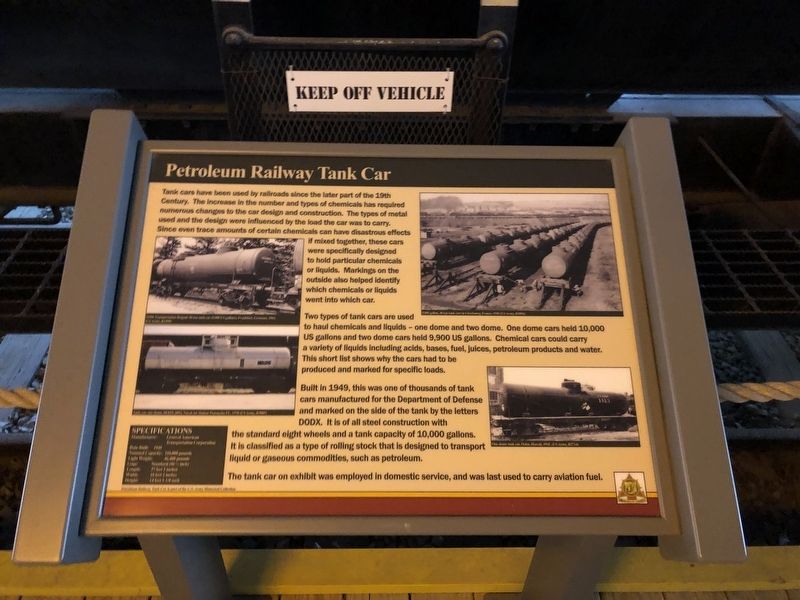
Tank cars have been used by railroads since the later part of the 19th Century. The increase in the number and types of chemicals has required numerous changes to the car design and construction. The types of metal used and the design were influenced by the load the car was to carry. Since even trace amounts of certain chemicals can have disastrous effects if mixed together, these cars were specifically designed to hold particular chemicals or liquids. Markings on the outside also helped identify which chemicals or liquids went into which car.
Two types of tank cars are used to haul chemicals and liquids - one dome and two dome. One dome cars held 10,000 US gallons and two dome cars held 9,900 US gallons. Chemical cars could carry a variety of liquids including acids, bases, fuel, juices, petroleum products and water. This short list shows why the cars had to be produced and marked for specific loads.
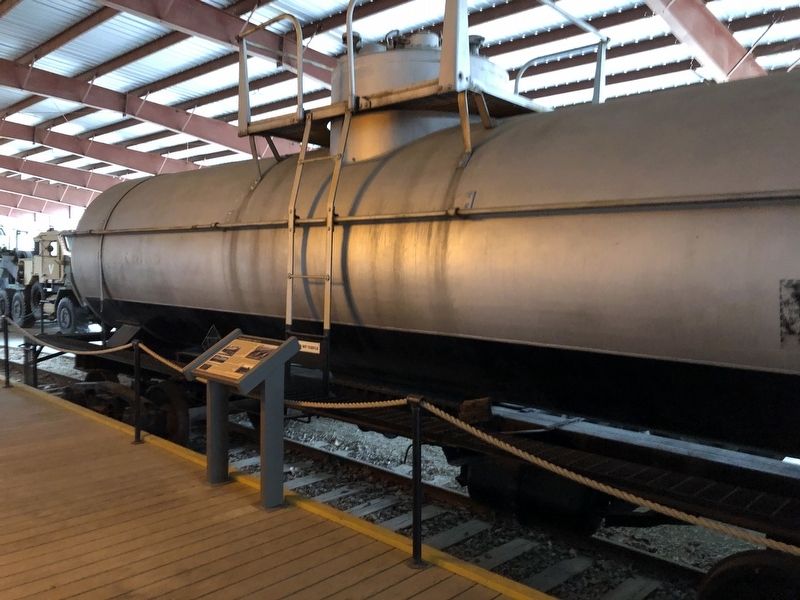
Built in 1949, this was one of thousands of tank cars manufactured for the Department of Defense and marked on the side of the tank by the letters DODX. It is of all steel construction with the standard eight wheels
this page online
The tank car on exhibit was employed in domestic service, and was last used to carry aviation fuel.
Erected by US Army Transportation Museum.
Topics. This historical marker is listed in this topic list: Railroads & Streetcars. A significant historical year for this entry is 1949.
Location. 37° 9.992′ N, 76° 34.474′ W. Marker is in Newport News, Virginia. It is in Fort Eustis. It can be reached from Washington Boulevard just south of Madison Avenue, on the right when traveling north. Touch for map. Marker is at or near this postal address: 300 Washington Blvd, Fort Eustis VA 23604, United States of America. Touch for directions.
Regionally, this marker is on Virginia’s Peninsula, in Hampton Roads, in Coastal Virginia, and in the Hampton Roads Metropolitan Area. It is also in the American South, specifically in the Upper South, in the Tidewater, and on the Eastern Seaboard. Globally, it is in the North Atlantic Region, North America, the Western Hemisphere,
Other nearby markers. At least 8 other markers are within walking distance of this marker: Wrecking Steam Locomotive Railway Crane (here, next to this marker); Berlin Duty Train - Passenger Coach (a few steps from this marker); M911, Tractor, 25 Ton, 8×6 (C-HET) (a few steps from this marker); Berlin Duty Train - Guard Car (a few steps from this marker); Diesel-Electric Locomotive, MRS-1 (a few steps from this marker); M747, Semitrailer, Heavy Equipment, 60 Tons (a few steps from this marker); M4A3, Tank, Medium, 75mm "Sherman" (a few steps from this marker); 40-ton Railway Flatcar (a few steps from this marker). Touch for a list and map of all markers in Newport News.
Credits. This page was last revised on February 1, 2023. It was originally submitted on February 28, 2021, by Devry Becker Jones of Washington, District of Columbia. This page has been viewed 485 times since then and 30 times this year. Photos: 1, 2. submitted on February 28, 2021, by Devry Becker Jones of Washington, District of Columbia.
