The Academy
“The site of it seemed to give me new life.”
| — | Hampton University | — |
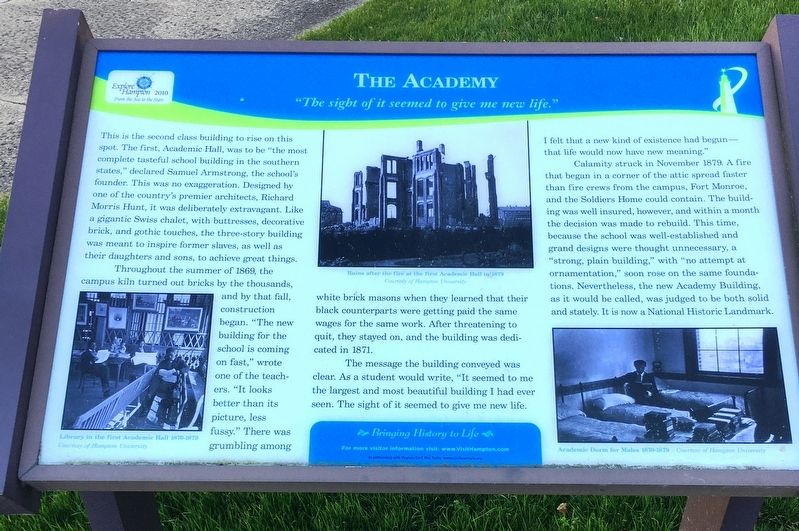
This is the second class building to rise on this spot. The first, Academic Hall, was to be “the most complete tasteful school building in the southern states,” declared Samuel Armstrong, the school’s founder. This was no exaggeration. Designed by one of the country’s premier architects, Richard Morris Hunt, it was deliberately extravagant. Like a gigantic Swiss chalet, with buttresses, decorative brick, and gothic touches., the three-story building was meant to inspire former slaves, as well as their daughters and sons, to achieve great things.
Throughout the summer of 1869, the campus kiln turned out bricks by the thousands, and by that fall, construction began. “The new building for the school is coming on fast,” wrote one of the teachers. “It looks better than its picture, less fussy.” There was grumbling among white brick masons when they learned that their black counterparts were getting paid the same wages for the same work. After threatening to quit, they stayed on, and the building was dedicated in 1871.
The message the building conveyed was clear. As a student would
this page online
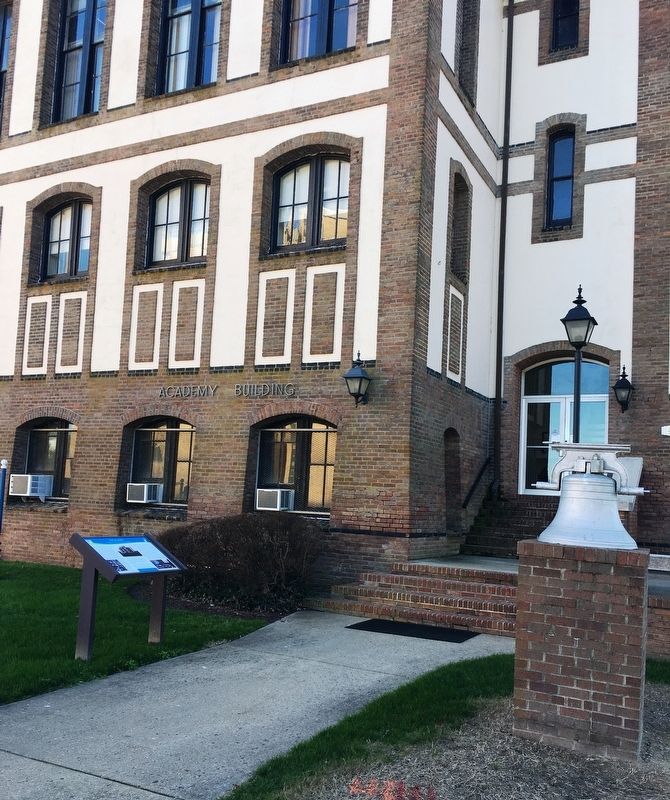
Calamity struck in November 1879. A fire that began in a corner of the attic spread faster than fire crews from the campus, Fort Monroe, and the Soldier’s Home could contain. The building was well insured, however, and within a month the decision was made to rebuild. This time, because the school was well-established and grand designs were thought unnecessary, “a strong plain building,” with “no attempt at ornamentation,” soon rose on the same foundations. Nevertheless, the new Academy Building , as it would be called, was judged to be both solid and stately. It is now a National Historic Landmark.
(captions)
Library in the first Academic Hall 1870-1879 Courtesy of Hampton University
Ruins after the fire at the first Academic Hall in 1879 Courtesy of Hampton University
Academic Dorn for Males 1870-1879 - Courtesy of Hampton University
Erected 2010 by Hampton Convention & Visitor
Topics and series. This historical marker is listed in these topic lists: African Americans • Education. In addition, it is included in the Historically Black Colleges and Universities series list.
Location. 37° 1.136′ N, 76° 20.339′ W. Marker is in Hampton, Virginia. It is in Phoebus. It is at the intersection of Marshall Avenue and Shore Road, on the left when traveling south on Marshall Avenue. The marker is located on the Hampton University campus. Touch for map. Marker is in this post office area: Hampton VA 23669, United States of America. Touch for directions.

Regionally, this marker is on Virginia’s Peninsula and in Coastal Virginia. It is also in the American South, specifically in the Upper South, in the Tidewater, and on the Eastern Seaboard. Globally, it is in the North Atlantic Region, North America, the Western Hemisphere, the Western World, and the Anglosphere. Historically, it finds itself in what was once the territory of the Mississippian Culture, one of the original Thirteen Colonies, one of the Confederate States of America, and the Antebellum South.
Other nearby markers. At least 8 other markers are within walking distance of this marker: Robert C. Ogden Auditorium (about 500 feet away, measured in a direct line); Wigwam (about 500 feet away); Hampton University Museum (about 700 feet away); Samuel Chapman Armstrong (approx. 0.2 miles away); Cemetery (approx. 0.2 miles away); The Ultimate Sacrifice (approx. 0.2 miles away); A National Cemetery System (approx. 0.2 miles away); Hampton National Cemetery (approx. 0.2 miles away). Touch for a list and map of all markers in Hampton.
Also see . . . Visit Hampton Virginia. Hampton Convention & Visitor Bureau (Submitted on March 1, 2021.)
Credits. This page was last revised on February 1, 2023. It was originally submitted on February 28, 2021, by Brandon D Cross of Flagler Beach, Florida. This page has been viewed 427 times since then and 60 times this year. Photos: 1, 2. submitted on February 28, 2021, by Brandon D Cross of Flagler Beach, Florida. • Bernard Fisher was the editor who published this page.
