Rock Hill in York County, South Carolina — The American South (South Atlantic)
Columbia Seminary Chapel
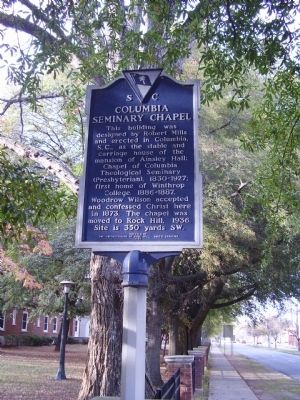
Photographed by Stanley and Terrie Howard, October 12, 2008
1. COLUMBIA SEMINARY CHAPEL Marker
This building was designed by Robert Mills and erected in Columbia, S.C., as the stable and carriage house of the mansion of Ainsley Hall; Chapel of Columbia Theological Seminary (Presbyterian), 1830-1927; first home of Winthrop College, 1886-1887. Woodrow Wilson accepted and confessed Christ here in 1873. The chapel was moved to Rock Hill, 1936. Site is 350 yards S.W.
Erected 1987 by South Carolina Department of Archives and History, sponsored by Presbyterians of Rock Hill, South Carolina. (Marker Number 46-7.)
Topics and series. This historical marker is listed in these topic lists: Education • Religion & Religious Structures. In addition, it is included in the Former U.S. Presidents: #28 Woodrow Wilson, and the South Carolina Historical Markers series lists. A significant historical year for this entry is 1873.
Location. 34° 56.498′ N, 81° 1.821′ W. Marker is in Rock Hill, South Carolina, in York County. It is on Oakland Avenue (U.S. 21). Touch for map. Marker is at or near this postal address: 1043 Founders Lane, Rock Hill SC 29731, United States of America. Touch for directions.

Regionally, this marker
this page online
Other nearby markers. At least 10 other markers are within walking distance of this marker: First Home of Winthrop College (approx. 0.2 miles away); McCorkle-Fewell-Long House / Oakland (approx. ¼ mile away); President's House (approx. 0.3 miles away); Armstrong-Mauldin House (approx. 0.4 miles away); Oakland Avenue Presbyterian Church (approx. 0.4 miles away); Wheels in Motion (approx. half a mile away); Jefferson Davis' Flight (approx. 0.6 miles away); James Milton Cherry House (approx. ¾ mile away); Veterans Garden (approx. 0.8 miles away); Vernon Grant (approx. 0.8 miles away). Touch for a list and map of all markers in Rock Hill.
Another marker is no longer nearby. Rock Hill Printing and Finishing Company / Rock Hill Buggy Company and Anderson Motor Company
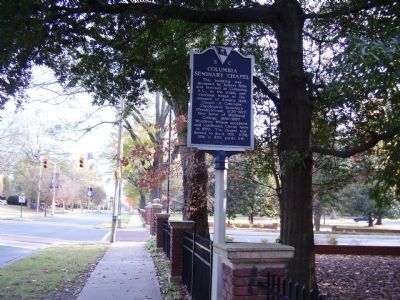
Photographed by Stanley and Terrie Howard, October 12, 2008
2. Columbia Seminary Chapel Marker
Also see . . .
1. Robert Mills. Robert Mills (August 12, 1781 – March 3, 1855) is sometimes called the first native born American to become a professional architect, though Charles Bulfinch perhaps has a clearer claim to this honor. (Submitted on January 17, 2010, by Brian Scott of Anderson, South Carolina.)
2. Robert Mills House (Ainsley Hall). The Robert Mills House, also known as Robert Mills Historic House and Park or the Ainsley Hall House, is a house in Columbia, South Carolina that was designed by Robert Mills. (Submitted on January 17, 2010, by Brian Scott of Anderson, South Carolina.)
3. Columbia Theological Seminary (Presbyterian). Official website of the Columbia Theological Seminary (Presbyterian). (Submitted on January 17, 2010, by Brian Scott of Anderson, South Carolina.)
4. Winthrop University. Official website of Winthrop University. (Submitted on January 17, 2010, by Brian Scott of Anderson, South Carolina.)
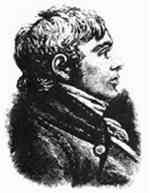
Photographed by Stanley and Terrie Howard, circa 2009
3. Robert Mills
(1781-1855)
(1781-1855)
Born in Charleston, South Carolina, Mills moved to Philadelphia in 1802 where he became an associate and student of Benjamin Henry Latrobe. He gradually became known in his own right. In 1820, he was appointed as acting commissioner of the Board of Public Works in South Carolina. In 1823, Mills was the superintendent of public buildings. In the next few years, he designed numerous buildings in South Carolina including court houses, the campus of the University of South Carolina, jails, and the Fireproof Building in Charleston.
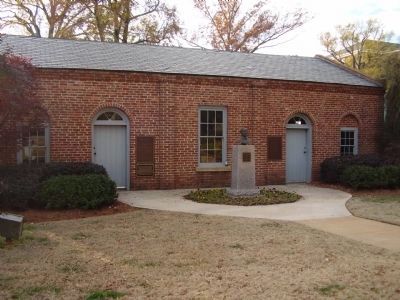
Photographed by Stanley and Terrie Howard, 2009
4. Columbia Seminary Chapel
In 1830, the mansion was acquired by the Presbyterian Synod of South Carolina and Georgia for a seminary campus, and the carriage house was converted into a chapel for the Columbia Theological Seminary. The main arched doorway was removed and replaced with a smaller rectangular window. Additional sash windows were probably added then to light the chapel, but this is not documented. These windows probably were not in place during the building’s time as a stable. The stalls were removed and replaced with pews and a pulpit on a raised wood floor for the chancel.
The ca. 1830 chapel remains basically unaltered. In 1886, David Bancroft Johnson requested the use of the Little Chapel as a classroom for the inaugural academic year of Winthrop Training School. The Seminary was closed because of an internal religious dispute. Permission was granted by the Presbyterian Church and the Little Chapel became the birthplace of Winthrop as an institution. The Little Chapel only served Winthrop as a classroom during its inaugural year. In the fall of 1887, the Winthrop Training School moved to a much larger building on Marion Street in Columbia, SC which contained four large rooms and the chapel returned to its prior use as a religious center for the Columbia Theological Seminary.
In 1927, the seminary moved to Decatur, GA. and the Little Chapel was left vacated. With pleas from the Winthrop Alumnae Association, Winthrop began a campaign to have the structure moved to Rock Hill. Their efforts were rewarded when the Seminary Board of Directors presented the Chapel to Winthrop on May 7, 1936. Plans were then set into motion to transport the building, brick by brick, to the Winthrop campus in Rock Hill, SC.
Credits. This page was last revised on January 26, 2026. It was originally submitted on March 6, 2009, by Stanley and Terrie Howard of Greer, South Carolina. This page has been viewed 1,413 times since then and 33 times this year. Photos: 1, 2, 3, 4. submitted on March 6, 2009, by Stanley and Terrie Howard of Greer, South Carolina. • Bill Pfingsten was the editor who published this page.
