
Fort Hamilton in Brooklyn in Kings County, New York — The American Northeast (Mid-Atlantic)
12-Inch Naval Gun, Mark V, Model 8
Photographed by Devry Becker Jones (CC0), January 18, 2025
1. 12-Inch Naval Gun, Mark V, Model 8 Marker
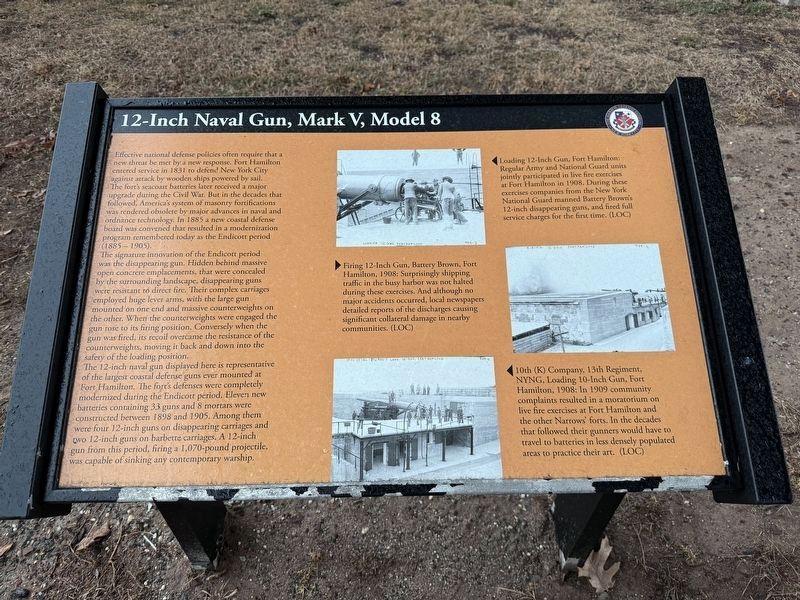
Effective national defense policies often require that a new threat be met with a new response. Fort Hamilton entered service in 1831 to defend New York City against attack by wooden ships powered by sail. The fort’s seacoast batteries later received a major upgrade during the Civil War. But in the decades the followed, America’s system of masonry fortifications was rendered obsolete by major advances in naval and ordnance technology. By 1885 a new coastal defense board was convened that resulted in a modernization program remembered today as the Endicott period (1885-1905).
The signature innovation of the Endicott period was the disappearing gun. Hidden behind massive open concrete emplacements, that were concealed by the surrounding landscape, disappearing guns were resistant to direct fire. Their complex carriages employed huge lever arms, with the large gun mounted on one end and massive counterweights on the other. When the counterweights were engaged, the gun rose to its firing position. Conversely, when the gun was fired, its recoil overcame the resistance of the counterweights, moving it back and down into the
this page online
Insert, top – Loading 12-Inch Gun, Fort Hamilton: Regular Army and National Guard units jointly participated in live-fire exercises at Fort Hamilton in 1908. During these exercises companies from the New York National Guard manned Battery Brown’s 12-inch disappearing guns, and fired full service charges for the first time. (LOC)
Insert, center – Firing 12-Inch Gun, Battery Brown, Fort Hamilton, 1908: Surprisingly shipping traffic of the busy harbor was not halted during these exercises. And although no major accidents occurred, local newspapers detailed reports of the discharges causing significant collateral

Photographed by Larry Gertner, June 20, 2017
2. 12-Inch Naval Gun, Mark V, Model 8 Marker
This is a former iteration of the marker which had weathered.
Insert, bottom – 10th (k) Company, 13th Regiment, NYNG, Loading 10-Inch Gun, Fort Hamilton, 1908: In 1909 community complaints resulted in a moratorium on live fire exercises and the other Narrows’ forts. In the decades that followed their gunners would have to travel to batteries in less densely populated areas to practice their arts. (LOC)
Topics. This historical marker is listed in these topic lists: Forts and Castles • Women.
Location. 40° 36.633′ N, 74° 1.902′ W. Marker is in Brooklyn, New York, in Kings County. It is in Fort Hamilton. It can be reached from Lee Avenue. Marker is on the grounds of the Fort Hamilton Army Base. Touch for map. Marker is in this post office area: Brooklyn NY 11252, United States of America. Touch for directions.

Regionally, this marker is in New York City. It is also in the American Northeast and on the Eastern Seaboard. Globally, it is in North America and the Western World. Historically, it finds itself in what was once one of the original Thirteen Colonies.
Other nearby markers. At least 8 other
Photographed by Devry Becker Jones (CC0), January 18, 2025
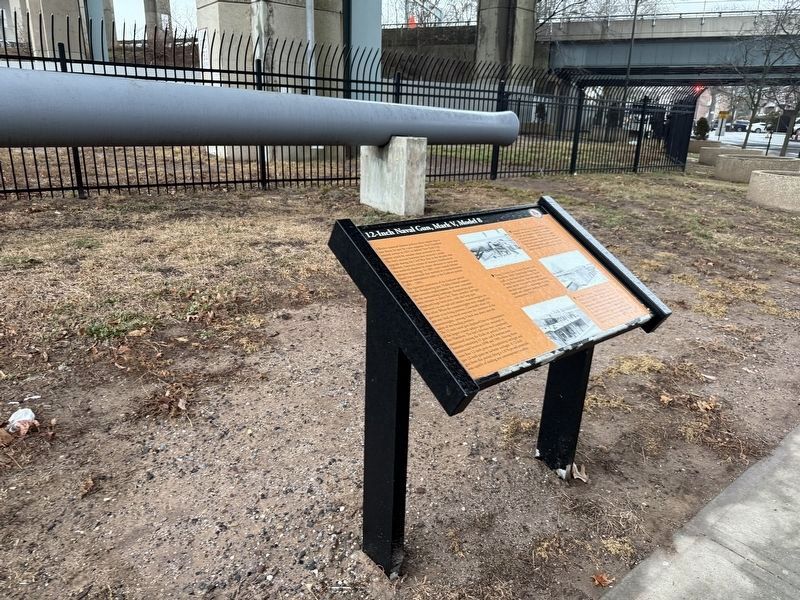
3. 12-Inch Naval Gun, Mark V, Model 8 Marker
Additional keywords. military equipment
Photographed by Larry Gertner, June 20, 2017
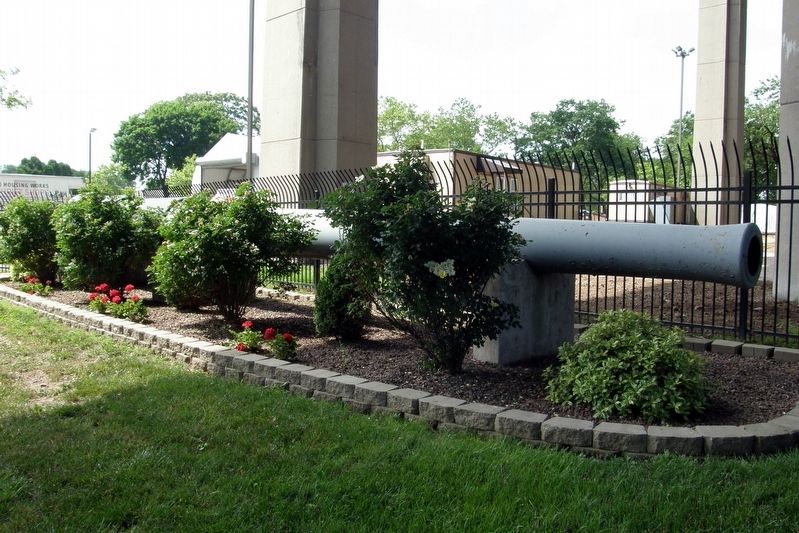
4. 12-Inch Naval Gun, Mark V, Model 8 on display
Credits. This page was last revised on January 22, 2025. It was originally submitted on June 20, 2017, by Larry Gertner of New York, New York. This page has been viewed 914 times since then and 69 times this year. Last updated on March 12, 2021, by Carl Gordon Moore Jr. of North East, Maryland. Photos: 1. submitted on January 22, 2025, by Devry Becker Jones of Washington, District of Columbia. 2. submitted on June 20, 2017, by Larry Gertner of New York, New York. 3. submitted on January 22, 2025, by Devry Becker Jones of Washington, District of Columbia. 4. submitted on June 20, 2017, by Larry Gertner of New York, New York.
Editor’s want-list for this marker. A wide view photo of the marker and the surrounding area together in context. • Can you help?
