Washington in Franklin County, Missouri — The American Midwest (Upper Plains)
Church, Rectory, and Jesuit Hall
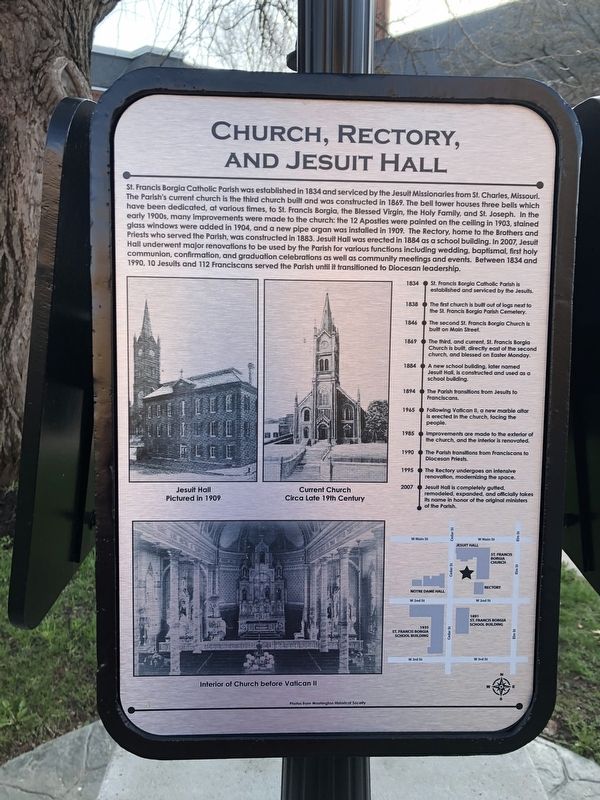
St. Francis Borgia Catholic Parish was established in 1834 and serviced by the Jesuit Missionaries from St. Charles, Missouri. The Parish's current church is the third church built and was constructed in 1869. The bell tower houses three bells which have been dedicated, at various times, to St. Francis Borgia, the Blessed Virgin, the Holy Family, and St. Joseph. In the early 1900s, many improvements were made to the church: the 12 Apostles were painted on the ceiling in 1903, stained glass windows were added in 1904, and a new pipe organ was installed in 1909. The Rectory, home to the Brothers and Priests who served the Parish, was constructed in 1883. Jesuit Hall was erected in 1884 as a school building. In 2007, Jesuit Hall underwent major renovations to be used by the Parish for various functions including wedding, baptismal, first holy communion, confirmation, and graduation celebrations as well as community meetings and events. Between 1834 and 1990, 10 Jesuits and 112 Franciscans served the Parish until it transitioned to Diocesan leadership.
1834 • St. Francis Borgia Catholic Parish is established and servicedby the Jesuits.
Click or scan to see
this page online
1838 • The first church is built out of logs next to the St. Francis Borgia Parish Cemetery.
1846 • The second St. Francis Borgia Church is built on Main Street.
1869 • The third, and current, St. Francis Borgia Church is built, directly east of the second church, and blessed on Easter Monday.
1884 • A new school building, later renamed Jesuit Hall, is constructed and used as a school building.
1894 • The Parish transitions from Jesuits to Franciscans.
1965 • Following Vatican II, a new marble altar is erected in the church, facing the people.
1985 • Improvements are made to the exterior of the church, and the interior is renovated.
1990 • The Parish transitions from Franciscans to Diocesan Priests.
1995 • The Rectory undergoes an intensive renovation, modernizing the space.
2007 • Jesuit Hall is completely gutted, remodeled, expanded, and officially takes its name in honor of the original ministers of the Parish.
Erected by Washington Historical Society, Incorporated.
Topics. This historical marker is listed in these topic lists: Education • Religion & Religious Structures. A significant historical year for this entry is 1834.
Location. 38° 33.639′ N,
Photographed by Duane and Tracy Marsteller, July 20, 2024
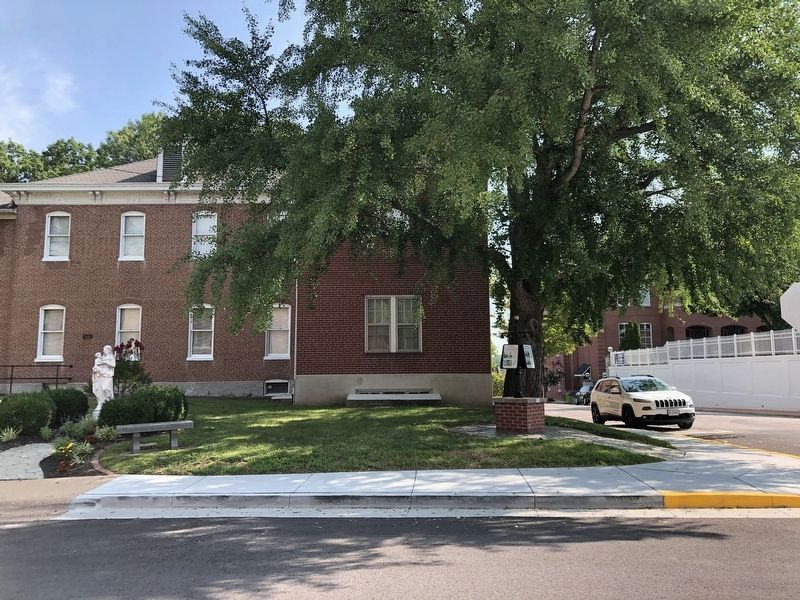
2. Church, Rectory, and Jesuit Hall Marker
Featured marker is on the left.

Regionally, this marker is in the Missouri River Corridor and in Greater St. Louis. It is also in the American Midwest, in the Lewis & Clark Corridor, in the Corn Belt, and on the Santa Fe Trail Corridor. Globally, it is in North America, the Western Hemisphere, the Western World, and the Anglosphere. Historically, it finds itself in what was once the territory of the Mississippian Culture, the Louisiana Purchase, and the Antebellum South.
Other nearby markers. At least 8 other markers are within walking distance of this marker: Notre Dame Hall (here, next to this marker); 1891 St. Francis Borgia School Building (here, next to this marker); 1935 St. Francis Borgia School Building (here, next to this marker); St. Francis Borgia Convent & School (within shouting distance of this marker); St. Francis Borgia Rectory (within shouting distance of this marker); Hibbeler Building (about 300 feet away, measured in a direct line); The Tibbe Historic District (about 300 feet away); St. Francis Borgia Church (about 300 feet away). Touch for a list and map of all markers in Washington.
Credits. This page was last revised on August 19, 2024. It was originally submitted on March 24, 2021, by Devry Becker Jones of Washington, District of Columbia. This page has been viewed 517 times since then and 52 times this year. Photos: 1. submitted on March 24, 2021, by Devry Becker Jones of Washington, District of Columbia. 2. submitted on August 13, 2024, by Duane and Tracy Marsteller of Murfreesboro, Tennessee.
