Conway Twitty
| — | Rock 'n Roll Highway 67 | — |
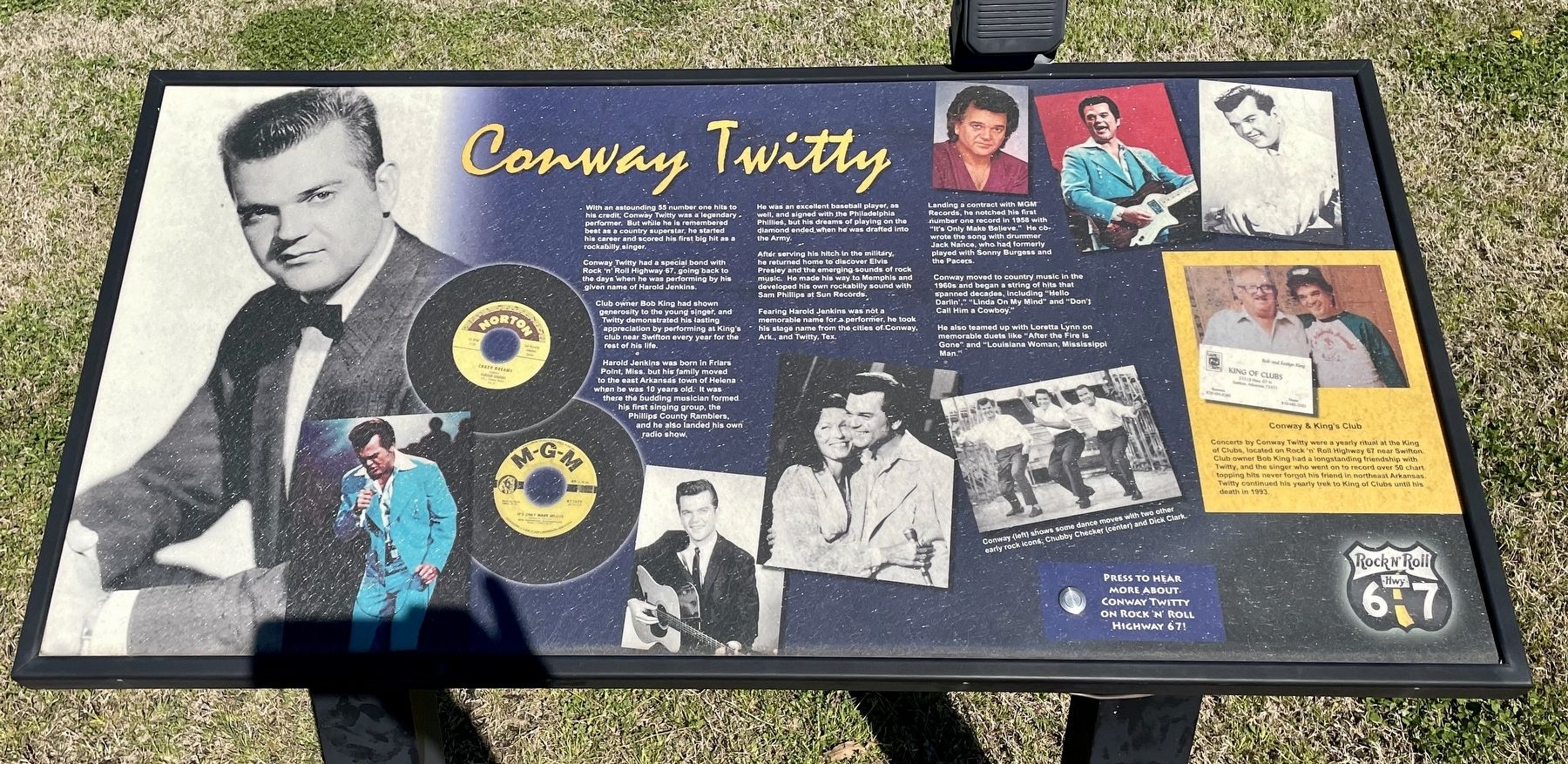
Conway-Twitty had a special bond with Rock 'n' Roll Highway 67, going back to the days when he was performing by his given name of Harold Jenkins.
Club owner Bob King had shown generosity to the young singer, and Twitty demonstrated his lasting. appreciation by performing at King's club near Swifton every year for the rest of his life.
Harald Jenkins was born in Friars Point, Miss, but his family moved to the east Arkansas town of Helena when he was 10 years old. It was there the budding musician formed his first singing group, the Phillips County Ramblers, and he also landed his own radio show.
He was an excellent baseball player, as well, and signed with the Philadelphia Phillies, but his dreams of playing on the diamond ended when he was drafted into the Army.
After serving his hitch in the military, he returned home to discover Elvis Presley and
this page online
Fearing Harold Jenkins was not a memorable name for a performer, he took his stage name from the cities of Conway, Ark., and Twitty, Tex.
Landing a contract with MGM Records, he notched his first number one record in 1958 with "It's Only Make Believe.” He co- wrote the song with drummer Jack Nance, who had formerly played with Sonny Burgess and the Pacers.
Conway moved to country music in the 1960s and began a string of hits that spanned decades, including "Hello Darlin',"' "Linda On My Mind" and "Don't Call Him a Cowboy." He also teamed up with Loretta Lynn on memorable duets like "After the Fire is Gone" and "Louisiana Woman, Mississippi Man."Landing a contract with MGM Records, he notched his first number one record in 1958 with "It's Only Make Believe.” He co- wrote the song with drummer Jack Nance, who had formerly played with Sonny Burgess and the Pacers.
Conway moved to country music in the 1960s and began a string of hits that spanned decades,
Topics. This historical marker is listed in these topic lists: Arts, Letters, Music • Entertainment. A significant historical year for this entry is 1958.
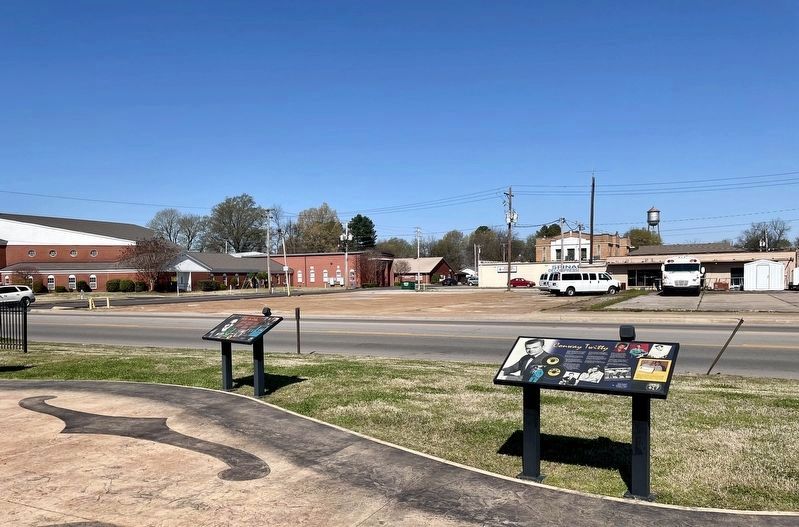
Location. 36° 4.033′ N, 90° 57.44′ W. Marker is in Walnut Ridge, Arkansas, in Lawrence County. It can be reached from SW Front Street south of West Elm Street, on the right when traveling south. Located at Guitar Walk near the Walnut Ridge Train Station. Touch for map. Marker is at or near this postal address: 109 SW Front St, Walnut Ridge AR 72476, United States of America. Touch for directions.

Regionally, this marker is in the American South and specifically in the Upper South. Globally, it is in North America, the Western Hemisphere, the Western World, and the Anglosphere. Historically, it finds itself in what was once the territory of the Mississippian Culture, the Louisiana Purchase, one of the Confederate States of America, and the Antebellum South.
Other nearby markers. At least 8 other markers are within walking distance of this marker: Sonny Burgess (here, next to this marker); Wanda Jackson (here, next to this marker); Billy Lee Riley (a few steps from this marker); Roy Orbison (a few steps from this marker); Johnny Cash (a few steps from this marker); Jerry Lee Lewis (a few steps from this marker); Carl Perkins (a few steps from this marker); When The Beatles Came to Town (about 600 feet away, measured in a direct line). Touch for a list and map of all markers in Walnut Ridge.
Credits. This page was last revised on April 13, 2021. It was originally submitted on April 7, 2021, by Mark Hilton of Montgomery, Alabama. This page has been viewed 537 times since then and 33 times this year. Photos: 1, 2. submitted on April 7, 2021, by Mark Hilton of Montgomery, Alabama.
