Claudius Crozet
The Blue Ridge Tunnel
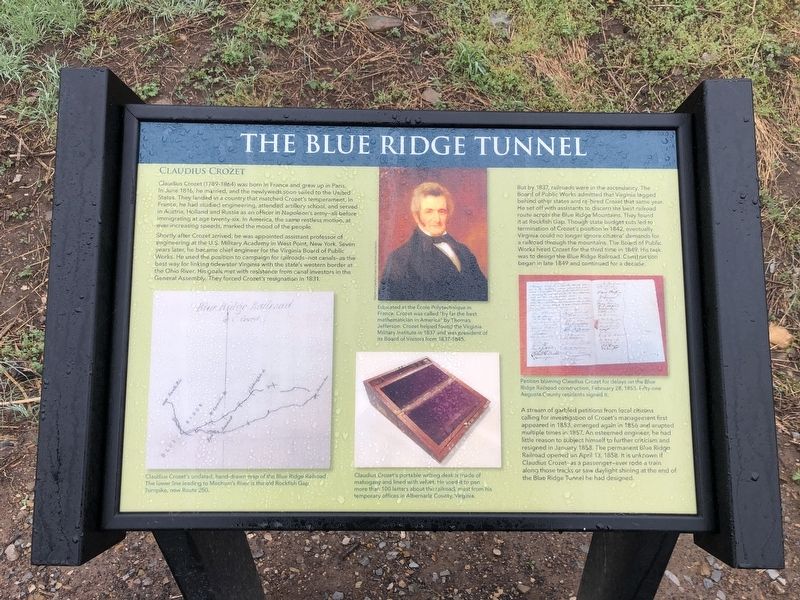
Claudius Crozet (1789-1864) was born in France and grew up in Paris. In June 1816, he married, and the newlyweds soon sailed to the United States. They landed in a country that matched Crozet's temperament. In France, he had studied engineering, attended artillery school, and served in Austria, Holland and Russia as an officer in Napoleon's army—all before immigrating at age twenty-six. In America, the same restless motion, at ever-increasing speeds, marked the mood of the people.
Shortly after Crozet arrived, he was appointed assistant professor of engineering at the U.S. Military Academy in West Point, New York. Seven years later, he became chief engineer for Virginia's Board of Public Works. He used the position to campaign for railroads—not canals—as the best way for linking tidewater Virginia with the state's western border at the Ohio River. His goals met with resistance from canal investors in the General Assembly. They forced Crozet's resignation in 1831.
But by 1837, railroads were in the ascendancy. The Board of Public Works admitted that Virginia lagged behind other states and re-hired
this page online
A stream of garbled petitions from local citizens calling for investigation of Crozet's management first appeared in 1853, emerged again in 1856 and erupted multiple times in 1857. An esteemed engineer, he had little reason to subject himself to further criticism and resigned in January 1858. The permanent Blue Ridge Railroad opened on April 13, 1858. It is unknown if Claudius Crozet—as a passenger—ever rode a train along those tracks or saw daylight shining at the end of the Blue Ridge Tunnel he had designed.
Erected 2020 by Nelson County Parks & Recreation.
Topics. This historical marker is listed in these topic lists:
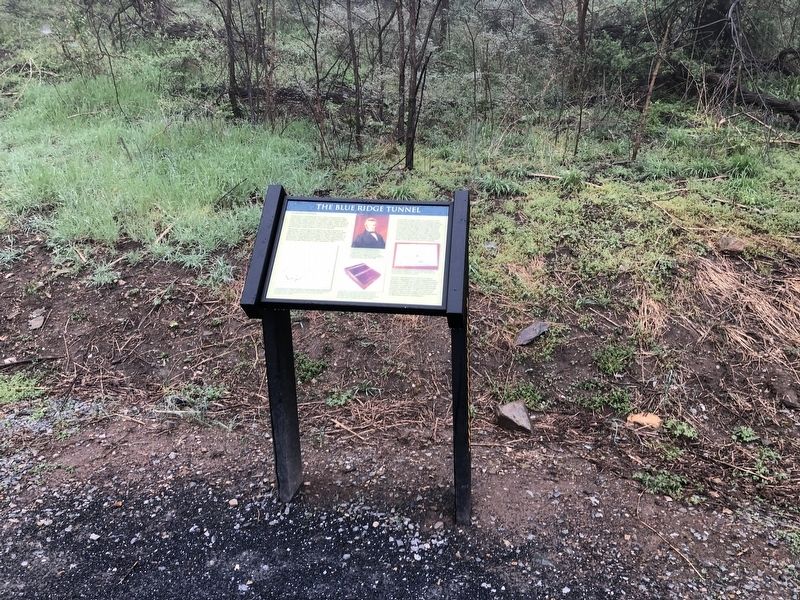
Location. 38° 1.919′ N, 78° 50.751′ W. Marker is in Afton, Virginia, in Nelson County. It is on Blue Ridge Tunnel Trail 0.2 miles west of Afton Depot Lane, on the right when traveling west. Touch for map. Marker is in this post office area: Afton VA 22920, United States of America. Touch for directions.

Regionally, this marker is in the Piedmont and in Central Virginia. It is also in the American South and specifically in the Upper South. Globally, it is in North America, the Western Hemisphere, the Western World, and the Anglosphere. Historically, it finds itself in what was once the territory of the Mississippian Culture, one of the original Thirteen Colonies, one of the Confederate States of America, and the Antebellum South.
Other nearby markers. At least 8 other markers are within walking distance of this marker: The Blue Ridge Railroad (about 700 feet away, measured in a direct line); Virginia's Nineteenth-Century Transportation Challenges (about 700 feet away); East Trailhead (approx. 0.2 miles away); The Laborers (approx. ¼ mile away); Blue Ridge Tunnel (approx. ¼ mile away); Blue Ridge Parkway (approx. 0.3 miles away); Rockfish Gap Meeting (approx. 0.3 miles away); Flight of Richard C. duPont (approx. 0.4 miles away). Touch for a list and map of all markers in Afton.
Credits. This page was last revised on April 11, 2021. It was originally submitted on April 11, 2021, by Devry Becker Jones of Washington, District of Columbia. This page has been viewed 391 times since then and 32 times this year. Photos: 1, 2. submitted on April 11, 2021, by Devry Becker Jones of Washington, District of Columbia.
