Chelsea Doughboy Statue
Chelsea Park
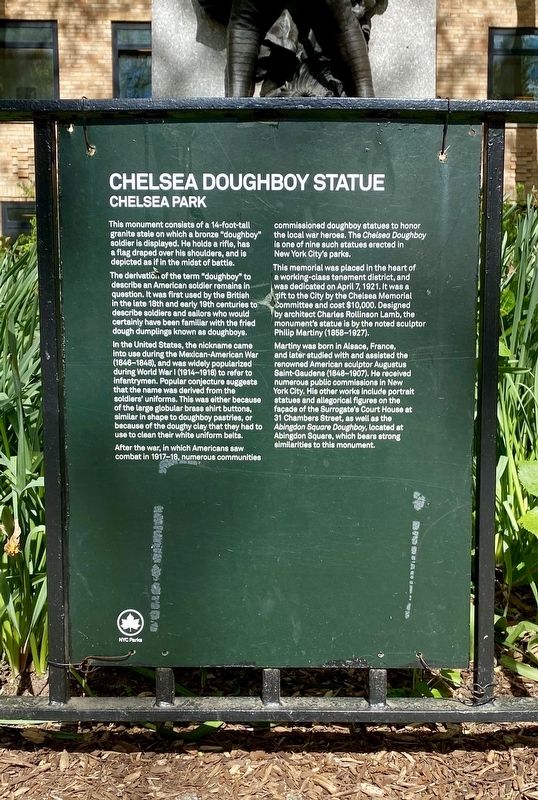
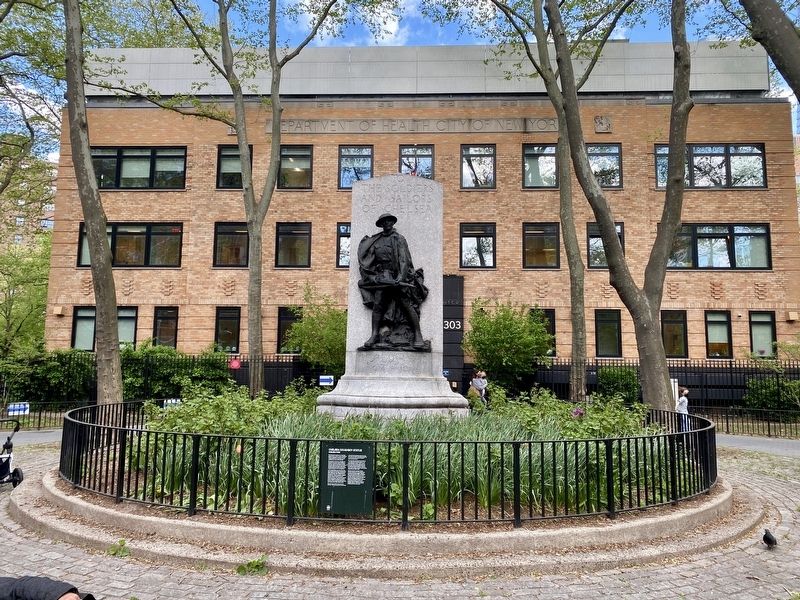
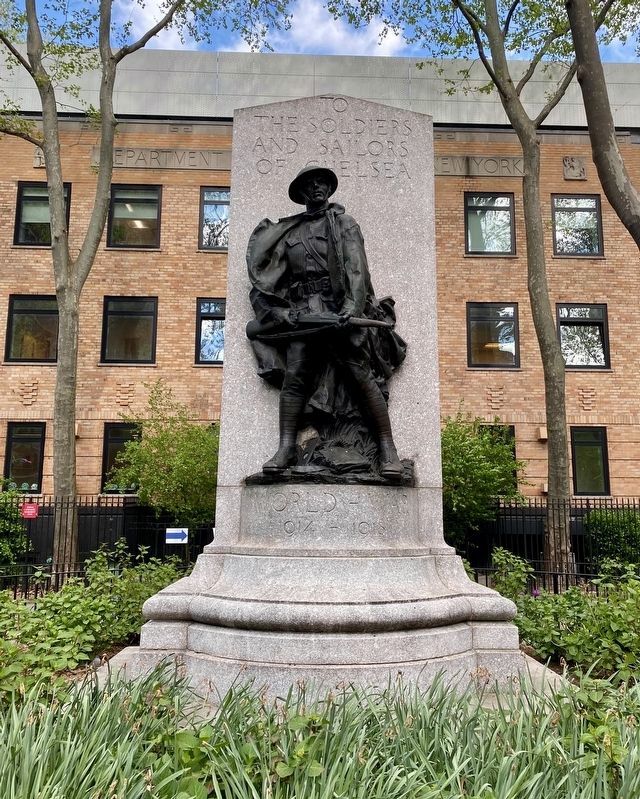
This monument consists of a 14-foot-tall granite stele on which a bronze "doughboy" soldier is displayed. He holds a rifle, has a flag draped over his shoulders, and is depicted as if in the midst of battle.
The derivation of the term "doughboy” to describe an American soldier remains in question. It was first used by the British in the late 18th and early 19th centuries to describe soldiers and sailors who would certainly have been familiar with the fried dough dumplings known as doughboys.
In the United States, the nickname came into use during the Mexican-American War (1846-1848), and was widely popularized during World War I (1914-1918) to refer to infantrymen. Popular conjecture suggests that the name was derived from the soldiers' uniforms. This was either because of the large globular brass shirt buttons, similar in shape to doughboy pastries, or because of the doughy clay that they had to use to clean their white uniform belts.
After the war, in which Americans saw combat in 1917-18, numerous communities commissioned doughboy statues to honor the local war heroes. The Chelsea Doughboy is one of nine such statues erected in New York City's parks.
This memorial was placed in the heart of a working-class tenement district, and was dedicated on April 7, 1921. It was a gift to the City by the Chelsea Memorial Committee and cost $10,000. Designed by architect Charles Rollinson Lamb, the monument's statue is by the noted sculptor Philip Martiny (1858-1927).
Martiny was born in Alsace, France, and later studied with and assisted the renowned American sculptor Augustus Saint-Gaudens (1848-1907), He received numerous public commissions in New York City. His other works include portrait statues and allegorical figures on the façade of the Surrogate's
this page online
Erected by NYC Parks.
Topics and series. This memorial is listed in these topic lists: Arts, Letters, Music • War, World I. In addition, it is included in the NYC Parks series list. A significant historical date for this entry is April 7, 1921.
Location. 40° 44.97′ N, 73° 59.977′ W. Memorial is in Manhattan, New York, in New York County. It is in Chelsea. It is on 9th Avenue near 28th Avenue, on the right when traveling south. Touch for map. Memorial is at or near this postal address: 303 9th Avenue, New York NY 10001, United States of America. Touch for directions.

Regionally, this memorial is in New York City. It is also in the American Northeast, in the Mid-Atlantic, and on the Eastern Seaboard. Globally, it is in the North Atlantic Region, North America, the Western Hemisphere, the Western World, and the Anglosphere. Historically, it finds itself in what was once New Netherland and also one of the original Thirteen Colonies.
Other nearby markers. At least 8 other markers are within walking
Ephemeral New York website entry
Click for more information.
Credits. This page was last revised on October 6, 2026. It was originally submitted on May 10, 2021, by Andrew Ruppenstein of Lamorinda, California. This page has been viewed 601 times since then and 48 times this year. Photos: 1. submitted on May 10, 2021, by Andrew Ruppenstein of Lamorinda, California. 2. submitted on September 28, 2026, by Trudi Jacobson of Slingerlands, New York. 3, 4. submitted on May 10, 2021, by Andrew Ruppenstein of Lamorinda, California.
