The Johlin Cabin
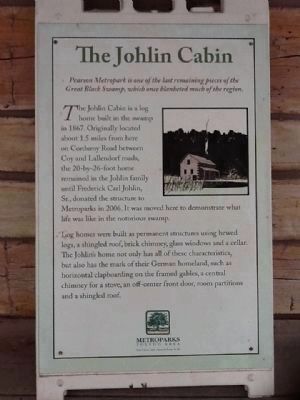
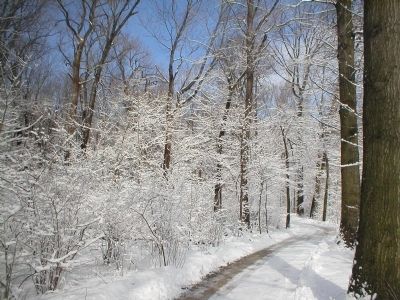
Pearson Metropark is one of the last remaining pieces of the Great Black Swamp, which once blanketed much of the region.
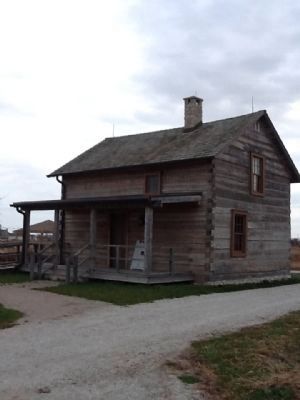
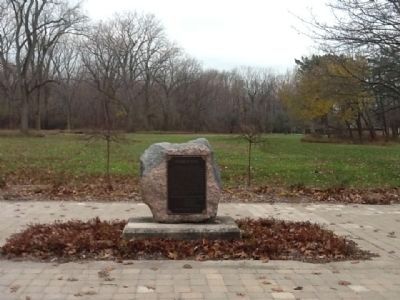
The Johlin Cabin is a log home built in the swamp in 1867. Originally located about 1.5 miles from here on Corduroy Road between Coy and Lallendorf roads, the 20-by-26-foot home remained in the Johlin family until Frederick Carl Johlin, Sr., donated the structure to Metroparks in 2006. It was moved here to demonstrate what life was like in the notorious swamp.
Log homes were built as permanent structures using hewed logs, a shingle roof, brick chimney, glass windows and a cellar. The Johlin's home not only has all of these characteristics, but also has the mark of their German homeland, such as horizontal clapboarding on the framed gables, a central chimney for a stove, an off-center front door, room partitions and a shingled roof.
Erected by Metroparks Toledo Area.
Topics. This historical marker is listed in this topic list: Notable Buildings. A significant historical year for this entry is 1867.
Location. Marker has been reported missing. It was located near 41° 38.5′ N, 83° 26.333′ W. Marker was
this page online

Regionally, this marker was on the Lake Erie Shore and in the Toledo Metropolitan Area. It was also in the American Midwest and in the Corn Belt. Globally, it was in North America, on the Great Lakes, in the Western Hemisphere, in the Western World, and in the Anglosphere. Historically, it found itself in what was once the Viceroyalty of New France, the Haudenosaunee (Iroquois) Confederacy, the territory of the Mississippian Culture, and the Northwest Territory.
Other nearby markers. At least 8 other markers are within 3 miles of this location, measured as the crow flies: CCC Builds A Park (within shouting distance of this marker); Natural Mosquito Repellent (approx. 0.6 miles away); A Sticky Situation (approx.
Also see . . . Johlin Cabin. Metroparks Toledo website entry (Submitted on April 10, 2022, by Larry Gertner of New York, New York.)
Additional commentary.
1. Pearson Park History
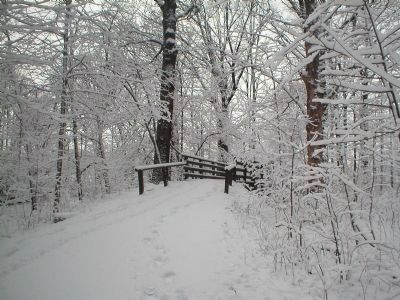
Pearson Metropark was part of the Great Black Swamp, a region once described as the most "forsacken,desolate, and inhospitable" wilderness in America. Today, Pearson is one of the last remnants of the infamous swamp. Pearson's fascinating history, natural attributes and recreational facilities make the 624 acre Metropark of the most heavily used in Lucas County.
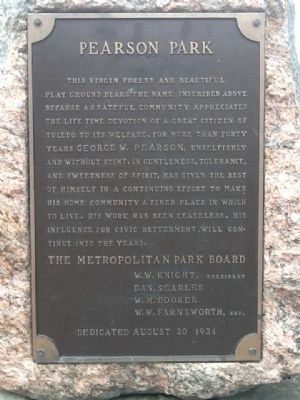
Pearson was dedicated August 30, 1934 in honor of George W. Pearson, an East Toledo resident and reporter for The Blade.
Mr. Pearson campaigned for 20 years to save the land that now composes the park, and hundreds of citizens joined the effort.
Many of the park's facilities were constructed during the Great Depression by workers of the Works Progress Administration and the Civilian Conversation Corps. Even the man-made ponds,originally dug with pics and shovels. Pearson's natural area is a remnant of the Black Swamp which was once a nearly impassable barrier to travel and settlement area. The dense woodland and soggie ground are to two factors: flatness of the land and heavy clay soils.
INFORMATION FROM TOLEDO AREA METROPARKS FLIER
Credits. This page was last revised on October 13, 2023. It was originally submitted on November 13, 2011, by Thomas Cluckey II of Oregon, Ohio. This page has been viewed 2,050 times since then and 74 times this year. Last updated on May 20, 2021, by Craig Doda of Napoleon, Ohio. Photos: 1, 2. submitted on November 16, 2011, by Thomas Cluckey II of Oregon, Ohio. 3. submitted on November 13, 2011, by Thomas Cluckey II of Oregon, Ohio. 4. submitted on November 16, 2011, by Thomas Cluckey II of Oregon, Ohio. 5. submitted on November 13, 2011, by Thomas Cluckey II of Oregon, Ohio. 6. submitted on November 16, 2011, by Thomas Cluckey II of Oregon, Ohio. • Devry Becker Jones was the editor who published this page.
