Black Diamonds
Three Rivers Heritage Trail
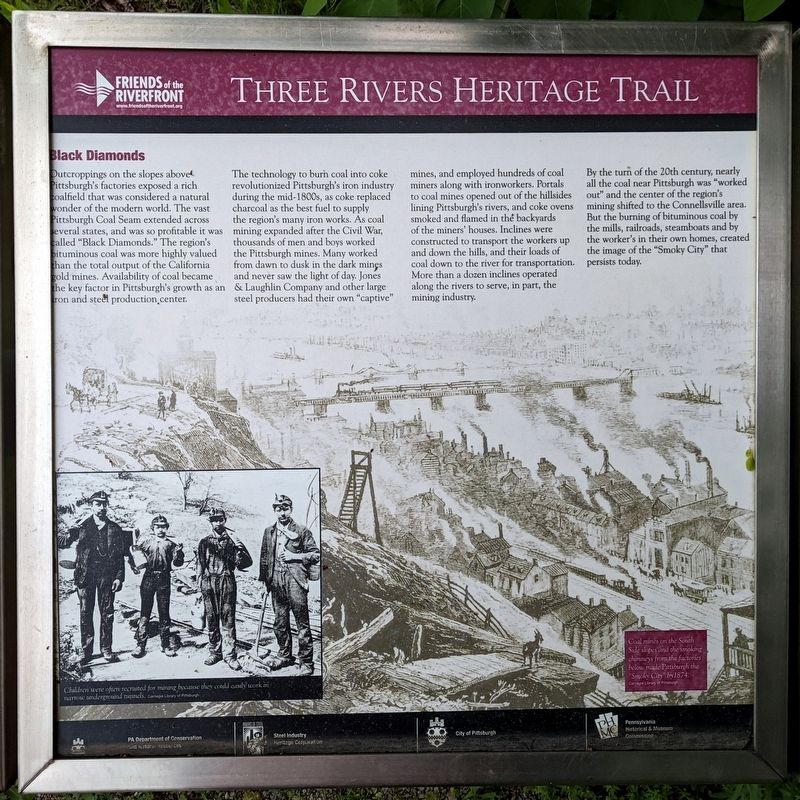
The technology to burn coal into coke revolutionized Pittsburgh's iron industry during the mid-1800s, as coke replaced charcoal as the best fuel to supply the region's many iron works. As coal mining expanded after the Civil War, thousands of men and boys worked the Pittsburgh mines. Many worked from dawn to dusk in the dark mines and never saw the light of day. Jones & Laughlin Company and other large steel producers had their own "captive" mines, and employed hundreds of coal miners along with ironworkers. Portals to coal mines opened out of the hillsides lining Pittsburgh's rivers, and coke ovens smoked and flamed in the backyards of the miners' houses. Inclines
this page online
By the turn of the 20th century, nearly all the coal near Pittsburgh was "worked out" and the center of the region's mining shifted to the Connellsville area. But the burning of bituminous coal by the mills, railroads, steamboats and by the worker's in their own homes, created the image of the "Smoky City" that persists today.
(captions)
Children were often recruited for mining because they could easily work in narrow underground tunnels. Carnegie Library of Pittsburgh
Coal mines on the South Side slopes and the smoking chimneys from the factories below made Pittsburgh the "Smoky City" by 1874. Carnegie Library of Pittsburgh
Erected by Friends of the Riverfront, DCNR, Steel Industry Heritage Corporation, City of Pittsburgh, PHMC.
Topics. This historical marker is listed in this topic list: Industry & Commerce.
Location. 40° 26.077′ N, 79° 59.084′ W. Marker
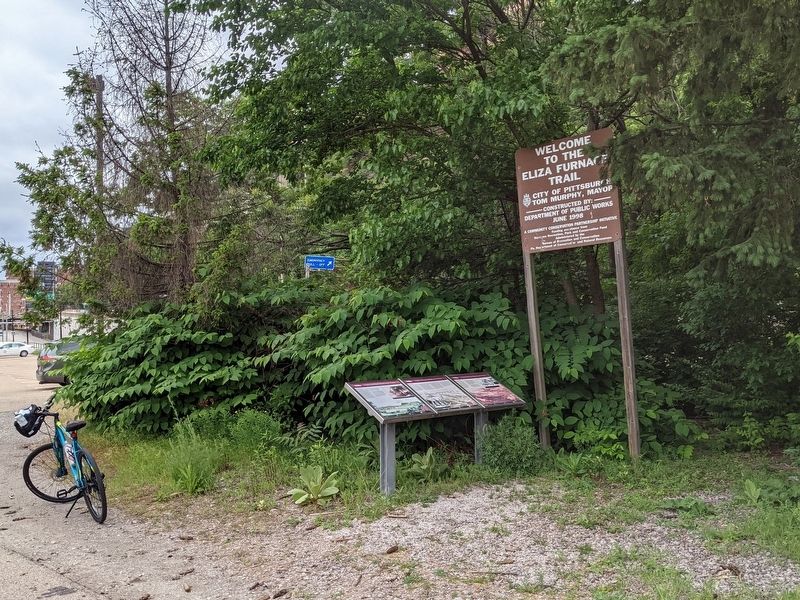

Regionally, this marker is in the American Northeast, in the Mid-Atlantic, in the Ohio River Valley, in Appalachia, and specifically in Northern Appalachia. Globally, it is in North America, the Western Hemisphere, the Western World, and the Anglosphere. Historically, it finds itself in what was once the Viceroyalty of New France, the Haudenosaunee (Iroquois) Confederacy, and one of the original Thirteen Colonies.
Other nearby markers. At least 8 other markers are within walking distance of this marker: Ormsby River Farms (here, next to this marker); Coal Transportation (here, next to this marker); Mercy Hospital (about 800 feet away, measured in a direct line); Oliver Iron and Steel (approx. 0.2 miles away); Immigrant Steel Workers (approx. 0.2 miles away); Pennsylvania Canal in Pittsburgh (approx. ¼ mile away); Pittsburgh Glass (approx. ¼ mile away); Panhandle Railroad (approx. ¼ mile away). Touch for a list and map of all markers in Pittsburgh.
Also see . . . Friends of the Riverfront. (Submitted on June 1, 2021.)
Credits. This page was last revised on February 2, 2023. It was originally submitted on June 1, 2021, by Bernard Fisher of Richmond, Virginia. This page has been viewed 704 times since then and 47 times this year. Photos: 1, 2. submitted on June 1, 2021, by Bernard Fisher of Richmond, Virginia.
