Gilliam Louisiana
this page online
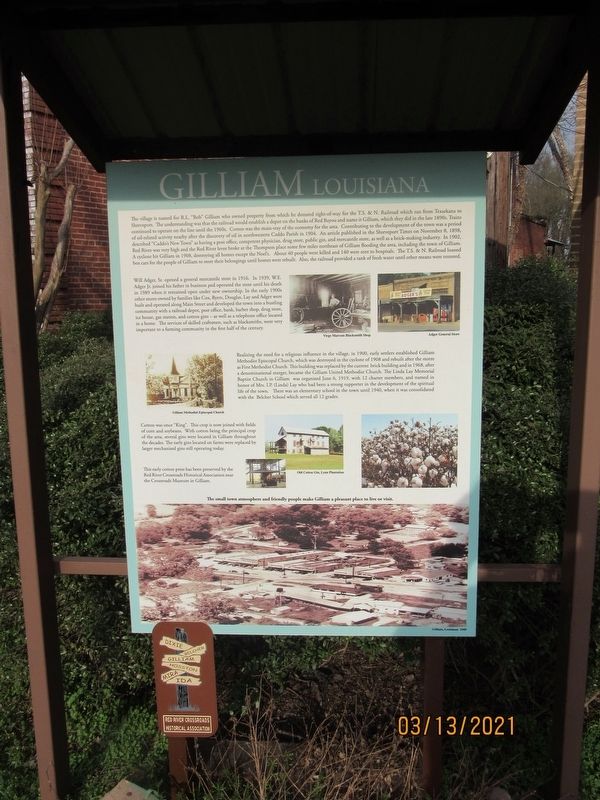
Will Adger, Sr. opened a general mercantile store in 1916. In 1939, W.E. Adger Jr. joined his father in business and operated the store until his death in 1989 when it remained open under new ownership. In the early 1900s other stores owned by families like Cox, Byers, Douglas, Lay and Adger were built and operated along Main Street and developed the town into a bustling community with a railroad depot, post office, bank, barber shop, drug store, ice house, gas station, and cotton gins - as well as a telephone office located in a home. The services of skilled craftsmen, such as blacksmiths, were very important to a farming community in the first half of the century.
Realizing the need for a religious influence in the village, in 1900, early settlers established Gilliam Methodist Episcopal Church, which was destroyed in the cyclone of 1908 and rebuilt after the storm as First Methodist Church. This building was replaced by the current brick building and in 1968, after
Cotton was once "King". This crop is now joined with fields of corn and soybeans. With cotton being the principal crop of the area, several gins were located in Gilliam throughout the decades. The early gins located on farms were replaced by larger mechanized gins still operating today.
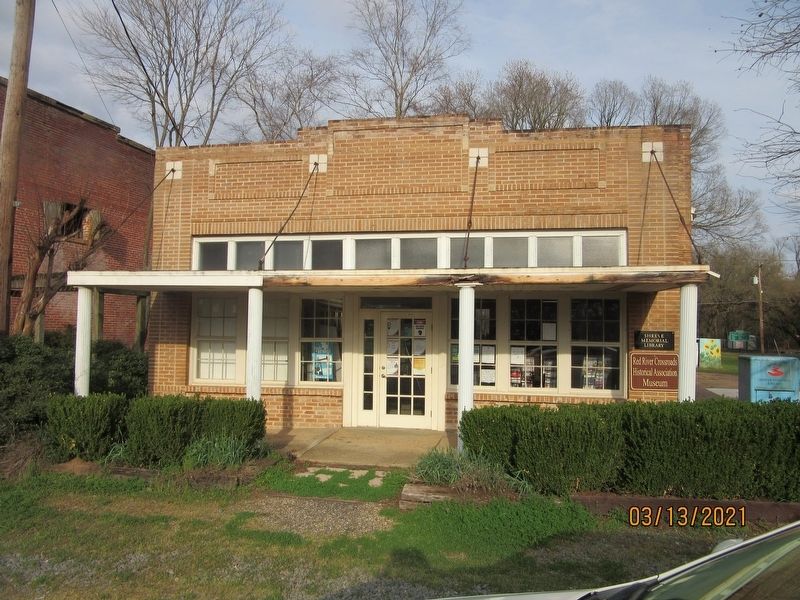
This early cotton press has been preserved by the Red River Crossroads Historical Association near Old Cotton Gin, Lynn Plantation the Crossroads Museum in Gilliam.
The small town atmosphere and friendly people make Gilliam a pleasant place to live or visit.
Erected by Red River Crossroads Historical Association.
Topics. This historical marker is listed in this topic list: Settlements & Settlers. A significant historical year for this entry is 1890.
Location. 32° 49.639′ N,

Regionally, this marker is in North Louisiana. It is also in the American South, specifically in the Deep South, and in the Piney Woods. Globally, it is in North America, a Gulf of Mexico state, the Western Hemisphere, the Western World, and the Anglosphere. Historically, it finds itself in what was once the territory of the Mississippian Culture, the Louisiana Purchase, one of the Confederate States of America, and the Antebellum South.
Other nearby markers. At least 8 other markers are within 3 miles of this marker, measured as the crow flies: Caddo Prairie Crossroads (a few steps from this marker); Town of Gilliam (a few steps from this marker); TS&N/T&P Railroad (within shouting distance of this marker); Gilliam United Methodist Church (about 400 feet away, measured in a direct line); Reuben Thom Douglas Home (about 600 feet away); Linda Lay Memorial (about 700 feet away); Justice Chapel Baptist Church (approx. 1.8 miles away); Lynn Plantation (approx. 2½ miles away). Touch for a list and map of all markers in Gilliam.
Credits. This page was last revised on June 7, 2021. It was originally submitted on June 7, 2021, by Jason Armstrong of Talihina, Oklahoma. This page has been viewed 1,961 times since then and 142 times this year. Photos: 1, 2. submitted on June 7, 2021, by Jason Armstrong of Talihina, Oklahoma. • Mark Hilton was the editor who published this page.
