Southwest Minneapolis in Hennepin County, Minnesota — The American Midwest (Upper Plains)
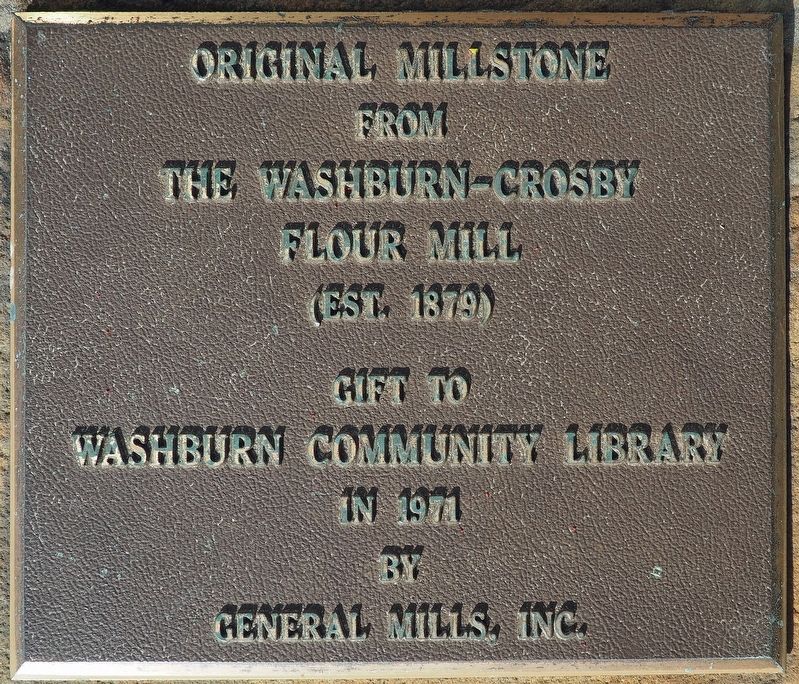
Original Millstone from the Washburn-Crosby Flour Mill
(Est. 1879)
Photographed by McGhiever, June 6, 2021
1. Original Millstone marker
Erected 1971.
Topics. This historical marker is listed in this topic list: Industry & Commerce. A significant historical year for this entry is 1879.
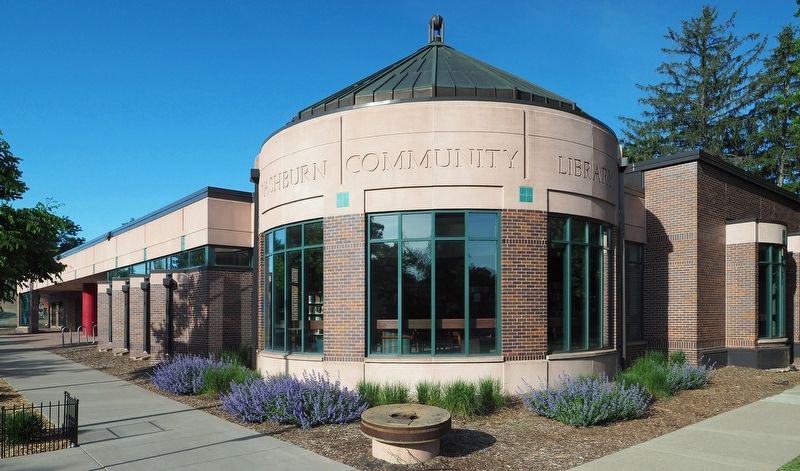
Location. 44° 54.455′ N, 93° 17.31′ W. Marker is in Minneapolis, Minnesota, in Hennepin County. It is in Southwest Minneapolis. It is at the intersection of Lyndale Avenue South and West Minnehaha Parkway, on the right when traveling south on Lyndale Avenue South. Marker and millstone are at the northeast corner of Washburn Library. Touch for map. Marker is at or near this postal address: 5244 Lyndale Ave S, Minneapolis MN 55419, United States of America. Touch for directions.

Regionally, this marker is in the Twin Cities Metropolitan Area. It is also in the American Midwest, in the Corn Belt, and in the Great River Road Region. Globally, it is in North America, the Western Hemisphere, the Western World, and the Anglosphere. Historically, it finds itself in what was once Rupert’s Land, the territory of the Mississippian Culture, and the Louisiana Purchase.
Other nearby markers. At least 8 other
this page online
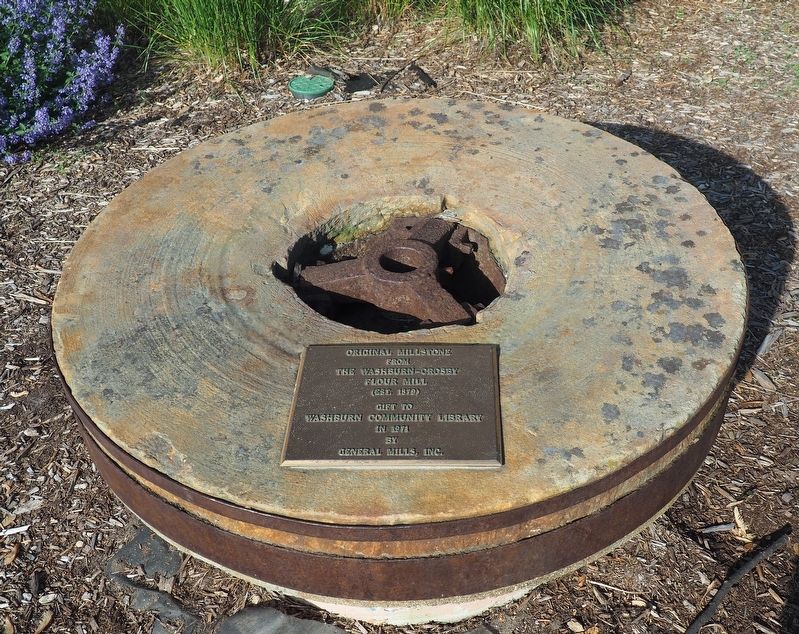
Regarding Original Millstone from the Washburn-Crosby Flour Mill. Washburn Library is named for William D. Washburn, a founder of the Washburn-Crosby Milling Company and a U.S. Senator. The Washburn-Crosby Milling Company later became General Mills. The millstone honors Minneapolis' heritage as a grain-milling center in the 19th and 20th centuries.
Photographed by McGhiever, June 6, 2021
2. Millstone with marker
Photographed by McGhiever, June 6, 2021
3. Millstone at the northeast corner of Washburn Library
Credits. This page was last revised on February 12, 2023. It was originally submitted on July 10, 2021, by McGhiever of Minneapolis, Minnesota. This page has been viewed 469 times since then and 47 times this year. Photos: 1, 2, 3. submitted on July 10, 2021, by McGhiever of Minneapolis, Minnesota. • Mark Hilton was the editor who published this page.
