
Near Durango in La Plata County, Colorado — The American Mountains (Southwest)
Florida River Railroad Bridge No. 437
Photographed by James Hulse, July 6, 2021
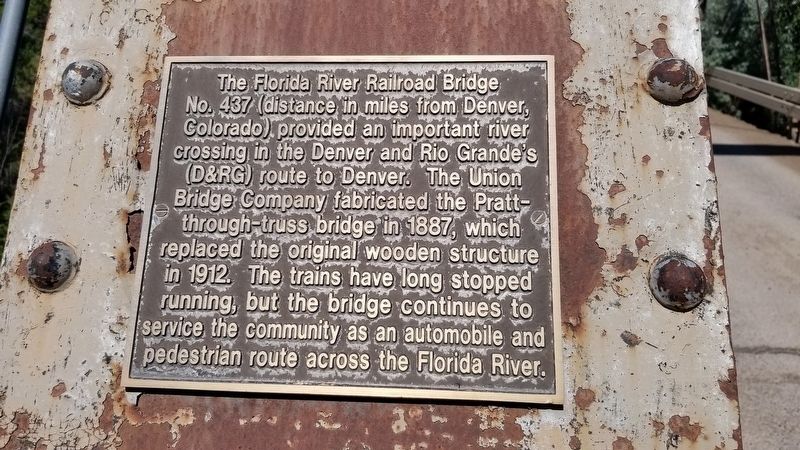
1. Florida River Railroad Bridge No. 437 Marker
The Florida River Railroad Bridge No. 437 (distance in miles from Denver, Colorado), provided an important river crossing in the Denver and Rio Grande's (D&RG) route to Denver. The Union Bridge Company fabricated the Pratt through-truss bridge in 1887, which replaced the original wooden structure in 1912. The trains have long stopped running, but the bridge continues to service the community as an automobile and pedestrian route across the Florida River.
Topics. This historical marker is listed in these topic lists: Bridges & Viaducts • Railroads & Streetcars. A significant historical year for this entry is 1887.
Location. 37° 12.854′ N, 107° 44.811′ W. Marker is near Durango, Colorado, in La Plata County. It is on Ranchos Florida Drive 0.2 miles east of County Highway 222, on the right when traveling east. The marker is located on the southeast side of the bridge. Touch for map. Marker is at or near this postal address: 338 Ranchos Florida Drive, Durango CO 81303, United States of America. Touch for directions.

Regionally, this marker is in the American Mountain West and at the Four Corners. Globally, it is in North America, the Rocky Mountains, the Western Hemisphere, the Western World, and the Anglosphere.
Other nearby markers. At least 8 other markers are within 8 miles of this marker, measured as the crow flies: Rose Garden (approx. 7.9 miles away); Vanishing Homeland (approx. 7.9 miles away); Welcome to the San Juan Skyway (approx. 7.9 miles away); Santa Rita (approx. 7.9 miles away); Durango's Smelter
this page online
Also see . . . Pratt Truss bridge. Since its introduction in 1844, this bridge design became part of hundreds of bridges created up to Second World War. It was designed by the Thomas Willis Pratt (1812 – 1875) and his father Caleb Pratt, a pair of American engineers, just several years after William Howe patented his famous Howe truss design. This bridge design immediately became widely used during the period when many bridges moved from wood components toward all-steel construction designs. Its most compelling feature was the ability was to span great distances using simple construction methods. It was regularly used to span anchor points that are up to 250 feet (76 meters) apart. It was most commonly used in railroad bridge construction, although it was also a preferred choice for creating other types of bridges all around the world until early 20th century. Source: History of Bridges (Submitted on July 17, 2021, by James Hulse of Medina, Texas.)
Photographed by James Hulse, July 6, 2021
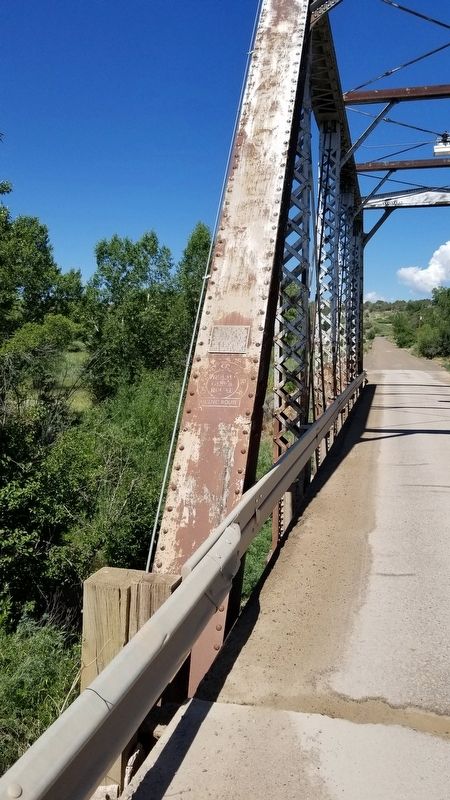
2. The Florida River Railroad Bridge No. 437 Marker on the bridge
Photographed by James Hulse, July 6, 2021
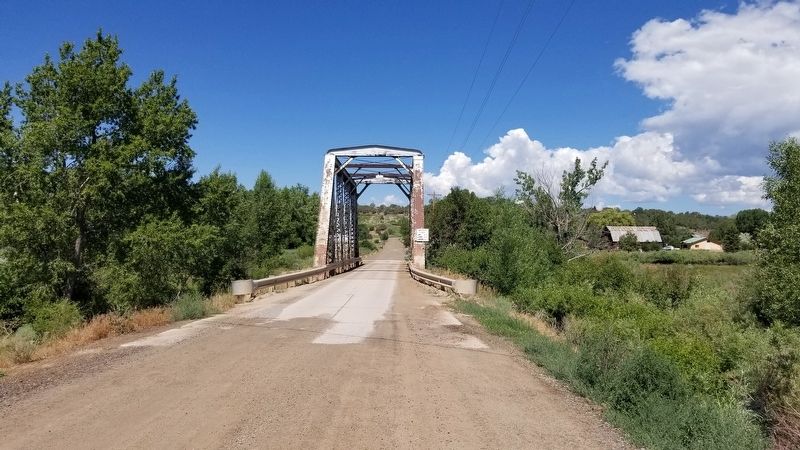
3. The view of the Florida River Railroad Bridge No. 437 and Marker from the road
Credits. This page was last revised on July 17, 2021. It was originally submitted on July 17, 2021, by James Hulse of Medina, Texas. This page has been viewed 903 times since then and 96 times this year. Photos: 1, 2, 3. submitted on July 17, 2021, by James Hulse of Medina, Texas.
