Palmyra in Fluvanna County, Virginia — The American South (Mid-Atlantic)
Site of Central High School
196 Main Street
| — | Fluvanna County Courthouse Historic District | — |
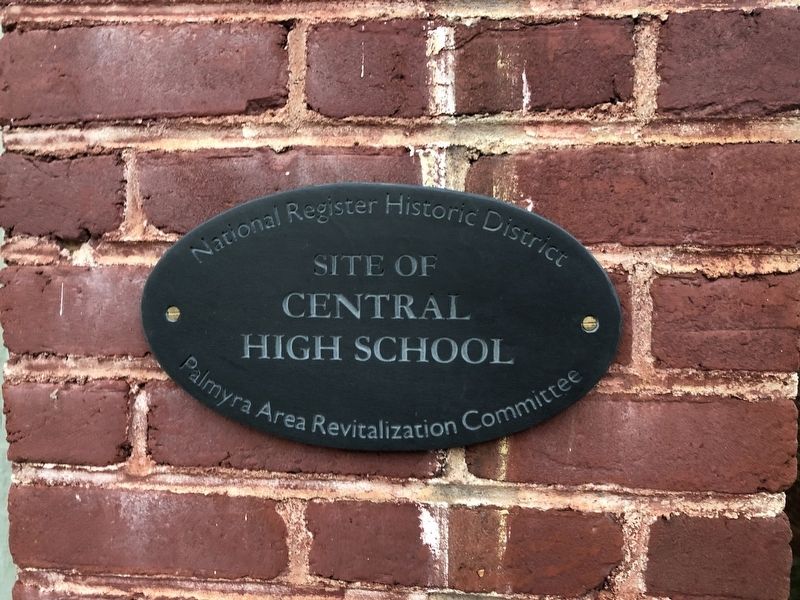
Erected by Palmyra Area Revitalization Committee.
Topics. This historical marker is listed in this topic list: Education.
Location. 37° 51.656′ N, 78° 15.881′ W. Marker is in Palmyra, Virginia, in Fluvanna County. It is on Main Street (Virginia Route 1001) just north of Court Square, on the right when traveling south. Touch for map. Marker is at or near this postal address: 196 Main St, Palmyra VA 22963, United States of America. Touch for directions.

Regionally, this marker is in the Piedmont and in Central Virginia. It is also in the American South and specifically in the Upper South. Globally, it is in North America, the Western Hemisphere, the Western World, and the Anglosphere. Historically, it finds itself in what was once the territory of the Mississippian Culture, one of the original Thirteen Colonies, one of the Confederate States of America, and the Antebellum South.
Other nearby markers. At least 8 other markers are within walking distance of this marker: Former Clerk's Office (a
this page online
Also see . . . National Register Nomination Form for the Historic District.
This excerpt has been taken from the statement of significance from the form (page 3):
From the time of its formation in 1777 until 1828, Fluvanna County did not have a satisfactory permanent county seat. In the spring of 1828, the question of a location for the court was again brought up. Sentiment was strong for and against removing the public buildings either to Wilmington or Palmyra, or repairing and enlarging the existing facilities on the south side of the Rivanna River. Tworeferenda were necessary before the partisans of Palmyra were victorious. The first public building put up in the new, centrally located, county seat was the stone jail, completed in 1829. The jail has built by John G. Hughes, a stonemason, and is markedly similar in style to several of the farm buildings Hughes had built for General Cocke at Bremo.
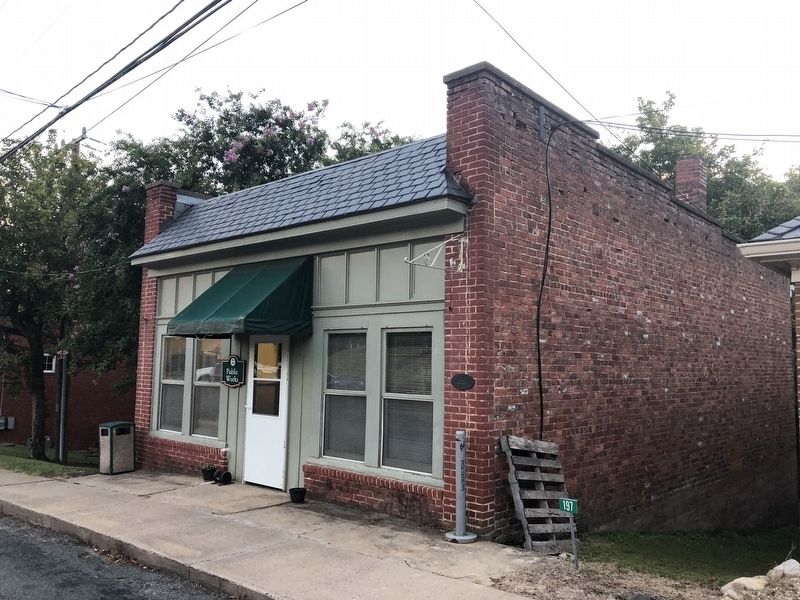
While the school is not specifically named in the form, James W. Moody of the Virginia Historic Landmarks Commission gives a general description of how the county seat was built in the 19th and 20th centuries. The form was prepared in 1970. (Submitted on September 21, 2023, by Devry Becker Jones of Washington, District of Columbia.)
Credits. This page was last revised on September 21, 2023. It was originally submitted on September 5, 2021, by Devry Becker Jones of Washington, District of Columbia. This page has been viewed 321 times since then and 22 times this year. Photos: 1, 2. submitted on September 5, 2021, by Devry Becker Jones of Washington, District of Columbia.
