Kerrytown in Ann Arbor in Washtenaw County, Michigan — The American Midwest (Great Lakes)
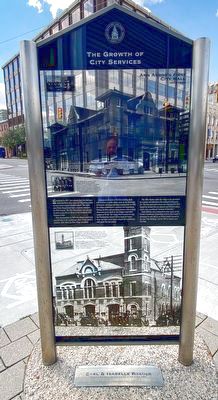
The Growth of City Services
Photographed by J.T. Lambrou, September 10, 2021
1. The Growth of City Services Marker
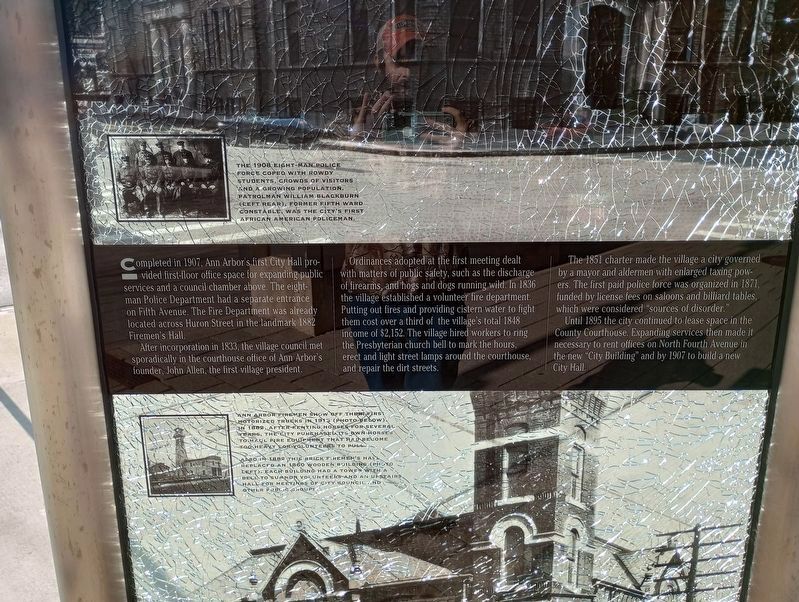
After incorporation in 1833, the village council met sporadically in the courthouse office of Ann Arbor's founder, John Allen, the first village president.
Ordinances adopted at the first meeting dealt with matters of public safety, such as the discharge of firearms, and hogs and dogs running wild. In 1836 the village established a volunteer fire department. Putting out fires and providing cistern water to fight them cost over a third of the village's total 1848 income of $2,152. The village hired workers to ring the Presbyterian church bell to mark the hours, erect and light street lamps around the courthouse, and repair the dirt streets.
The 1851 charter made the village a city governed by a mayor and aldermen with enlarged taxing powers. The first paid police force was organized in 1871, funded by license fees on saloons and billiard tables, which were considered "sources of disorder."
Until 1895 the city continued to lease space in the County Courthouse. Expanding services then made it necessary to rent offices on North Fourth Avenue in the new "City Building" and by 1907 to build a new City Hall.
Topics. This historical marker is listed in these topic lists: Charity & Public Work • Settlements & Settlers. A significant historical year for this entry is 1907.
Location. 42° 16.889′ N, 83° 44.757′ W. Marker is in Ann Arbor, Michigan, in Washtenaw County. It is in Kerrytown. It is at the intersection of North Fifth Avenue and East Huron Street, on the left when traveling south on North Fifth
this page online

Regionally, this marker is in Southeast Michigan and in Greater Detroit. It is also in the American Midwest. Globally, it is in North America, the Western Hemisphere, the Western World, and the Anglosphere. Historically, it finds itself in what was once the Northwest Territory.
Other nearby markers. At least 8 other markers are within walking distance of this marker: Essential City Services (a few steps from this marker); New City Government, New Issues, and a New City Hall (a few steps from this marker); Ann Arbor and LGBTQ+ History / Ann Arbor and Human Rights (within shouting distance of this marker); Central Title Service Building (about 400 feet away, measured in a direct line); Antislavery Society (about 400 feet away); Building New Around Old: The Construction of the Present Courthouse (about 600 feet away); Michigan Becomes a State (about 600 feet away); Hospitality on Courthouse Square (about 600 feet away). Touch for a list and map of all markers in Ann Arbor.
Photographed by Craig Doda, November 11, 2023
2. The Growth of City Services Marker
Photographed by J.T. Lambrou, September 10, 2021
3. The Growth of City Services Marker
Photographed by J.T. Lambrou, September 10, 2021
4. The Growth of City Services Marker
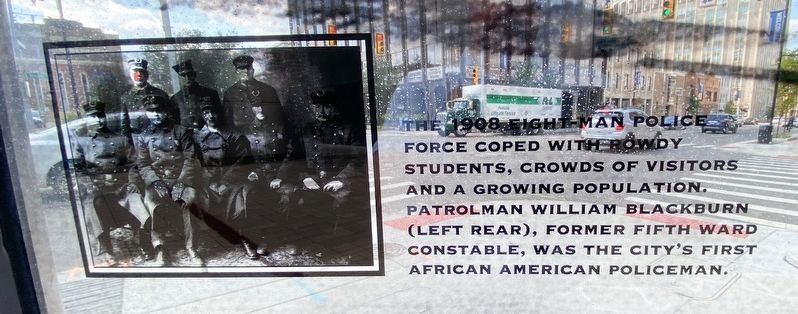
The 1908 eight-man police force coped with rowdy students, crowds of visitors and a growing population. Patrolman William Blackburn (left rear), former fifth ward constable, was the city's first African American policeman.
Photographed by J.T. Lambrou, September 10, 2021
5. The Growth of City Services Marker
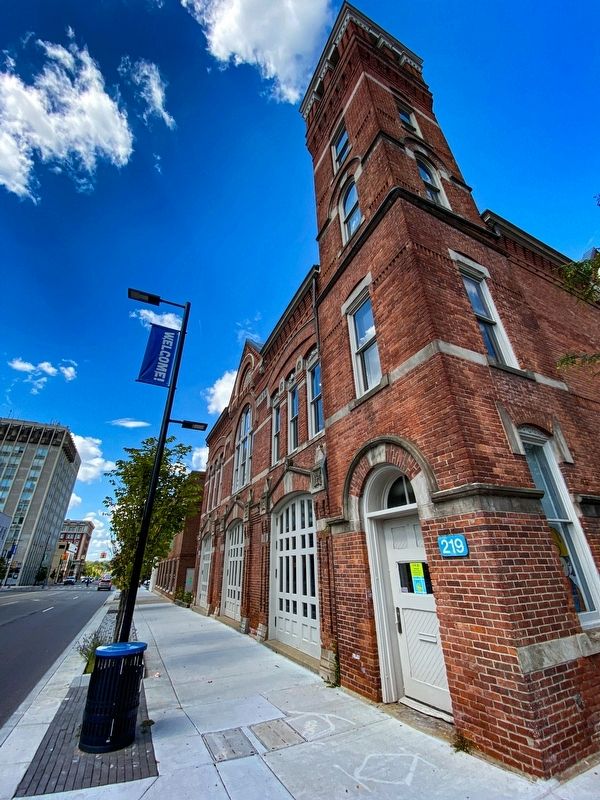
The new 1882 fire hall discussed on marker.
Credits. This page was last revised on November 23, 2023. It was originally submitted on September 13, 2021, by J.T. Lambrou of New Boston, Michigan. This page has been viewed 252 times since then and 24 times this year. Photos: 1. submitted on September 13, 2021, by J.T. Lambrou of New Boston, Michigan. 2. submitted on November 14, 2023, by Craig Doda of Napoleon, Ohio. 3, 4, 5. submitted on September 13, 2021, by J.T. Lambrou of New Boston, Michigan. • Mark Hilton was the editor who published this page.
