Fairlawn in Southeast Washington in Washington, District of Columbia — The American Northeast (Mid-Atlantic)
Good Times on Good Hope
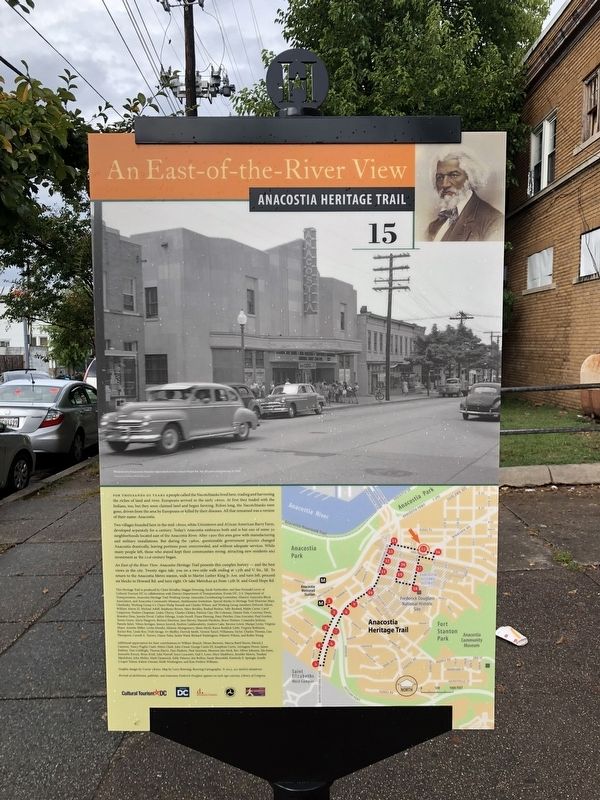
An East-of-the-River View
| — | Anacostia Heritage Trail | — |
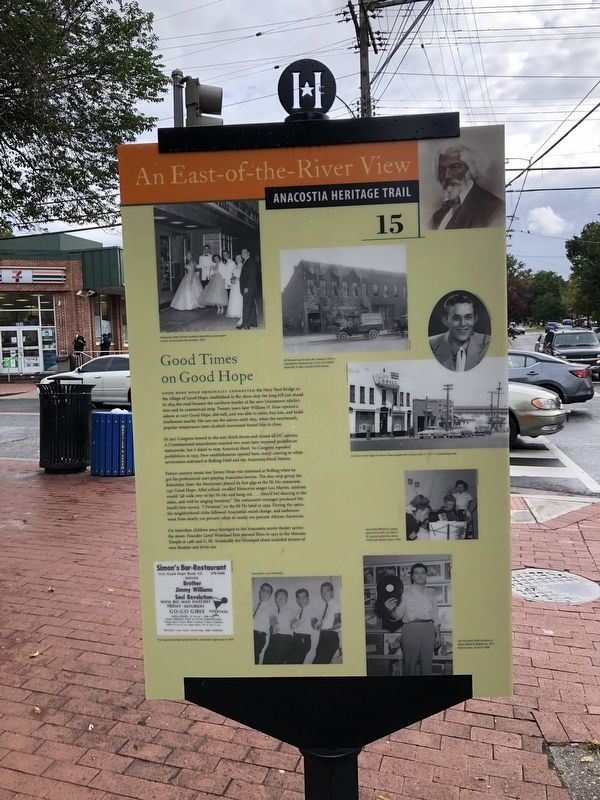
Good Hope Road originally connected the Navy Yard Bridge to the village of Good Hope, established in the 1820s atop the long hill just ahead. In 1854 the road became the northern border of the new Uniontown subdivision and its commercial strip. Twenty years later William H. Rose opened a saloon at 1207 Good Hope, did well, and was able to retire, buy lots, and build rowhouses nearby. His son ran the saloon until 1895, when the enormously popular temperance (anti-alcohol) movement forced him to close.
In 1917 Congress bowed to the anti-drink forces and closed all DC saloons. A Constitutional amendment enacted to years later imposed prohibition nationwide, but it failed to stop America's thirst. So Congress repealed prohibition in 1933. New establishments opened here, many catering to white servicemen stationed at Bolling Field and the Anacostia Naval Station.
Future country star Jimmy Dean was stationed at Bolling when he got his professional start playing Anacostia taverns. The doo-wop group the Bobolinks (later the Memories) played its first gigs at the Hi-Ho restaurant, 1431 Good Hope. After school, recalled Memories
this page online
On Saturdays children once thronged to the Anacostia movie theater across the street. Founder Lloyd Wineland first showed films in 1923 to the Masonic Temple at 14th and U, SE. Eventually the Wineland chain included dozens of area theaters and drive-ins.
Erected 2013 by Cultural Tourism DC. (Marker Number 15.)
Topics and series. This historical marker is listed in these topic lists: Arts, Letters, Music • Entertainment • Industry & Commerce. In addition, it is included in the Anacostia Heritage Trail series list. A significant historical year for this entry is 1854.
Location. 38° 52.014′ N, 76° 59.101′ W. Marker is in Southeast Washington in Washington, District of Columbia. It is in Fairlawn. It is at the intersection of

Regionally, this marker is in the Washington Metropolitan Area. It is also in the American Northeast, in the Upper South, in the Mid-Atlantic, in the Tidewater, and in the Chesapeake Bay Region. Globally, it is in North America, the Western Hemisphere, the Western World, and the Anglosphere.
Other nearby markers. At least 8 other markers are within walking distance of this marker: Education Matters (within shouting distance of this marker); Uniontown, DC's First Suburb (about 500 feet away, measured in a direct line); Rose's Row (about 700 feet away); Mother Churches and Their Daughters (approx. 0.2 miles away); ADACI (approx. 0.2 miles away); Booth's Escape (approx. 0.2 miles away); The Sage of Anacostia (approx. 0.2 miles away); Welcome to the Go-Go Museum & Café. (approx. 0.2 miles away). Touch for a list and map of all markers in Southeast Washington.
Credits. This page was last revised on January 30, 2023. It was originally submitted on September 22, 2021, by Devry Becker Jones of Washington, District of Columbia. This page has been viewed 1,466 times since then and 84 times this year. Photos: 1, 2, 3. submitted on September 22, 2021, by Devry Becker Jones of Washington, District of Columbia.
