Near Pikeville in Bledsoe County, Tennessee — The American South (East South Central)
Pikeville African Methodist Episcopal Zion Church
Southeast Tennessee Religious Heritage Trail
Photographed by Duane and Tracy Marsteller, October 23, 2021
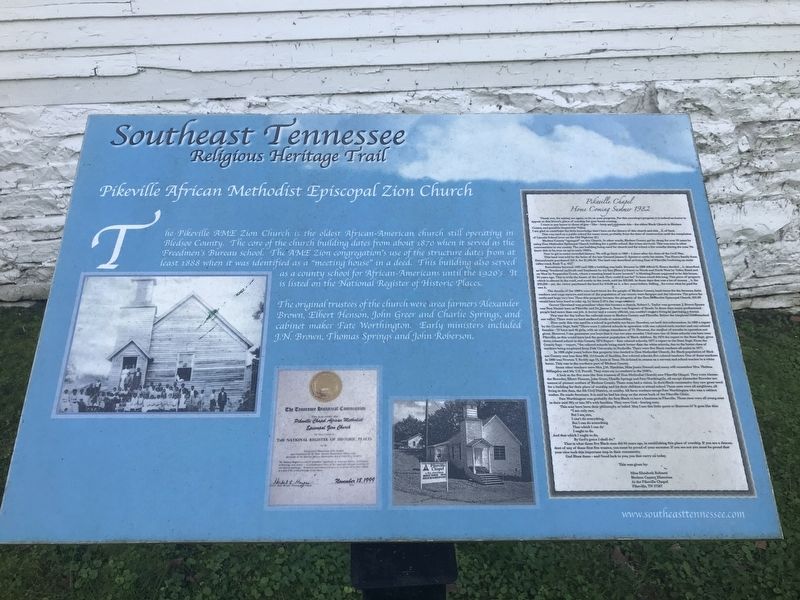
1. Pikeville African Methodist Episcopal Zion Church Marker
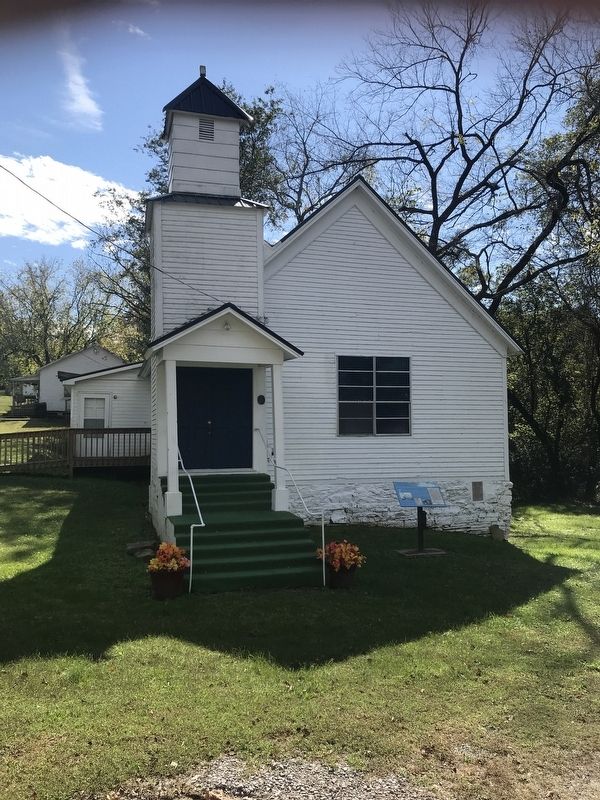
The Pikeville AME Zion Church is the oldest African-American church still operating in Bledsoe County. The core of the church building dates from about 1870 when it served as the Freedmen's Bureau school. The AME Zion congregation's use of the structure dates from at least 1888 when it was identified as a "meeting house” in a deed. This building also served as a county school for African-Americans until the 1920's. It is listed on the National Register of Historic Places.
The original trustees of the church were area farmers Alexander Brown, Elbert Henson, John Greer and Charlie Springs, and cabinet maker Fate Worthington. Early ministers included J.N. Brown, Thomas Springs and John Roberson.
Topics and series. This historical marker is listed in these topic lists: African Americans • Education • Religion & Religious Structures. In addition, it is included in the African Methodist Episcopal Zion (AME Zion) Church series list. A significant historical year for this entry is 1870.
Location. 35° 36.316′ N, 85° 11.124′ W. Marker is near Pikeville, Tennessee, in Bledsoe County. It is on Upper East Valley Road (Tennessee
this page online

Regionally, this marker is in the Cumberland Plateau. It is also in the American South, specifically in the Upper South, in Appalachia, and specifically in Southern Appalachia. Globally, it is in North America, the Western Hemisphere, the Western World, and the Anglosphere. Historically, it finds itself in what was once the territory of the Mississippian Culture, one of the Confederate States of America, and the Antebellum South.
Other nearby markers. At least 8 other markers are within walking distance of this marker: Dr. James A. Ross House (about 800 feet away, measured in a direct line); Bledsoe County Jail (approx. 0.2 miles away); Bledsoe County (approx. 0.2 miles away); John Bridgman House (approx. 0.2 miles away); Bledsoe County Veterans Memorial (approx. 0.2 miles away); Pikeville During the Civil War (approx. 0.2 miles away); R.E. Winsett (approx. 0.2 miles away); James Beriah Frazier (approx. 0.3 miles away). Touch for a list and map
Photographed by Duane and Tracy Marsteller, October 23, 2021
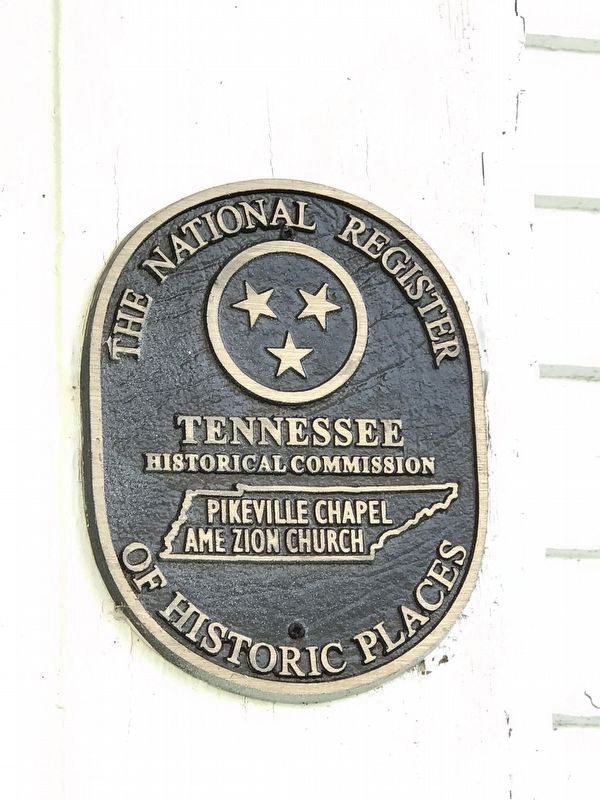
2. Pikeville African Methodist Episcopal Zion Church Secondary Marker
This plaque, placed by the Tennessee Historical Commission, notes the church's inclusion in the National Register of Historic Places.
Regarding Pikeville African Methodist Episcopal Zion Church. Excerpt from the National Register nomination:
… From its founding throughout the Jim Crow era, the setting and location of the church was significant to its association with African-American ethnic heritage. Lying on the east bank of the Sequatchie River, the church is physically segregated from the remainder of Pikeville. It was next to the town, but clearly not part of town. Even today it lies outside the official incorporated boundaries of the City of Pikeville. However, the riverside location also was desirable for the church's members. They held baptismal ceremonies in the river and the location was ideal for church social gatherings and picnics. As the oldest African-American church in the entire county, the grounds were used for all types of social and cultural events throughout the twentieth century. After the mid-1920s, the Rosenwald School could assume some of those civic roles — as a voting booth, a place for lectures, and the like. The more "controversial" events, such as when local blacks gathered to discuss anti-lynching lawsin the 1910s and 1920s and later civil rights legislation in the 1950s and 1960s, could not occur at the school. These meetings took place at the church.via NPS, unknown3. Pikeville African Methodist Episcopal Zion ChurchNational Register of Historic Places Digital Archive on NPGallery website entry
Click for more information.

Photographed by Duane and Tracy Marsteller, October 23, 2021
4. Pikeville African Methodist Episcopal Zion Church Marker
Credits. This page was last revised on November 10, 2024. It was originally submitted on October 24, 2021, by Duane and Tracy Marsteller of Murfreesboro, Tennessee. This page has been viewed 710 times since then and 72 times this year. Photos: 1, 2. submitted on October 24, 2021, by Duane and Tracy Marsteller of Murfreesboro, Tennessee. 3. submitted on April 15, 2022, by Larry Gertner of New York, New York. 4. submitted on October 24, 2021, by Duane and Tracy Marsteller of Murfreesboro, Tennessee.
