Douglas in Chicago in Cook County, Illinois — The American Midwest (Great Lakes)
Welcome to Bronzeville
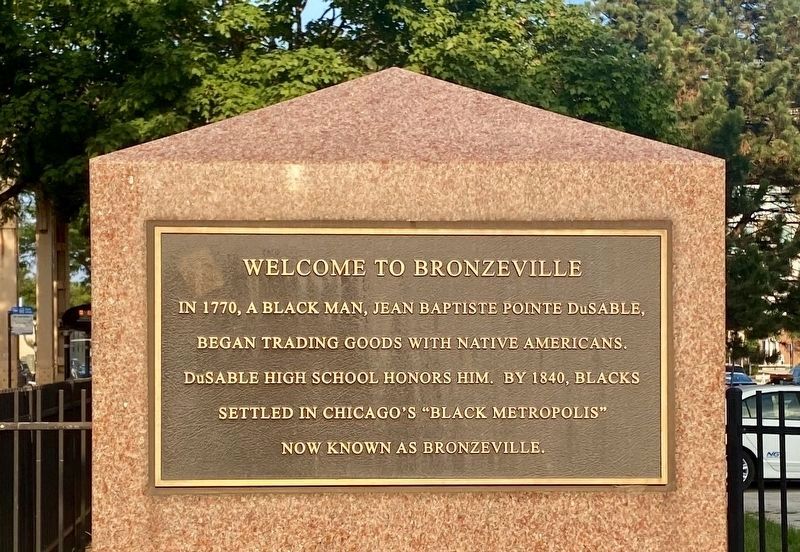
Photographed by Andrew Ruppenstein, August 27, 2021
1. Welcome to Bronzeville Marker - panel one
(panel two:)
The Harlem Globetrotters originated in Bronzeville using members of the Wendell Phillips High School basketball team. Robert S. Abbott founded the Chicago Defender newspaper. He also encouraged Bessie Coleman a resident to become the first Black female pilot. Jack L. Cooper, the first Black radio broadcaster in Chicago, aired in 1929. Lu Palmer journalist and news media personality, promoted black empowerment and social equality on his weekly show.
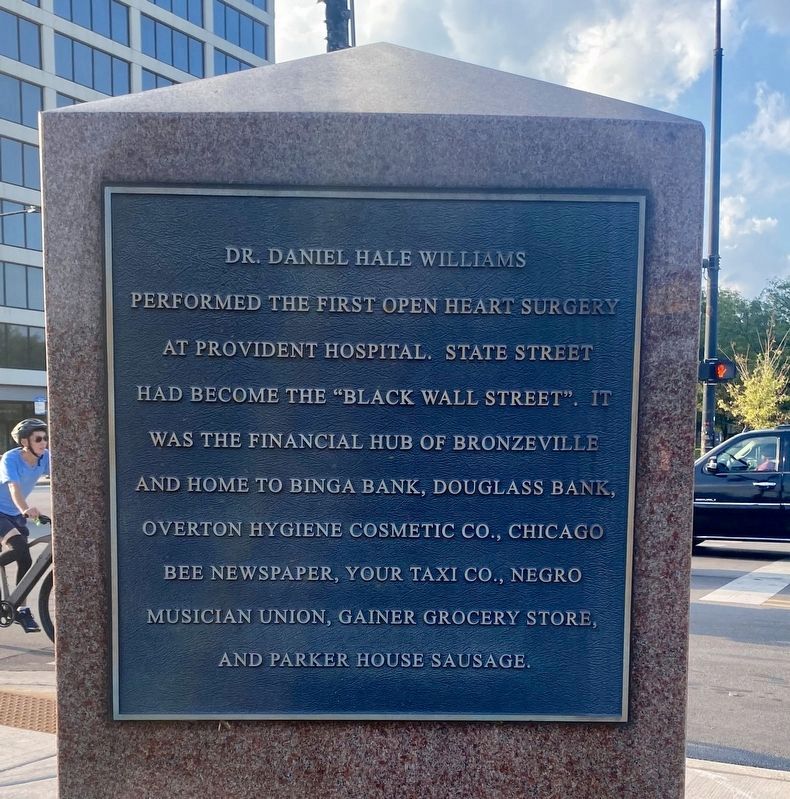
(panel three:)
Dr. Daniel Hale Williams performed the first open heart surgery at Provident Hospital. State Street had become the "Black Wall Street". It was the financial hub of Bronzeville and home to Binga Bank, Douglass Bank, Overton Hygiene Cosmetic Co., Chicago Bee Newspaper, Your Taxi Co., Negro Musician Union, Gainer Grocery Store, and Parker House Sausage.
Erected 2009 by Bronzeville Merchant Association.
Topics.
this page online
Location. 41° 49.855′ N, 87° 37.579′ W. Marker is in Chicago, Illinois, in Cook County. It is in Douglas. It is at the intersection of South State Street and East 35th Street, on the right when traveling north on South State Street. Touch for map. Marker is in this post office area: Chicago IL 60616, United States of America. Touch for directions.

Regionally, this marker is on Chicago’s South Side and in Chicago’s Bronzeville. It is also in the American Midwest. Globally, it is in North America, on the Great Lakes, in the Western Hemisphere, in the Western World, and in the Anglosphere. Historically, it finds itself in what was once the Viceroyalty of New France, the territory of the Mississippian Culture, and the Northwest Territory.
Other nearby markers. At least 8 other markers are within walking distance of this marker: A different marker also named Welcome to Bronzeville (within shouting distance of this marker); Joseph Sanford
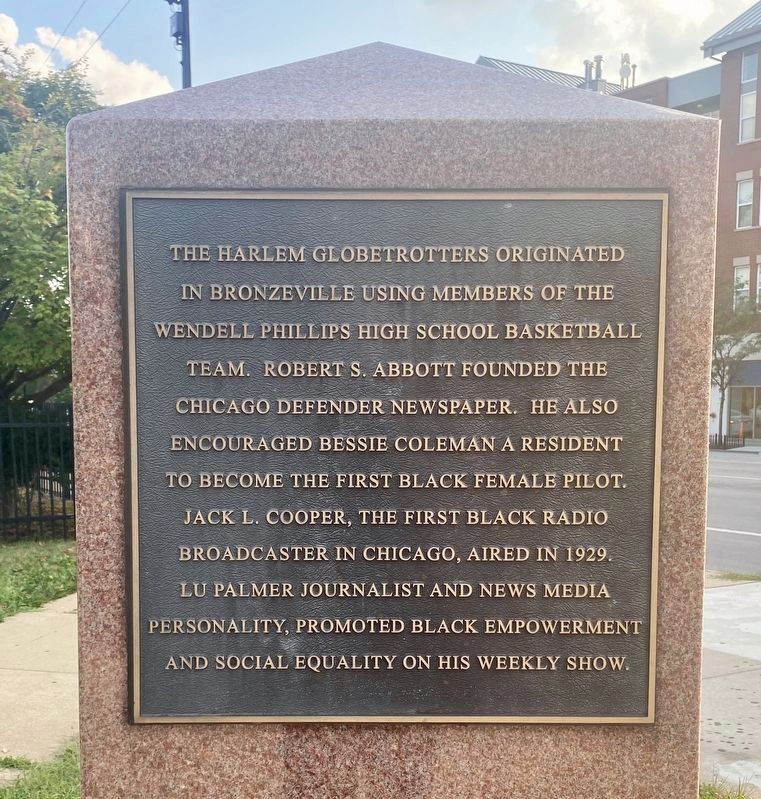
Photographed by Andrew Ruppenstein, August 27, 2021
2. Welcome to Bronzeville Marker - panel two
Also see . . .
1. Bronzeville: The Black Metropolis (Build Bronzeville).
"In the first half of the 20th century, Bronzeville was one of the most important destinations of the “Great Migration”, becoming the home to hundreds of thousands of Blacks fleeing oppression in the South. Confronted with residential segregation and a culture of commercial exclusion, Blacks created the Black Metropolis, a "city-within-a-city" that provided all of the essentials for day-to-day living and put Black Chicago on the map. Commerce flourished, jobs were abundant, and innovations in music, literature, theater and beyond attracted people from across Chicago and defined America. They gave rise(Submitted on December 3, 2021.)to a Black Arts Movement, created gospel and electrified blues, built hundreds of businesses, and created a political base that eventually would give birth to the nation’s first Black president."Photographed by Andrew Ruppenstein, August 27, 20213. Welcome to Bronzeville Marker - panel three
2. Bronzeville, the Black Metropolis (YouTube, 2 min.). "Excerpts from footage for the documentary TALKING BLACK in AMERICA (www.talkingblackinamerica.org)" (Submitted on December 3, 2021.)
3. Bronzeville Memorialized (We the People Residents' Journal). Short article describing the Obelisk project, of which this marker is part of. (Submitted on December 3, 2021.)
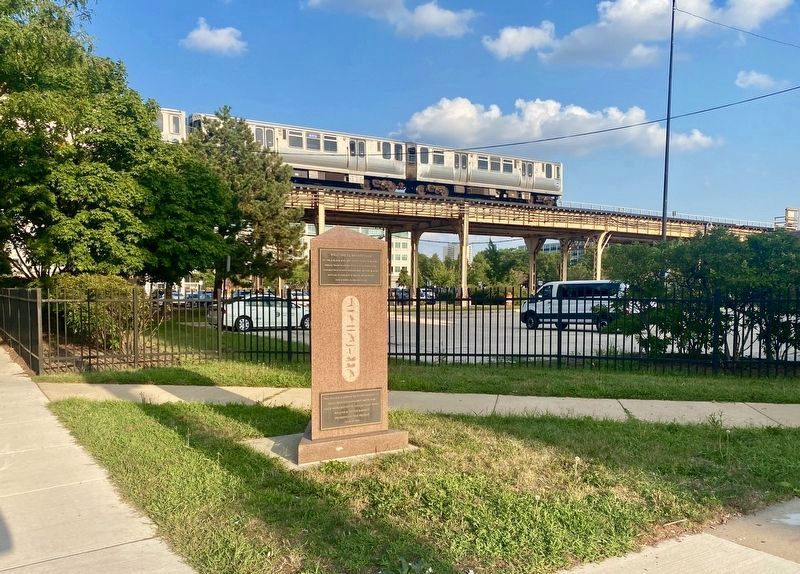
Photographed by Andrew Ruppenstein, August 27, 2021
4. Welcome to Bronzeville Obelisk and Marker - wide view
Photographed by Andrew Ruppenstein, August 27, 2021
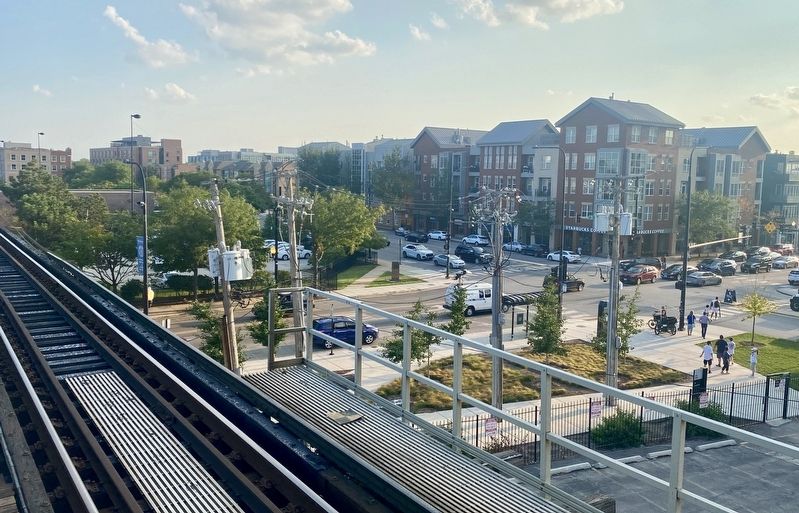
5. Welcome to Bronzeville Marker - wider view, looking southwest from the el
The Bronzeville obelisk is visible here in the center of the picture, occupying a triangular plot at the intersection of 35th and South State Streets.
Photographed by Andrew Ruppenstein, August 27, 2021
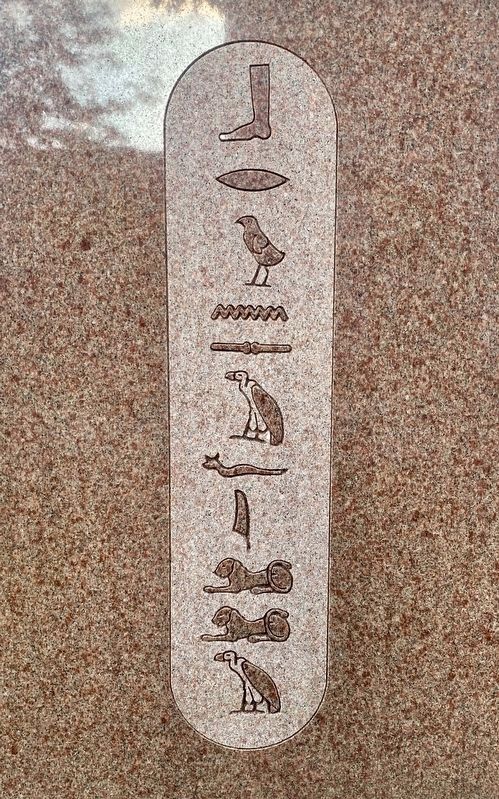
6. Welcome to Bronzeville Marker - cartouche
On the face of obelisk is a cartouche with "Bronzeville" spelled out in the Egpytian hieroglyph alphabet. (𓃀 = B, 𓂋 = R, 𓅱 = O, etc.)
Credits. This page was last revised on September 29, 2026. It was originally submitted on December 3, 2021, by Andrew Ruppenstein of Lamorinda, California. This page has been viewed 682 times since then and 35 times this year. Photos: 1, 2, 3, 4, 5, 6. submitted on December 3, 2021, by Andrew Ruppenstein of Lamorinda, California.
