Oak Park in Cook County, Illinois — The American Midwest (Great Lakes)
Frank Lloyd Wright Home and Studio
Photographed by Andrew Ruppenstein, December 4, 2021
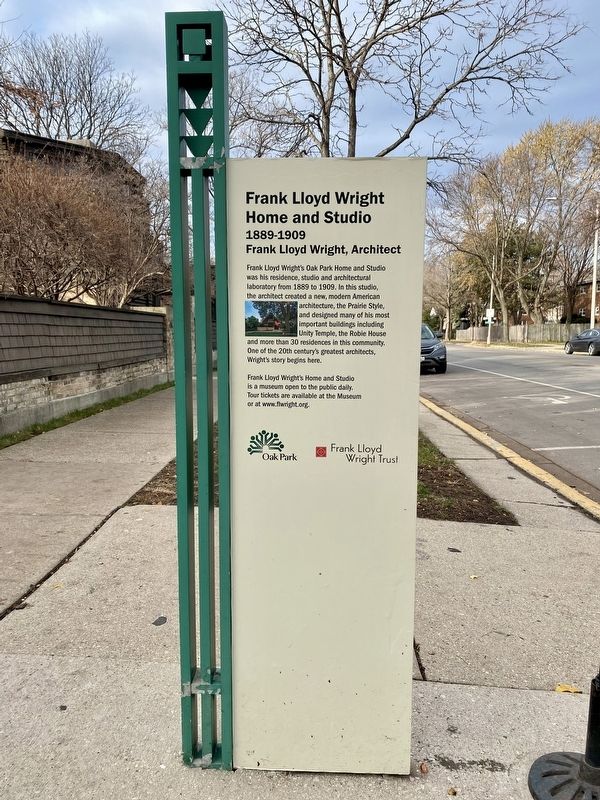
1. Frank Lloyd Wright Home and Studio Marker
Frank Lloyd Wright Home and Studio
1889-1909
Frank Lloyd Wright, Architect
Frank Lloyd Wright's Oak Park Home and Studio was his residence, studio and architectural laboratory from 1889 to 1909. In this studio, the architect created a new, modern American architecture, the Prairie Style, and designed many of his most important buildings including Unity Temple, the Robie House and more than 30 residences in this community. One of the 20th century's greatest architects, Wright's story begins here.
Frank Lloyd Wright's Home and Studio is a museum open to the public daily. Tour tickets are available at the Museum or at www.flwright.org.
Erected by Frank Lloyd Wright Trust, City of Oak Park.
Topics and series. This historical marker is listed in this topic list: Architecture. In addition, it is included in the Frank Lloyd Wright, and the National Historic Landmarks series lists. A significant historical date for this entry is April 9, 1959.
Location. 41° 53.655′ N, 87° 47.964′ W. Marker is in Oak Park, Illinois, in Cook County. It is at the intersection of Chicago Avenue and Forest Avenue, on the right when traveling
this page online

Regionally, this marker is in Greater Chicago. It is also in the American Midwest. Globally, it is in North America, on the Great Lakes, in the Western Hemisphere, in the Western World, and in the Anglosphere. Historically, it finds itself in what was once the Viceroyalty of New France, the territory of the Mississippian Culture, and the Northwest Territory.
Other nearby markers. At least 8 other markers are within walking distance of this marker: Frank Lloyd Wright Preservation Fund (here, next to this marker); Frank Lloyd Wright Home and Studio Campaign (a few steps from this marker); Grace W. Trout (about 400 feet away, measured in a direct line); Moore-Dugal Residence (about 600 feet away); Ernest Hemingway Boyhood Home (approx. 0.2 miles away); Birthplace of Ernest Hemingway (approx. ¼ mile away); Austin Gardens Woodland Habitat (approx. 0.3 miles away); a different marker also named Austin Gardens Woodland Habitat (approx. 0.3 miles away). Touch for a list and map
Photographed by Andrew Ruppenstein, December 4, 2021
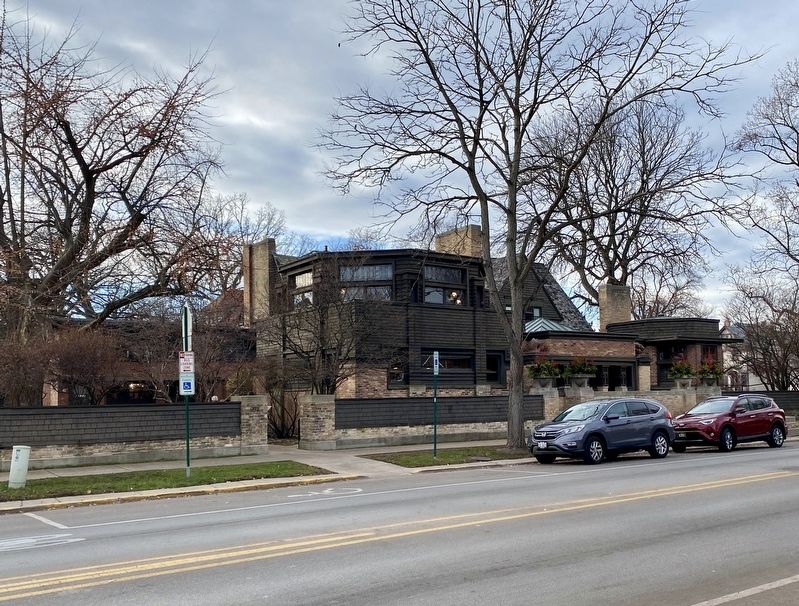
2. Frank Lloyd Wright Home and Studio
View of the home/studio, with the marker just out of the picture on the left.
Also see . . .
1. Frank Lloyd Wright Home & Studio...951 Chicago Avenue (Historic American Building Survey). Library of Congress website entry:
HABS survey with a house history plus photos.
"Significance: This structure, consisting of a group of buildings, includes the first residence of Frank Lloyd Wright built for himself. His home, built in 1889, shows the assimilation of the Eastern "Shingle Style," though giving evidence of an already present tendency to simplify and unify. Similarly, the Studio wing, added in 1895, shows early experimentation with the open plan. Together, the House and Studio are a source and proving ground for ideas and forms which were put to dramatic use throughout Wright's career."(Submitted on December 24, 2021.)
2. Oak Park Home and Studio. Frank Lloyd Wright Foundation website entry:
"The home was the first over which Wright had complete artistic control, and he would use it as an opportunity to experiment with design concepts that contained the seeds of his architectural philosophy. Wright revised the design of the building multiple times, continually(Submitted on December 24, 2021.)refining ideas that would shape his work for decades to come. The exterior of the house, which he would later refer to as “Seaside Colonial,” reflects his early interest in the Shingle style, then popular on the East Coast and favored by his previous employer, Joseph Lyman Silsbee. Sullivan’s stylistic influence can also be seen in the simplification and abstraction of the building and its plan."Photographed by Andrew Ruppenstein, December 4, 20213. Frank Lloyd Wright Home and Studio - detailMounted to exterior wall.
3. Frank Lloyd Wright. Wikipedia entry:
"Frank Lloyd Wright (June 8, 1867 – April 9, 1959) was an American architect, designer, writer, and educator. He designed more than 1,000 structures over a creative period of 70 years. Wright believed in designing in harmony with humanity and the environment, a philosophy he called organic architecture. This philosophy was exemplified in Fallingwater (1935), which has been called "the best all-time work of American architecture". Wright played a key role in the architectural movements of the twentieth century, influencing architects worldwide through his works and hundreds of apprentices in his Taliesin Fellowship."(Submitted on December 24, 2021, by Andrew Ruppenstein of Lamorinda, California.)
Photographed by Andrew Ruppenstein, December 4, 2021
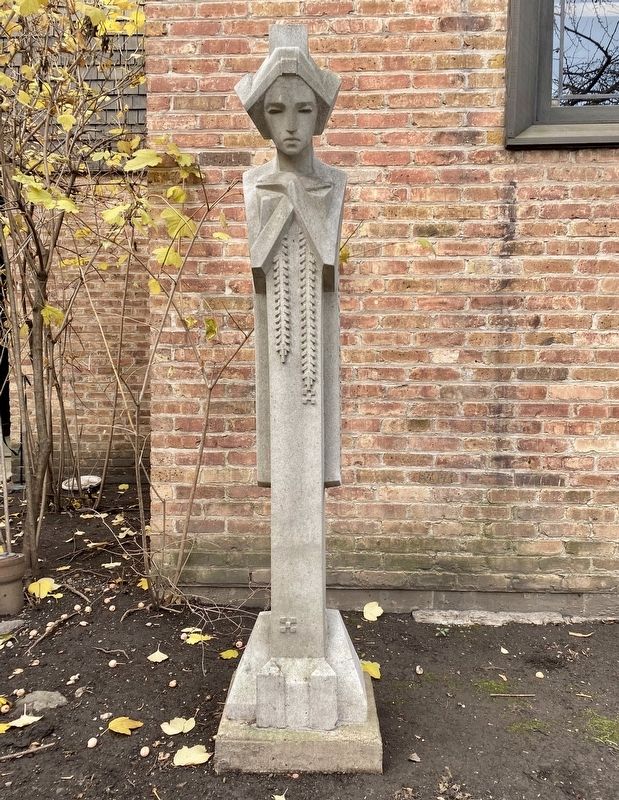
4. Frank Lloyd Wright Home and Studio - detail
The sprite is found in the courtyard.
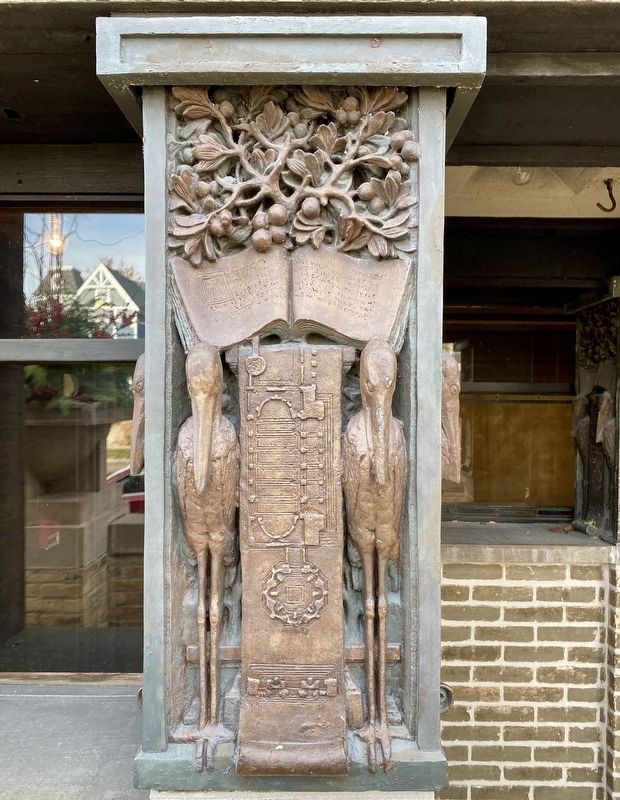
Photographed by Andrew Ruppenstein, December 4, 2021
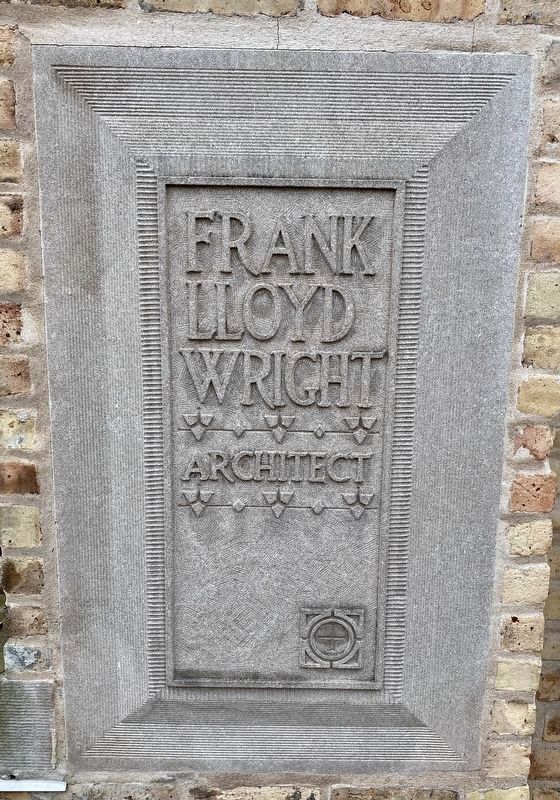
5. Frank Lloyd Wright Home and Studio Marker - detail
This and similar panels are found a bit to the west of the entrance on the building exterior.
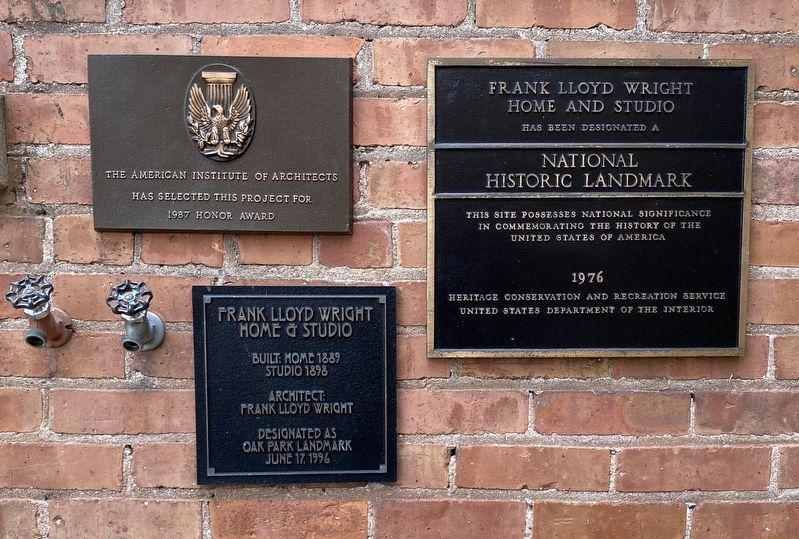
Photographed by Andrew Ruppenstein, December 4, 2021
6. Frank Lloyd Wright Home and Studio - additional plaques
In the courtyard, on the wall to the left of the building entrance are three plaques: an Oak Park landmark plaque, and AIA recognition plaque, and a National Historic Landmark plaque.
Credits. This page was last revised on January 30, 2023. It was originally submitted on December 24, 2021, by Andrew Ruppenstein of Lamorinda, California. This page has been viewed 777 times since then and 35 times this year. Photos: 1, 2, 3, 4, 5, 6. submitted on December 24, 2021, by Andrew Ruppenstein of Lamorinda, California.
