Highlands/Perkins in Baton Rouge in East Baton Rouge Parish, Louisiana — The American South (West South Central)
LSU Baseball History
Photographed by Cajun Scrambler, July 3, 2021
1. LSU Baseball History Marker
Inscription.
LSU Baseball History. .
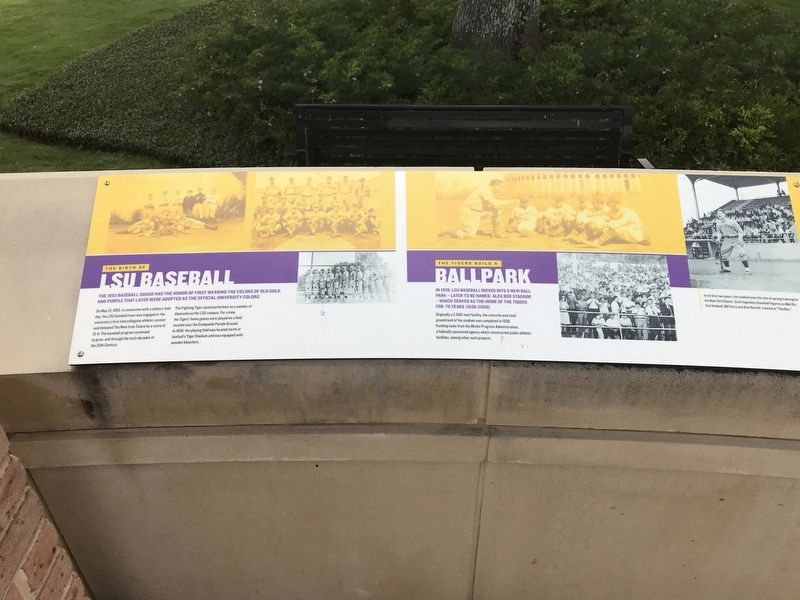
The Birth of LSU Baseball, . The 1903 Baseball squad had the honor of first wearing the colors of Old Gold and Purple that later were adopted as the official University colors On May 13, 1893, in connection with a military field day , the LSU baseball team was engaged in the university's first intercollegiate athletic contest and defeated The Nine from Tulane by a score of 10-8. The baseball program continued to grow and through the decades of the 20th Century. The Fighting Tiger squad performed on a number of diamonds on the LSU campus. For a time, the Tigers' home games were played on a field located near the Campanile Parade Ground. In 1936, the playing field was located north of the football's Tiger Stadium and was equipped with wooden bleachers.,
The Tigers Build a Ballpark. , In 1938, LSU Baseball moved into a new ball park - Later to be named Alex Box Stadium - which served as the home of the Tigers for 70 tears (1938-2008). Originally a 2,500-seat facility, the concrete and steel grandstand of the stadium was completed in 1938. Funding came from the Works Progress Administration, a federally sponsored agency which constructed public athletic facilities, among other such projects. In its first two years, the stadium was the site of spring training for the New York Giants. Such legendary baseball figures as Mel Ott, Carl Hubbell, Bill Terry and Dick Bartell trained at "The Box.",
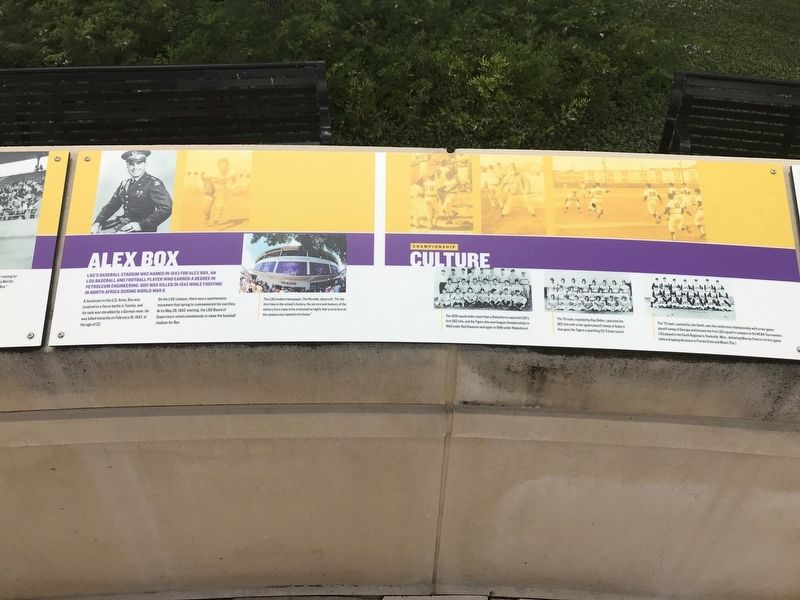
Alex Box. , LSU's baseball stadium was named in 1943 for Alex Box, an LSU baseball and football player who earned a degree in petroleum engineering. Box was killed in 1943 while fighting in North Africa during World War II. A lieutenant in the U.S. Army, Box was involved in a fierce battle in Tunisia, and his tank was shredded by a German mine. He was killed instantly on February 19, 1943 at the age of 22. On the LSU campus, there was a spontaneous movement that spring to commemorate his sacrifice. At its May 28, 1943 meeting, the LSU Board of Supervisors voted unanimously to name the baseball stadium for Box. On the LSU campus, there was a spontaneous movement that spring to commemorate his sacrifice. At its May 28, 1943 meeting, the LSU Board of Supervisors voted unanimously to name the baseball stadium for Box. The LSU student newspaper, The Reveille, observed, "For the first time in the school's history, the service and memory of the military hero came to be esteemed so highly that a structure on the campus was named in his honor.",
Championship Culture. The 1939 squad under coach Harry Rabenhorst captured LSU's first SEC title, and the Tigers also won league championships in 1943 under Red Swanson and again in 1946 under Rabenhorst. The 61 team, coached by Ray Didier, captured the SEC title with a two-game playoff sweep of Auburn that gave the Tigers a sparkling 20-5 final record. The 75 team, coached by Jim Smith, won the conference championship with a two-game playoff sweep of Georgia and became the first LSU squad to compete in the NCAA Tournament LSU played in the South Regional in Starkville, Miss defeating Murray State in its first game before dropping decisions to Florida State and Miami (Fla.).,
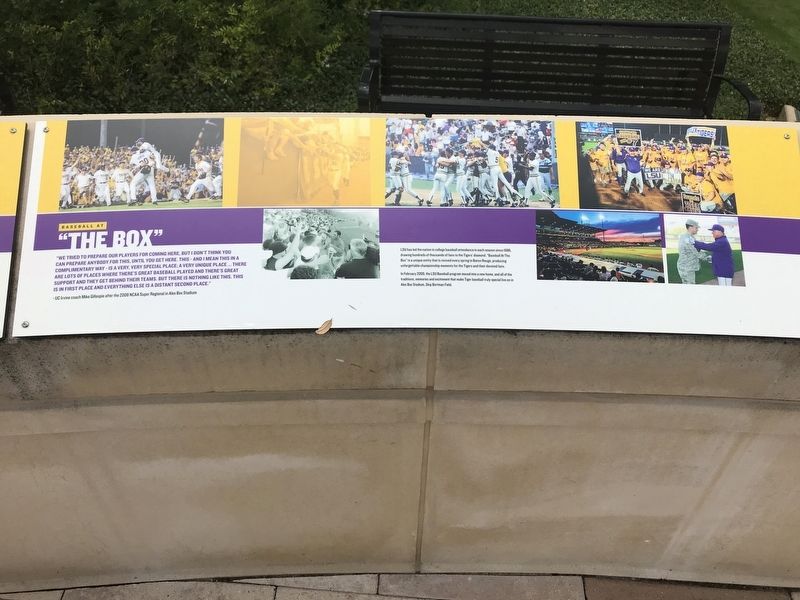
Baseball at "The Box". , "We tried to prepare our players for coming here, but I don't think you can prepare anybody for this, until you get here. This - and I mean this in a complimentary way - is a very, very special place; a very unique place ... there are lots of places where there's great baseball played and there's great support and they get behind their teams. But there is nothing like this. This is in first place and everything else is a distant second place." - UC Irvine coach Mike Gillespie after the 2008 NCAA Super Regional in Alex Box Stadium., LSU has led the nation in college baseball attendance in each season since 1996, drawing hundreds of thousands of fans to the Tigers' diamond. "Baseball At The Box" is a unique entity that is revived every spring in Baton Rouge, producing unforgettable championship moments for the Tigers and their devoted fans. In February 2009, the LSU Baseball program moved into a new home, and all of the traditions, memories and excitement that make Tiger baseball truly special live on in Alex Box Stadium, Skip Bertman Field.,
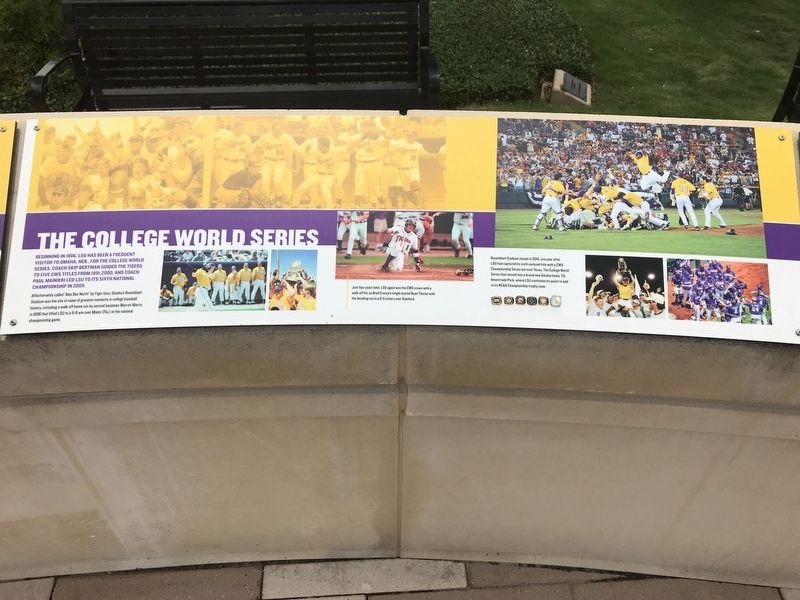
The College World Series. , Beginning in 1986, LSU has been a frequent visitor to Omaha, Neb, for the College World Series. Coach Skip Bertman guided the Tigers to five CWS titles from 1991-2000, and Coach Paul Mainieri led LSU to its sixth National Championship in 2009. Affectionately called "Alex Box North" by Tiger fans, Omaha's Rosenblatt Stadium was the site of some of greatest moments in college baseball history, including a walk-off home run by second baseman Warren Morris in 1996 that lifted LSU to a 9-8 win over Miami (Fla.) in the national championship game. Just four years later, LSU again won the CWS crown with a walk-off hit, as Brad Cresse's single scored Ryan Theriot with the deciding run in a 6-5 victory over Stanford. Rosenblatt Stadium closed in 2010, one year after LSU had captured its sixth national title with a CWS Championship Series win over Texas. The College World Series then moved into a brand new Omaha home, TD Ameritrade Park, where LSU continues its quest to add to its NCAA Championship trophy case.,
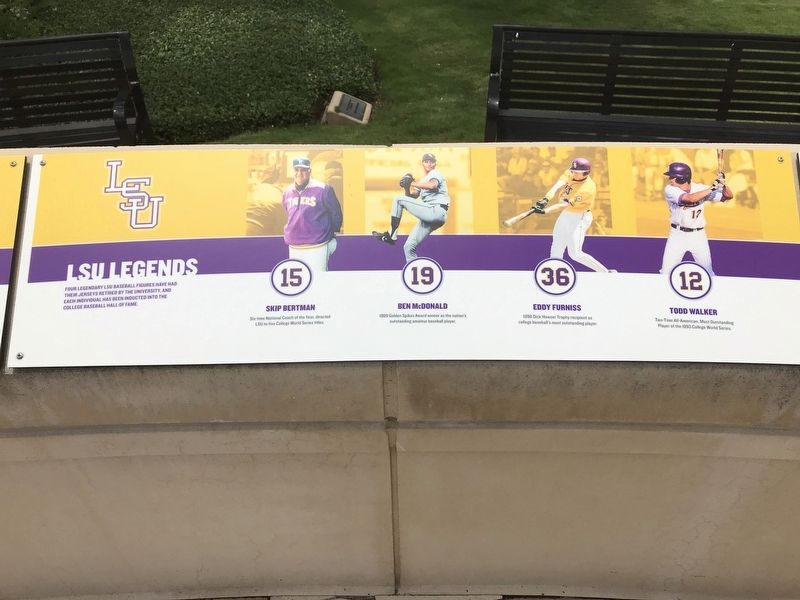
LSU Legends. , Four Legendary LSU Baseball figures have had their jerseys retired by the University, and each individual has been inducted into the College Baseball Hall of FameSkip Bertman Six-time National Coach of the Year, directed LSU to five College World Series Ben McDonald 1989 Golden Spikes Award winner as the nation's outstanding amateur baseball player Eddie Furniss 1998 Dick Howser Trophy recipient as college baseball's most outstanding player Todd Walker two-Time All-American, Most Outstanding Player of the 1993 College World Series.,
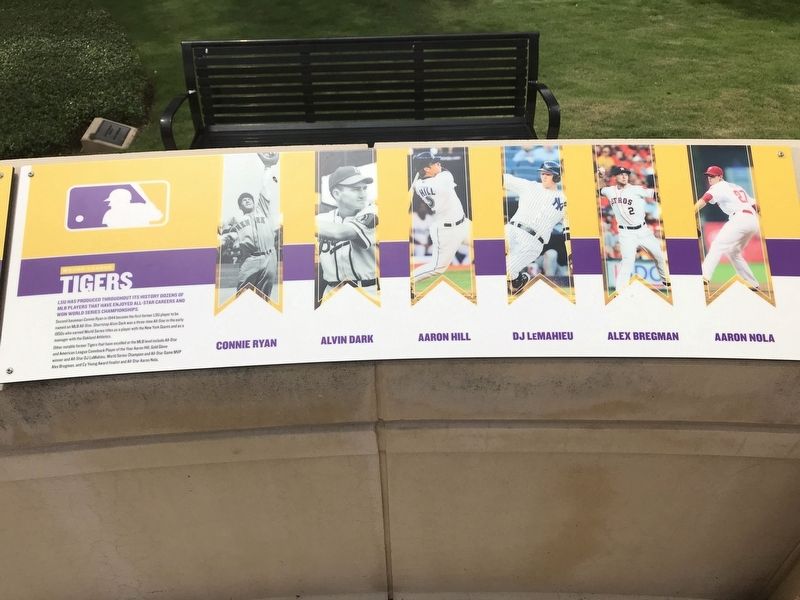
Major League Tigers . LSU has produced throughout its history dozens of MLB players that have enjoyed All-Star careers and won World Series Championships. Second baseman Connie Ryan in 1944 became the first former LSU player to be named an MLB All-Star. Shortstop Alvin Dark was a three-time All-Star in the early 1950s who earned World Series titles as a player with the New York Giants and as a manager with the Oakland Athletics Other notable former Tigers that have excelled at the MLB level include All-Star and American League Comeback Player of the Year Aaron Hill, Gold Glove winner and All-Star DJ LeMahieu, World Series Champion and All-Star Game MVP Alex Bregman, and Cy Young Award finalist and All-Star Aaron Nola.
The Birth of LSU Baseball
The 1903 Baseball squad had the honor of first wearing the colors of Old Gold and Purple that later were adopted as the official University colors On May 13, 1893, in connection with a military field day , the LSU baseball team was engaged in the university's first intercollegiate athletic contest and defeated The Nine from Tulane by a score of 10-8. The baseball program continued to grow and through the decades of the 20th Century. The Fighting Tiger squad performed on a number of diamonds on the LSU campus. For a time, the Tigers' home games were played on a field located near the Campanile Parade Ground. In 1936, the playing field was located north of the football's Tiger Stadium and was equipped with wooden bleachers.
The Tigers Build a Ballpark
In 1938, LSU Baseball moved into a new ball park - Later to be named Alex Box Stadium - which served as the home of the Tigers for 70 tears (1938-2008). Originally a 2,500-seat facility, the concrete and steel
grandstand of the stadium was completed in 1938.
Funding came from the Works Progress Administration,
a federally sponsored agency which constructed
Click or scan to see this page online
public athletic
facilities, among other such projects. In its first two years, the stadium was the site of spring training for
the New York Giants. Such legendary baseball figures as Mel Ott,
Carl Hubbell, Bill Terry and Dick Bartell trained at "The Box."
Alex Box
LSU's baseball stadium was named in 1943 for Alex Box, an LSU baseball and football player who earned a degree in petroleum engineering. Box was killed in 1943 while fighting in North Africa during World War II. A lieutenant in the U.S. Army, Box was
involved in a fierce battle in Tunisia, and
his tank was shredded by a German mine. He
was killed instantly on February 19, 1943 at
the age of 22. On the LSU campus, there was a spontaneous
movement that spring to commemorate his sacrifice.
At its May 28, 1943 meeting, the LSU Board of
Supervisors voted unanimously to name the baseball
stadium for Box. On the LSU campus, there was a spontaneous
movement that spring to commemorate his sacrifice.
At its May 28, 1943 meeting, the LSU Board of
Supervisors voted unanimously to name the baseball
stadium for Box. The LSU student newspaper, The Reveille, observed, "For the
first
Photographed by Cajun Scrambler, July 3, 2021
2. LSU Baseball History Marker
time in the school's history, the service and memory of the
military hero came to be esteemed so highly that a structure on
the campus was named in his honor."
Championship Culture
The 1939 squad under coach Harry Rabenhorst captured LSU's
first SEC title, and the Tigers also won league championships in
1943 under Red Swanson and again in 1946 under Rabenhorst.
The 61 team, coached by Ray Didier, captured the
SEC title with a two-game playoff sweep of Auburn
that gave the Tigers a sparkling 20-5 final record.
The 75 team, coached by Jim Smith, won the conference championship with a two-game
playoff sweep of Georgia and became the first LSU squad to compete in the NCAA Tournament
LSU played in the South Regional in Starkville, Miss defeating Murray State in its first game
before dropping decisions to Florida State and Miami (Fla.).
Baseball at "The Box"
"We tried to prepare our players for coming here, but I don't think you
can prepare anybody for this, until you get here. This - and I mean this in a
complimentary way - is a very, very special place; a very unique place ... there
are lots of places where there's great baseball played and there's great
support and they get behind their teams. But there is nothing like this. This
is in first place and everything else is a distant second place."
Photographed by Cajun Scrambler, July 3, 2021
3. LSU Baseball History Marker
- UC Irvine coach Mike Gillespie after the 2008 NCAA Super Regional in Alex Box Stadium.
LSU has led the nation in college baseball attendance in each season since 1996,
drawing hundreds of thousands of fans to the Tigers' diamond. "Baseball At The
Box" is a unique entity that is revived every spring in Baton Rouge, producing
unforgettable championship moments for the Tigers and their devoted fans.
In February 2009, the LSU Baseball program moved into a new home, and all of the
traditions, memories and excitement that make Tiger baseball truly special live on in
Alex Box Stadium, Skip Bertman Field.
The College World Series
Beginning in 1986, LSU has been a frequent
visitor to Omaha, Neb, for the College World
Series. Coach Skip Bertman guided the Tigers
to five CWS titles from 1991-2000, and Coach
Paul Mainieri led LSU to its sixth National
Championship in 2009. Affectionately called "Alex Box North" by Tiger fans, Omaha's Rosenblatt
Stadium was the site of some of greatest moments in college baseball
history, including a walk-off home run by second baseman Warren Morris
in 1996 that lifted LSU to a 9-8 win over Miami (Fla.)
Photographed by Cajun Scrambler, July 3, 2021
4. LSU Baseball History Marker
in the national
championship game. Just four years later, LSU again won the CWS crown with a walk-off hit, as Brad Cresse's single scored Ryan Theriot with the deciding run in a 6-5 victory over Stanford. Rosenblatt Stadium closed in 2010, one year after
LSU had captured its sixth national title with a CWS
Championship Series win over Texas. The College World
Series then moved into a brand new Omaha home, TD
Ameritrade Park, where LSU continues its quest to add
to its NCAA Championship trophy case.
LSU Legends
Four Legendary LSU Baseball figures have had their jerseys retired by the University, and each individual has been inducted into the College Baseball Hall of Fame Skip Bertman Six-time National Coach of the Year, directed LSU to five College World Series Ben McDonald 1989 Golden Spikes Award winner as the nation's outstanding amateur baseball player Eddie Furniss 1998 Dick Howser Trophy recipient as college baseball's most outstanding player Todd Walker two-Time All-American, Most Outstanding Player of the 1993 College World Series.
Major League Tigers
LSU has produced throughout its history dozens of MLB players that have enjoyed All-Star careers and won World Series Championships. Second
Photographed by Cajun Scrambler, July 3, 2021
5. LSU Baseball History Marker
baseman Connie Ryan in 1944 became the first former LSU player to be
named an MLB All-Star. Shortstop Alvin Dark was a three-time All-Star in the early
1950s who earned World Series titles as a player with the New York Giants and as a
manager with the Oakland Athletics
Other notable former Tigers that have excelled at the MLB level include All-Star
and American League Comeback Player of the Year Aaron Hill, Gold Glove
winner and All-Star DJ LeMahieu, World Series Champion and All-Star Game MVP
Alex Bregman, and Cy Young Award finalist and All-Star Aaron Nola.
Erected by LSU Athletics.
Topics. This historical marker is listed in this topic list: Sports.
Location. 30° 24.337′ N, 91° 11.305′ W. Marker is in Baton Rouge, Louisiana, in East Baton Rouge Parish. It is in Highlands/Perkins. It is on Gourrier Avenue. Touch for map. Marker is in this post office area: Baton Rouge LA 70803, United States of America. Touch for directions.
Regionally, this marker is in Louisiana’s Florida Parishes. It is also in the American South, specifically in the Deep South, and in
Photographed by Cajun Scrambler, July 3, 2021
6. LSU Baseball History Marker
the Great River Road Region. Globally, it is in North America, a Gulf of Mexico state, the Western Hemisphere, the Western World, and the Anglosphere. Historically, it finds itself in what was once New Spain, the territory of the Mississippian Culture, the Louisiana Purchase, one of the Confederate States of America, and the Antebellum South.
More about this marker. 6 markers located at the Baseball "Legacy Park" area at the Ballpark.
Photographed by Cajun Scrambler, December 27, 2021
7. LSU Baseball History Marker
Credits. This page was last revised on February 12, 2023. It was originally submitted on January 1, 2022, by Cajun Scrambler of Assumption, Louisiana. This page has been viewed 1,686 times since then and 64 times this year. Photos:1, 2, 3, 4, 5, 6, 7. submitted on January 1, 2022, by Cajun Scrambler of Assumption, Louisiana.