
Scotland in Northeastern Region, Connecticut — The American Northeast (New England)
Washington-Rochambeau Revolutionary Route
Eastern Connecticut
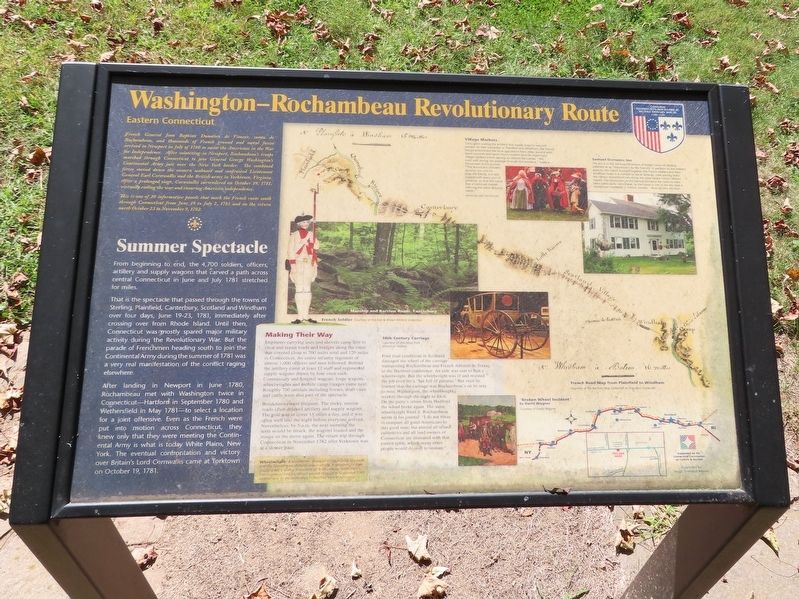
Photographed by Michael Herrick, September 19, 2019
1. Washington—Rochambeau Revolutionary Route Marker
This is one of 10 informative panels that mark the French route south through Connecticut from June 19 to July 2, 1781 and on the return north October 23 to November 9, 1782.
That is the spectacle that passed through the towns of Sterling, Plainfield, Canterbury, Scotland and
this page online
After landing in Newport in June 1780, Rochambeau met with Washington twice in Connecticut — Hartford in September 1780 and Wethersfield in May 1781 — to select a location for a joint offensive. Even as the French were put into motion across Connecticut, they knew only that they were meeting the Continental Army is what is today White Plains, New York. The eventual confrontation and victory over Britain's Lord Cornwallis came at Yorktown on October 19, 1781.
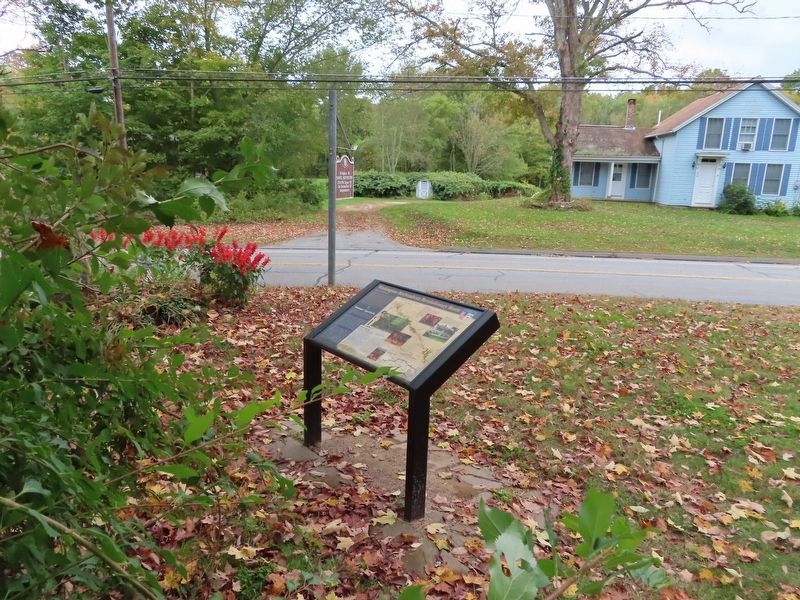
Photographed by Michael Herrick, October 4, 2019
2. Washington—Rochambeau Revolutionary Route Marker
Breakdowns were frequent. The rocky, narrow roads often delayed artillery and supply wagons. The goal was to cover 15 miles a day, and it was often well into the night before everyone arrived. Nevertheless, by 5 a.m. the next morning the tents would be struck, the wagons loaded and the troops on the move again. The return trip through Connecticut in November 1782 after Yorktown was at a slower pace.
Wheelwright: A woodworker engaged in the making of wheels and the heavier type of horse drawn vehicle. A wheelwright from Scotland left a lasting impression on Rochambeau when the French general and his officers passed through in September 1780 on their way to the conference in Hartford with Washington. 18th Century Carriage Courtesy of the New York Historical Society
Poor road conditions in Scotland damaged the wheel of the carriage transporting Rochambeau and French Admiral de Ternay to the Hartford conference. An aide was sent to find a wheelwright. But the wheelwright was ill and resisted the job even for a “hat full of guineas.” But once he learned that the carriage was Rochambeau's on its way to meet Washington, the wheelwright worked through the night to fix it. On the party's return from Hartford the wheel broke again. The same wheelwright fixed it. Rochambeau wrote in his journal: "I do not mean to compare all good Americans to this good man; but almost all inland cultivators and all land owners of Connecticut are animated with that patriot spirit, which many other people would do well to imitate."
( photo captions )
Village Markets
Time spent waiting for artillery and supply wagons was not wasted. At their campsites in Plainfield and Windham, the French troops entertained the local population from miles around with band concerts and spent much coveted silver at impromptu village markets which sprang up around the camps. "We lived well during our passage through this province," wrote a Frenchman in his journal. "The Americans crowded around, not only to hear the bands, but also loaded with every sort of produce, so that the camp was a continual market, offering the most delicious wares." Photo by Jack McConnell
Samuel Dorrance Inn
The inn is in the Sterling Hill section of today's town of Sterling (referred to as "Voluntown" by the French). In addition to the military aspects, the march brought together the French soldiers and their American hosts in a number of social settings, chief among them the various homes and inns along the route where French officers stayed. The encounters at the Samuel Dorrance inn seem to have been particularly memorable, as the house is one of the few that is mentioned repeatedly in French sources. Photo by John Muldoon
Topics and series. This historical marker is listed in this topic list: War, US Revolutionary. In addition, it is included in the Former U.S. Presidents: #01 George Washington, and the The Washington-Rochambeau Route series lists. A significant historical month for this entry is May 1781.
Location. 41° 41.91′ N, 72° 5.091′ W. Marker is in Scotland in Northeastern Region, Connecticut. It is at the intersection of Huntington Road (Connecticut Route 14) and Pinch Street, on the left when traveling east on Huntington Road. Located in front of the Samuel Huntington House. Touch for map. Marker is at or near this postal address: 36 Huntington Road, Scotland CT 06264, United States of America. Touch for directions.

Regionally, this marker is in Connecticut’s Quiet Corner. It is also in the American Northeast and in New England. Globally, it is in North America, the Western Hemisphere, the Western World, and the Anglosphere. Historically, it finds itself in what was once Windham County and also one of the original Thirteen Colonies.
Other nearby markers. At least 8 other markers are within 4 miles of this marker, measured as the crow flies: Samuel Huntington Birthplace (here, next to this marker); Scotland World War II Monument (about 700 feet away, measured in a direct line); Scotland Vietnam War Monument (about 700 feet away); Scotland (approx. 0.2 miles away); Rochambeau Route (approx. 3.3 miles away); Miss Laura Huntington House (approx. 3.7 miles away); Windham Vietnam Memorial (approx. 3.8 miles away); Windham (approx. 3.8 miles away). Touch for a list and map of all markers in Scotland.
Credits. This page was last revised on May 19, 2026. It was originally submitted on September 30, 2019, by Michael Herrick of Southbury, Connecticut. This page has been viewed 980 times since then and 69 times this year. Last updated on January 11, 2022, by Carl Gordon Moore Jr. of North East, Maryland. Photos: 1. submitted on September 30, 2019, by Michael Herrick of Southbury, Connecticut. 2. submitted on October 5, 2019, by Michael Herrick of Southbury, Connecticut. • J. Makali Bruton was the editor who published this page.
